
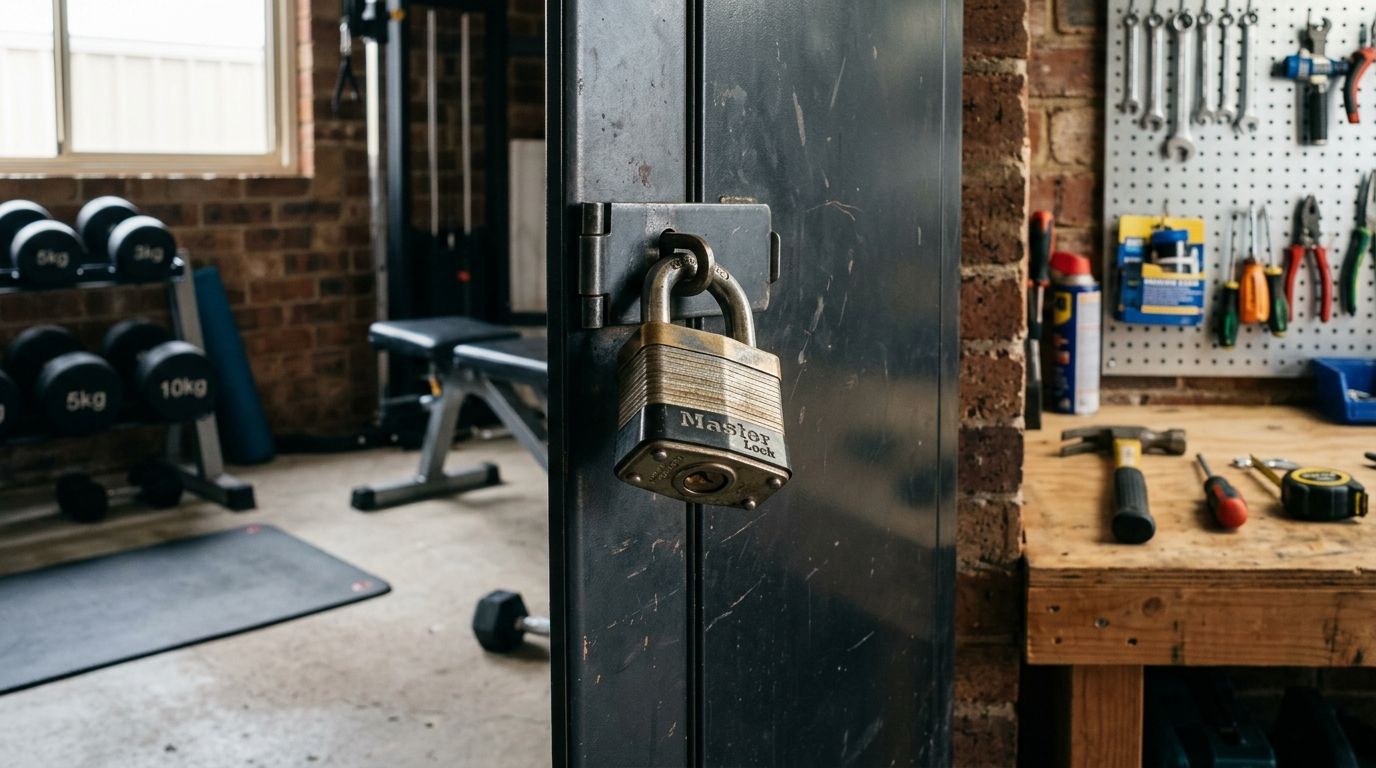
A home gym or workshop needs a lock built for a detached or semi-detached space: a hardened steel padlock with a shackle diameter of at least 3/8 inch for a garage or shed door, or an electronic deadbolt with keypad entry for an attached room inside the house. The hidden cost most people miss is the door and hasp behind the lock — a Grade 1 padlock on a thin hasp or a hollow-core door gets defeated in seconds regardless of the lock's rating.
- The best lock for a home gym or workshop is a hardened steel padlock (ANSI/BHMA Grade 2 or higher) for detached spaces in 2026.
- Attached home gyms do better with an electronic deadbolt or keypad lock instead of a padlock.
- A weak hasp or hollow door defeats even a high-security lock — upgrade both together.
- Combination padlocks are convenient for shared access but rank below keyed locks on shear resistance.
Why this matters
A home gym or workshop holds equipment worth more than most people assume — a squat rack, a table saw, power tools, a welder — and it usually sits in a garage, shed, or basement with weaker perimeter security than the front door of the house. Standard combination padlocks sold at hardware stores are built for gym lockers, not for resisting bolt cutters against a cold garage door in Massachusetts in January 2026. Matching the lock to the door type and the value inside it is the difference between a minor inconvenience and a real loss.
What's the best lock for a home gym or workshop?
The right lock depends on whether the space is attached to the house or stands alone, and whether one person needs access or several. Here's how the main options compare:
| Lock type | Best for | Shear/pick resistance | Weather durability |
|---|---|---|---|
| Hardened steel padlock (Grade 2+) | Detached shed, garage, workshop | High | Good with a boron-alloy shackle |
| Combination padlock | Shared gym access, low-value storage | Low to moderate | Fair — combos can freeze in winter |
| Electronic deadbolt | Attached home gym, interior door | High | Excellent (indoor use) |
| Keypad entry lock | Multi-user workshop, no keys to lose | High | Good, check IP rating for outdoor units |
| Chain and disc lock combo | Overhead garage doors, trailers | High | Good |
For a detached garage converted into a workshop, a gym locker padlock built for hardware-store shackle standards is not the same tier as a hardened security padlock — check the rating before buying, not after a break-in.
Hardened steel padlock (ANSI/BHMA Grade 2 or higher): the top pick for detached spaces
A hardened steel padlock with a boron-alloy shackle is the standard recommendation for a standalone shed, detached garage, or barn workshop in 2026. The shackle should be at least 3/8 inch in diameter — thinner shackles cut through with bolt cutters in under a minute. Pair it with a hasp bolted through the door frame, not just screwed into the surface, or the lock becomes irrelevant.
Buy this option if the gym or workshop sits in a detached structure and you need one durable lock that isn't tied to a smart-home system.
Electronic deadbolt: the top pick for an attached home gym
An electronic deadbolt with a keypad works better than a padlock for a converted spare room or basement gym that's part of the main house. It skips the physical key entirely, which matters when hands are full of dumbbells or covered in sawdust, and most units log entry times if that's useful for a shared household. Electronic deadbolt installation for an interior door is a straightforward retrofit on most standard door preps.
Buy this option for an attached room where you want keyless access and don't need outdoor weather resistance.
Chain and disc lock: the top pick for overhead garage doors
A hardened disc lock paired with a chain through the garage door track stops the door from being pried open even when the automatic opener is bypassed. This matters for garages doubling as workshops where the overhead door is the main entry point and a standard padlock has nothing to attach to.
Hold this as a secondary layer — it supplements a keyed entry door, it doesn't replace one.
Combination padlock: skip it for high-value equipment
Combination padlocks are common on gym lockers because convenience matters more than security in that setting. For a workshop with power tools or a home gym with a full equipment rack, the dial mechanism is easier to shim and the shackle is usually thinner than on keyed high-security models.
Wait on this option unless the space holds low-value items and multiple people need access without carrying a key.
Why lock choice varies for a home gym or workshop
- Attached vs. detached structure — interior doors support electronic deadbolts; exterior sheds and garages need weather-rated padlocks or keypad locks rated for outdoor exposure.
- Equipment value — a rack of free weights and a treadmill carries different risk than a table saw, a welder, and a compressor.
- Number of regular users — a shared family gym or a garage workshop used by roommates favors keypad or combination access over a single physical key.
- Climate exposure — a padlock mounted outside in Middlesex County winters needs winterizing attention or it can freeze solid by February.
- Insurance requirements — some homeowner policies specify a minimum lock grade for detached structures storing high-value tools; check the policy before buying the cheapest option.
- Door and hasp condition — even a Grade 1 padlock fails if the hasp is surface-mounted with short screws instead of through-bolted into the frame.
Get your lock upgraded this week
Licensed 24/7 mobile locksmith service across Middlesex County, MA.
Is a keyed padlock or a combination lock better for a workshop?
A keyed padlock beats a combination lock on shear and shim resistance, which matters more for a workshop holding power tools than the convenience a combination offers. Combination locks make sense when several people need access without carrying keys, but for a single-user workshop in 2026, a hardened keyed padlock is the stronger default.
Do I need a high-security lock for a home gym?
A high-security lock is worth it when the gym is attached to the house and doubles as an entry point, since a standard interior lockset wasn't built to resist forced entry. High-security lock installation adds pick and bump resistance that a builder-grade lockset skips entirely, and it's a one-time upgrade rather than a recurring cost.
What if I run a gym or fitness studio, not just a home setup?
A commercial gym or fitness studio needs a different approach than a residential workshop — master key systems, staff access schedules, and locker banks all change the calculation. A locksmith who works with commercial gyms and fitness studios regularly can spec locker locks and entry hardware built for member turnover, not a one-time home purchase.
FAQ
What's the best lock for a home gym or workshop in 2026?
The best lock for a home gym or workshop in 2026 is a hardened steel padlock rated ANSI/BHMA Grade 2 or higher for detached structures, or an electronic deadbolt for an attached room. Match the lock to whether the space is inside or outside the main house.
Is a combination padlock secure enough for a garage workshop?
A combination padlock is secure enough for low-value storage but not for a garage workshop holding power tools, since the dial mechanism shims more easily than a hardened keyed shackle. Reserve combination locks for shared, low-stakes access.
How thick should a padlock shackle be for a workshop?
A workshop padlock shackle should be at least 3/8 inch in diameter to resist standard bolt cutters. Thinner shackles found on basic hardware-store locks cut through in under a minute.
Can I use a smart lock on a detached shed or workshop?
A smart lock works on a detached shed or workshop only if it carries an outdoor weather rating, since most electronic deadbolts are built for interior use. Check the IP rating before installing one outside in a Massachusetts winter.
Should I replace the hasp along with the padlock?
Yes — replace the hasp along with the padlock if it's surface-screwed rather than through-bolted into the door frame. A high-security padlock on a weak hasp gives you no real security gain.
Does a home gym need the same lock as a home office?
A home gym and a home office don't need the same lock unless both are attached rooms with similar access needs. A home office holding documents or electronics often benefits from a keypad lock for the same reasons a home gym does.
One last thing
The padlock brand matters less than most buyers assume — the shackle diameter and the ANSI/BHMA grade stamped on the lock body tell you more about real-world resistance than marketing copy does. Check that number before checkout, not after someone tests the hasp with bolt cutters.


