
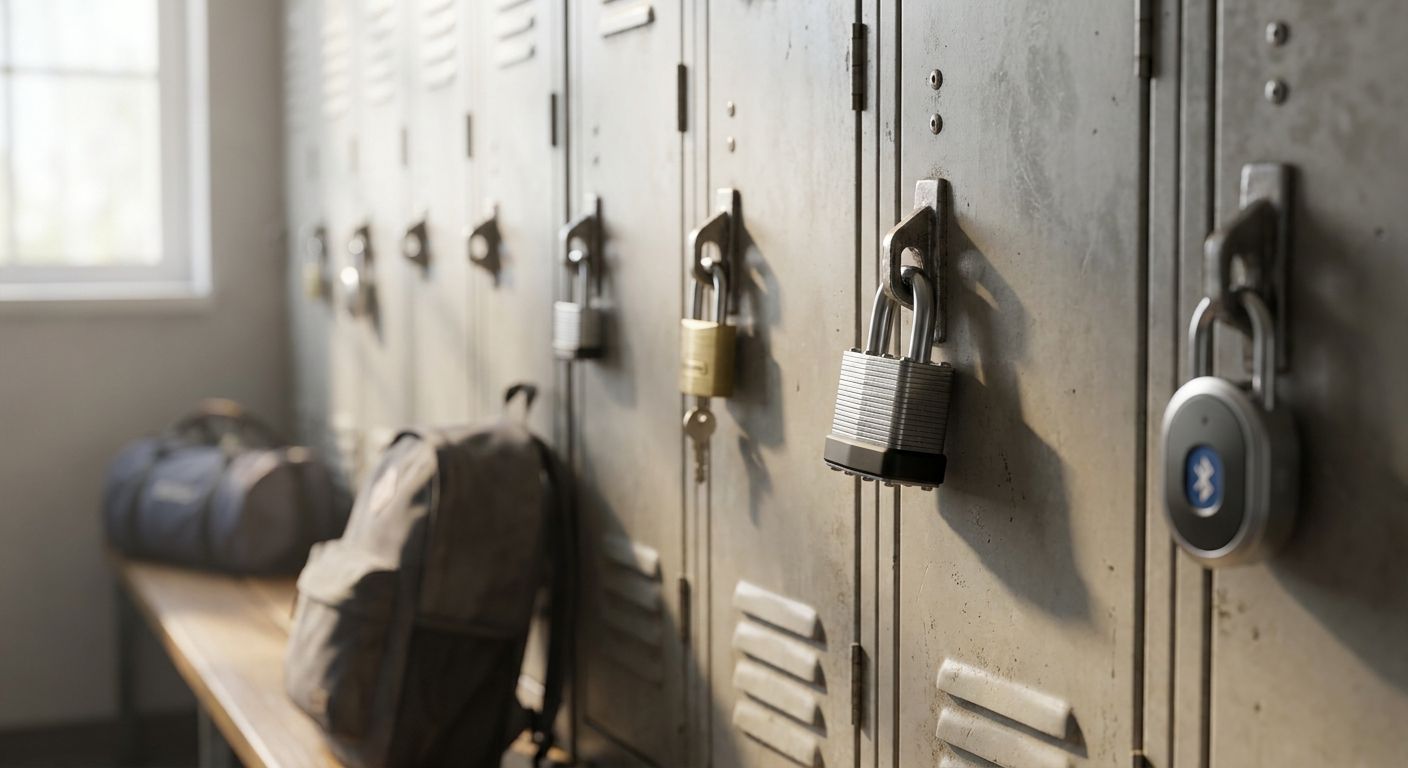
Master Lock's dial combination padlock is the safest default for gym lockers, a resettable combination lock wins for school lockers that get reassigned every semester, and a keyed brass padlock is the pick when one person owns the locker for the whole year. If you just need the fast answer to best padlocks for lockers, that's it — the rest of this guide breaks down why, plus where a locksmith fits in when a lock jams or nobody can remember the combination.
- Master Lock dial combination locks are the best padlocks for lockers used daily at a gym in 2026.
- Resettable combination padlocks fit school lockers reassigned every semester without rekeying.
- Keyed brass padlocks suit lockers with one long-term owner, like a personal gym cubby.
- Bluetooth padlocks add phone-based unlock but depend on battery life and app reliability.
- A shackle under 1/4 inch is bolt-cutter bait; look for hardened steel closer to 5/16 inch.
Why this matters
A padlock is the only thing standing between a locker room and someone else's wallet, gym bag, or backpack. Schools and gyms buy in bulk, which means the cheapest option often gets picked without anyone checking shackle strength or resettability.
The wrong choice creates real headaches in 2026: a keyed lock with one key means a locked-out student misses class, and a combination lock nobody resets between semesters means last year's occupant still has the code. Apex Lock N Key fields calls from gym managers and school facilities staff dealing with exactly this — stuck shackles, forgotten combinations, and locks that need cutting off entirely. Picking the right padlock category up front avoids most of those calls.
What makes the best padlock for lockers
- Shackle strength — hardened steel, ideally 5/16 inch or thicker, resists bolt cutters and prying
- Resettability — school and gym-membership lockers turn over constantly; a lock that can't be reset forces a full replacement
- No-key-to-lose design — combination locks remove the single point of failure a lost key creates
- Weather and moisture resistance — locker rooms are humid; a lock that rusts shut in a year is a bad deal regardless of price
- Recognizable brand support — widely used brands like Master Lock have published reset instructions and lost-combination lookup by serial number
- Fit for the use case — a lock built for a gym bag isn't automatically right for a school locker used five days a week
Best padlocks for lockers at a glance
| Padlock type | Best for | Standout feature | Key limitation |
|---|---|---|---|
| Master Lock dial combination | Daily gym locker use | No key to lose or forget | Dial can be slow for large hands or rushed changing-room moments |
| Resettable combination padlock | School lockers reassigned yearly | Owner sets a new code in seconds | Combo must actually be reset — skipped step defeats the purpose |
| Keyed brass padlock | Single long-term locker owner | Fast, familiar lock-and-go | One key means one lost key equals a locked-out user |
| Bluetooth smart padlock | Tech-forward gym members | Phone unlock, no dial or key | Dead battery or app outage strands the user |
| TSA-recognized travel padlock | Shared gym bag or luggage-style lockers | Works with standard master-key inspection systems | Not built for daily locker-room wear |
| Word-based combination lock | Young kids, elementary/middle school | Words are easier to remember than digit strings | Fewer combination permutations than a numeric dial |
1. Master Lock dial combination padlock: best for daily gym locker use
This is the classic three-number dial lock most people picture when they think of a locker room. It spins to a set combination with no key involved, which matters in a gym setting where members are already juggling a towel, water bottle, and phone.
Master Lock dial combination pros:
- Nothing to lose — the combination lives in memory, not a pocket
- Widely stocked, so a damaged unit is easy to replace with an identical model
- Serial-number lookup support exists for forgotten combinations on many models
Master Lock dial combination cons:
- Slower to open than a key turn, which annoys people in a rush
- Dial wear over years of daily gym use can make numbers harder to read
Best for: gyms and fitness studios issuing lockers on a daily or membership basis. Verdict: Buy for any gym locker program in 2026.
2. Resettable combination padlock: best for school lockers reassigned every year
A resettable combination padlock lets the owner punch in the old code once and set a brand-new one, no tools required. Schools that reassign lockers every August need this far more than a fixed-combination lock, because last year's student otherwise keeps working access.
Resettable combination padlock pros:
- New student gets a private code in under a minute
- No locksmith visit needed just to change the combination
- Works across a whole hallway of lockers without buying new hardware each fall
Resettable combination padlock cons:
- Only secure if the reset step actually happens between students
- Reset mechanism can wear out faster than a fixed-combination dial after years of turnover
Best for: middle and high schools handling annual locker reassignment. Verdict: Buy, but build the reset step into the check-out process.
3. Keyed brass padlock: best for a single long-term locker owner
A keyed padlock is the simplest option: insert key, turn, done. It fits a scenario where one person owns the same locker for months or years — a personal gym cubby, a staff locker, a coach's equipment cage.
Keyed brass padlock pros:
- Fastest open-and-close motion of any lock on this list
- No combination to forget under stress
- Widely available in weather-resistant finishes for humid locker rooms
Keyed brass padlock cons:
- One lost key means the owner is locked out until a locksmith cuts the shackle or extracts a broken key
- Duplicate keys floating around defeat the point of a personal lock
Best for: staff lockers and single-owner gym cubbies, not shared or rotating assignments. Verdict: Buy for individual, long-term use; Skip for shared or reassigned lockers.
4. Bluetooth smart padlock: best for tech-forward gym members
A Bluetooth padlock unlocks from a paired phone app instead of a dial or key. It appeals to gym members who already carry a phone into the locker room and want one less thing to remember.
Bluetooth smart padlock pros:
- Unlock by phone, no combination or key needed
- Some models log open/close activity for the owner's own reference
- No dial to wear out from daily spinning
Bluetooth smart padlock cons:
- A dead phone or dead lock battery strands the user with no backup entry method on most models
- App or Bluetooth connectivity issues turn a 5-second unlock into a frustrating delay
Best for: individual gym members who want a phone-based alternative and understand the battery tradeoff. Verdict: Hold until you've confirmed the model has a physical backup key or code.
5. TSA-recognized travel padlock: best for shared gym bag or luggage-style lockers
These locks are built to work with the standard master-key inspection systems used at airports, and the same shackle-and-body design shows up on gym bags and some shared storage lockers at multi-use facilities. They're not built specifically for locker-room duty, but they cover a real gap for people who move between a gym bag, a car, and a locker in the same day.
TSA-recognized travel padlock pros:
- Compatible with standard inspection master keys, useful for frequent travelers
- Compact and lightweight compared to locker-room-grade combination locks
- Combination-based, so no personal key to lose
TSA-recognized travel padlock cons:
- Master-key compatibility is a known tradeoff — a lock anyone with the right master key can open is not the highest-security option
- Built for luggage duty, not the daily open-close cycle of a locker used five days a week
Best for: shared gym bags and luggage-style storage rather than permanent locker assignment. Verdict: Hold for locker room duty; Buy for its actual travel use case.
6. Word-based combination lock: best for young kids in elementary or middle school
Instead of three numbers, this lock uses a short sequence of letters that spell a word the child chooses. It solves a real problem for younger students who struggle to remember a number string under the pressure of a crowded hallway.
Word-based combination lock pros:
- Easier to recall for younger students than a pure number sequence
- Same no-key convenience as a standard combination dial
- Familiar dial mechanism, so no new hardware skill required
Word-based combination lock cons:
- Fewer possible combinations than a numeric dial, which matters slightly for security
- Less common on shelves than standard number-based locks, so replacement can take longer to source
Best for: elementary and middle school students who need an easier-to-remember option. Verdict: Buy for younger age groups specifically.
How this ranking was built
Each padlock type was scored against the criteria above — shackle strength, resettability, no-key design, moisture resistance, and fit for the specific locker use case — rather than ranked on brand name alone. That's why the list splits by use case instead of naming one universal winner: a lock that's right for a gym member is often wrong for a school hallway, and vice versa.
Locked out of a gym or school locker?
Apex Lock N Key handles stuck padlocks and lost combinations 24/7 in Middlesex County.
Which padlock should you choose?
For a gym locker used daily, Master Lock's dial combination padlock is the default buy in 2026 — no key to track, no code that needs resetting between visits. For a school locker reassigned every year, the resettable combination padlock wins because the reset step is built into the hardware instead of requiring a replacement. If one person owns the locker long-term, a keyed brass padlock is still the fastest and simplest option, as long as a spare key exists somewhere other than the owner's own bag.
“A shackle under a quarter inch thick is bolt-cutter bait — look for hardened steel closer to 5/16 inch on anything protecting real valuables.”
Gym owners and school facilities managers weighing lock programs for 2026 should also think about what happens when a lock fails — a jammed shackle, a forgotten combination with no serial number on file, or a break-in that damages a bank of lockers. Apex Lock N Key's work with gyms and fitness studios and daycare and school facilities covers exactly that gap when the padlock itself isn't the problem anymore.
FAQ
What is the best padlock for a gym locker in 2026?
A dial combination padlock from a widely stocked brand like Master Lock is the best padlock for a gym locker in 2026 because it removes the risk of a lost key entirely. It also holds up well to the daily open-close cycle of a busy locker room.
Are combination locks or keyed locks better for school lockers?
Resettable combination locks are better for school lockers because they get reassigned every school year without needing new hardware. A keyed lock only makes sense when one student keeps the same locker long-term and a spare key is stored securely.
Can a locksmith open a locker padlock without the combination?
Yes, a locksmith can open most locker padlocks without the combination using non-destructive picking or, when the lock is damaged, controlled shackle cutting. This is faster and cleaner than forcing the lock yourself and risking damage to the locker door.
Do school or gym locker padlocks need to be TSA-approved?
No, TSA-approved locks are designed for luggage inspection systems, not locker-room duty. A standard dial combination or resettable padlock is the better fit for daily locker use.
Is a Bluetooth padlock safe for kids to use on a school locker?
A Bluetooth padlock works for older students comfortable managing an app and charging a device, but it carries real risk if the battery dies with no backup key or code. A standard combination lock is the safer default for younger students.
What's the difference between a shrouded and non-shrouded padlock?
A shrouded padlock has a metal collar covering the shackle, which blocks bolt cutters from getting a clean bite. Non-shrouded padlocks are lighter and cheaper but easier to cut, so they're better suited to low-risk storage than a locker holding valuables.
How do you get a stuck padlock off a school or gym locker?
Try the combination or key again slowly first, since rushed attempts are the most common cause of a jammed dial or shackle. If the lock still won't release, a locksmith can cut it off without damaging the locker frame.
Should a gym or school replace all its locks after a break-in?
Not always a full replacement — often the affected lockers just need new padlocks and a review of who still has old combinations or keys. A facilities manager dealing with a break-in should treat it the same way a homeowner treats residential rekeying after a burglary: assume any code or key that existed before is compromised.
One last thing
The number written on the back of a combination padlock isn't a serial number for looks — most major brands use it to look up a forgotten combination without cutting the lock. Gyms and schools that toss the packaging and never record that number end up paying for a replacement lock instead of a five-minute lookup, which is one of the most avoidable costs in a facilities budget for 2026.


