
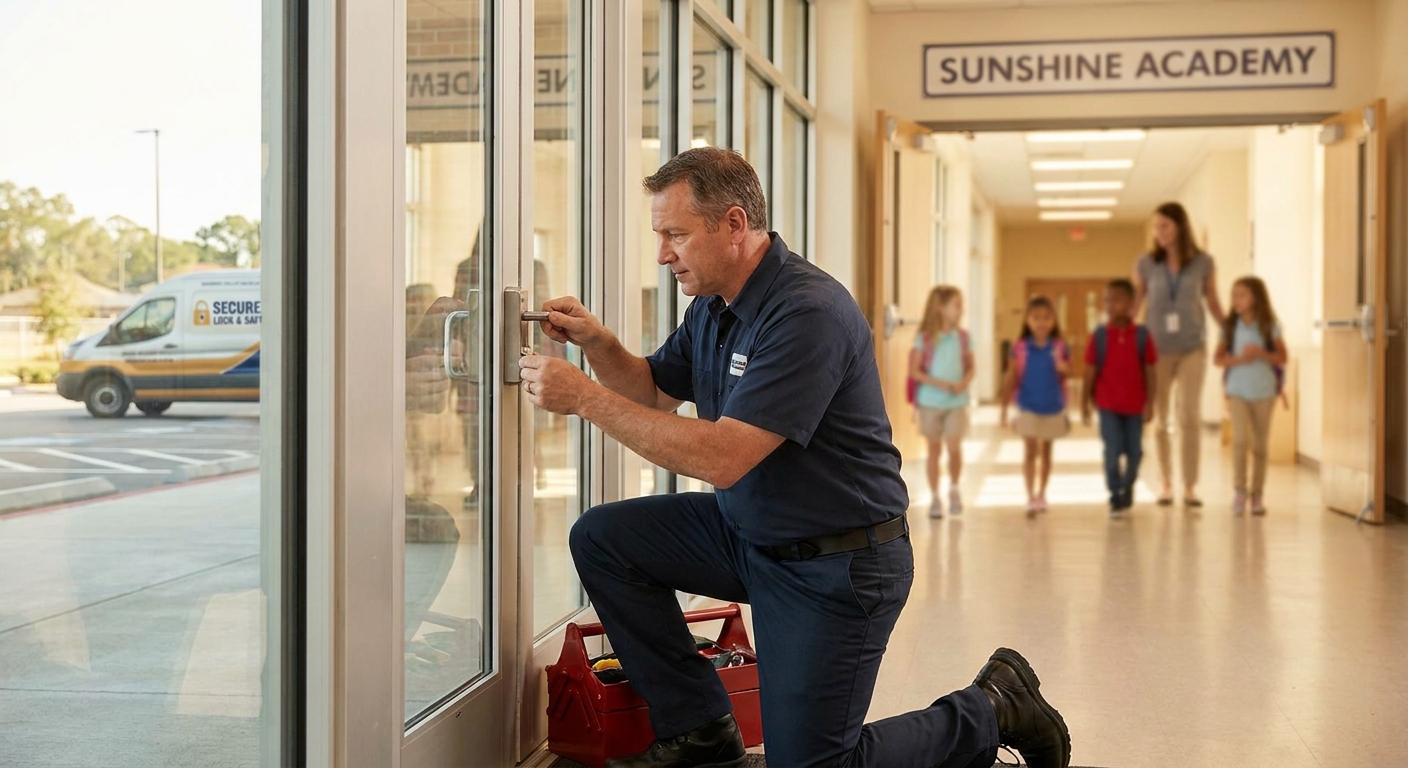
A commercial locksmith for daycare centers and schools has to solve two problems at once: keep intruders out and keep kids able to get out fast in an emergency. That combination — access control plus fire code egress — is different from securing a retail shop or a warehouse, and it changes which hardware and which locksmith you hire in 2026.
- A commercial locksmith for daycare centers must handle master keying, panic hardware, and MA fire code compliance together — Buy licensed, insured providers only.
- Rekeying after staff turnover is the single most common request from Middlesex County child care centers in 2026.
- Skip residential-grade smart locks with shared codes — they fail the audit trail that licensed programs need.
- Panic hardware is required on exit doors serving 50+ occupants under Massachusetts building code — verify before you sign off.
Why this matters
A daycare or school that gets its locks wrong faces two kinds of risk: a licensing citation from the state, or a real safety failure during a fire drill or a lockdown. Neither is theoretical. Massachusetts Department of Early Education and Care (EEC) inspections look at entry security and egress together, and a locksmith who only knows retail deadbolts will miss both.
Apex Lock N Key works with facility directors across Middlesex County who need a locksmith that understands staff turnover, parent pickup logistics, and code-required exit hardware — not just a deadbolt swap.
Who this is for
This guide is for daycare directors, school facilities managers, and center owners in Middlesex County who need to secure a building where dozens of adults come and go daily but only staff should ever hold a working key. If you're managing parent drop-off, substitute teachers, and after-hours cleaning crews on one set of locks, this is written for you.
What to look for in a commercial locksmith for daycare centers and schools
Licensing and insurance specific to occupied care facilities
Any locksmith working inside an occupied daycare or school needs to carry liability insurance that covers work in a facility with children present, not just general contractor coverage. Ask for proof before scheduling — a licensed and insured commercial locksmith should hand this over without hesitation in 2026.
Experience with master key systems
A daycare needs a hierarchy: directors get master access, lead teachers get their classroom and shared spaces, substitutes get nothing beyond the room they're assigned. A locksmith who defaults to one key for the whole building is solving the wrong problem.
Fire code and egress knowledge
Exit doors serving 50 or more occupants in Massachusetts assembly and educational occupancies require panic hardware under the state building code. A commercial locksmith for daycare centers needs to know this cold — a lock that satisfies your insurance company but blocks a fast exit fails the one job that matters most.
Fast turnaround on rekeying after staff changes
Child care has high staff turnover, and every departing employee is a potential key still in circulation. Rekeying costs less and takes less time than replacing hardware outright, and a locksmith who can turn around a full-building rekey within a day keeps your center compliant without a gap in coverage.
Access control that logs who came and went
Parent pickup, licensed drop-in staff, and inspectors all need entry without a shared code that anyone can text to a friend. Electronic access control with individual codes or fobs gives you a log — a shared four-digit code on a keypad does not.
Response time for lockouts
A director locked out at 6:45am with parents already arriving needs a locksmith who answers, not a voicemail. A 24/7 commercial locksmith with a real Middlesex County dispatch is worth more here than one offering a slightly cheaper rate.
Get a security assessment for your center
Licensed, insured locksmith service across Middlesex County, available 24/7.
Top picks: security setups that actually work for daycares and schools
Master key system with tiered access — the safe pick
A graduated master key system gives directors full-building access, lead teachers room-and-common-area access, and support staff single-room access. One director-level key change covers the whole hierarchy if a master goes missing. Verdict: Buy — this is the baseline every licensed center should have by 2026.
Electronic keypad or fob entry — the upgrade
Electronic access control replaces a shared code with individual credentials, and it logs every entry with a timestamp — useful when EEC asks who was in the building and when. Medical and dental offices use nearly identical setups for the same audit-trail reason; see how access control works for medical offices for a comparable install. Verdict: Buy for centers with more than 15 staff rotating through.
Panic hardware on all rated exit doors — non-negotiable
Crash bars and panic exit devices on doors serving 50 or more occupants aren't optional under Massachusetts code, and a locksmith should flag any door that's out of compliance during the first visit. Verdict: Buy — this is a code requirement, not a nice-to-have.
Full rekey after every director or lead teacher departure — the maintenance habit
Rekeying every exterior lock and interior office door after a director-level departure closes the loop on any copied key. It typically runs a fraction of the cost of a full lock replacement and takes a single visit. Verdict: Buy — build it into your offboarding checklist.
Video doorbell alone with no lock upgrade — the wildcard that underdelivers
A video doorbell tells you who's at the door, but it doesn't stop anyone from walking in if the underlying lock is a standard residential deadbolt. It's a nice add-on layered on top of real access control, not a replacement for it. Verdict: Consider only as a supplement, never as the primary security measure.
What to avoid
- Shared four-digit keypad codes with no individual tracking — looks like access control, functions like an unlocked door once the code spreads among parents and substitute staff.
- Big-box residential smart locks on exterior doors — most aren't rated for commercial door thickness or fire-rated frames, and they void the panic hardware requirement on egress doors.
- "Lifetime" key duplication left unmanaged — if a hardware store can cut a copy of your master without your name on a signed authorization list, you don't have a controlled system, you have a suggestion.
“If a childcare provider can share one keycode by text message, you don't have access control — you have a suggestion.”
Verdict comparison
| Setup | Best for | Fire code fit | Verdict |
|---|---|---|---|
| Tiered master key system | Every licensed center | Compatible with rated hardware | Buy |
| Electronic keypad/fob entry | 15+ staff, high turnover | Compatible, logs entry | Buy |
| Panic hardware on exit doors | Any door serving 50+ occupants | Required by MA code | Buy |
| Rekey after staff departure | Ongoing maintenance | No impact | Buy |
| Video doorbell only | Supplement to real access control | No impact on egress | Consider |
| Shared keypad code, no logging | Nobody in a licensed facility | Undermines audit trail | Skip |
FAQ
What does a commercial locksmith for daycare centers actually install?
A commercial locksmith for daycare centers typically installs tiered master key systems, electronic keypad or fob entry, and panic hardware on exit doors serving 50 or more occupants. The exact mix depends on staff count and building layout.
Is a smart lock better than a traditional lock for a daycare?
Electronic access control with individual codes beats a shared traditional key for daycares because it logs who entered and when, which matters for EEC compliance. A basic residential smart lock is not the same thing and usually isn't rated for a commercial exit door.
How often should a daycare rekey its locks?
Rekey every time a director, lead teacher, or anyone with master-level access leaves the center. Most licensed centers in Middlesex County rekey at least once or twice a year given typical staff turnover in 2026.
Does panic hardware cost more than a standard exit lock?
Panic hardware costs more upfront than a standard lever lock, but it's required by Massachusetts building code on doors serving 50 or more occupants in educational and assembly spaces, so the comparison isn't optional for most centers.
Can one master key system work for a daycare with multiple buildings?
Yes, a tiered master key system can span multiple buildings on one campus, with directors holding master access and teachers restricted to their assigned building or classroom.
What happens during a lockout at a daycare before opening hours?
A 24/7 commercial locksmith should be able to respond and get a director back inside before parents start arriving for drop-off, without damaging code-rated door hardware.
Do substitute teachers need their own access codes?
Yes — individual, time-limited codes for substitute or temporary staff keep the access log accurate and let you revoke a single credential without rekeying the whole building.
Is electronic access control worth it for a small center under 10 staff?
For centers under 10 staff, a tiered master key system with a strict rekey policy is often enough in 2026 — electronic access control pays off once staff count and turnover both rise.
One last thing
The most overlooked detail in daycare security isn't the front door — it's the fact that most centers never audit who still has a working key after a staff departure. A rekey costs far less than the risk of a copied key floating around six months after someone's last shift, and it takes one visit to close that gap for good in 2026.


