
Law firms and professional offices in Middlesex County keep client files, signed contracts, and privileged records behind locks that often haven't been touched since the office opened. This guide breaks down what a commercial locksmith for law firms and professional offices should actually recommend, what to skip, and how to think about the work heading into 2026.
- Master key systems solve the multi-partner access problem for law firms with 3+ attorneys — Buy.
- ANSI Grade 1 deadbolts belong on every exterior door guarding client files — non-negotiable in 2026.
- Rekeying after any staff departure is the single most skipped step for professional offices.
- Skip biometric access control under 15 employees — the setup doesn't match the risk for most small firms.
- A licensed commercial locksmith for law firms should show insurance proof before touching a single lock.
Why this matters
A law office isn't a residence and it isn't a retail storefront — it sits in between, with confidentiality obligations that most commercial lock setups were never built around. Client files, settlement documents, and HR records all live behind the same doors that get rekeyed (or don't) whenever an associate leaves or a lease turns over.
Most professional offices in Middlesex County are still running on builder-grade hardware installed when the suite was first leased. That's fine for a storage closet. It's a liability when a departed paralegal still has a working key two years later.
Apex Lock N Key works with law firms and professional offices across Middlesex County on exactly this gap — matching lock hardware and access control to how the office actually operates, not just what the landlord installed.
Who this is for
This guide is built for office managers, managing partners, and practice administrators at firms with anywhere from 2 to 50 employees — solo practitioners sharing a suite, mid-size firms with associates and support staff, and professional offices (accounting, insurance, medical billing) that handle comparably sensitive records. If your office holds client files behind a lock that came with the building, keep reading.
What to look for in a commercial locksmith for law firms
Master key hierarchy that matches your org chart
A firm with partners, associates, and administrative staff needs a master key system where access tiers mirror who actually needs into which room. Partners get master access to file rooms and the server closet; associates get their own office plus common areas; support staff get common areas only. Without this, every lock change means rekeying the entire suite instead of one door.
ANSI Grade 1 hardware on every exterior and file-room door
ANSI/BHMA Grade 1 deadbolts are the commercial-duty rating — built for higher cycle counts and stronger resistance to forced entry than the Grade 2 or Grade 3 hardware found in most retail hardware store kits. A file room holding client contracts and privileged communications should never sit behind anything below Grade 1.
Rekeying built into your offboarding checklist
Every staff departure — voluntary or not — is a rekeying trigger. A firm that skips this after three or four exits over a couple of years has effectively handed out an unknown number of working keys to people no longer on payroll. This is the single most common gap professional offices carry into 2026 without realizing it.
Electronic access control with a real audit trail
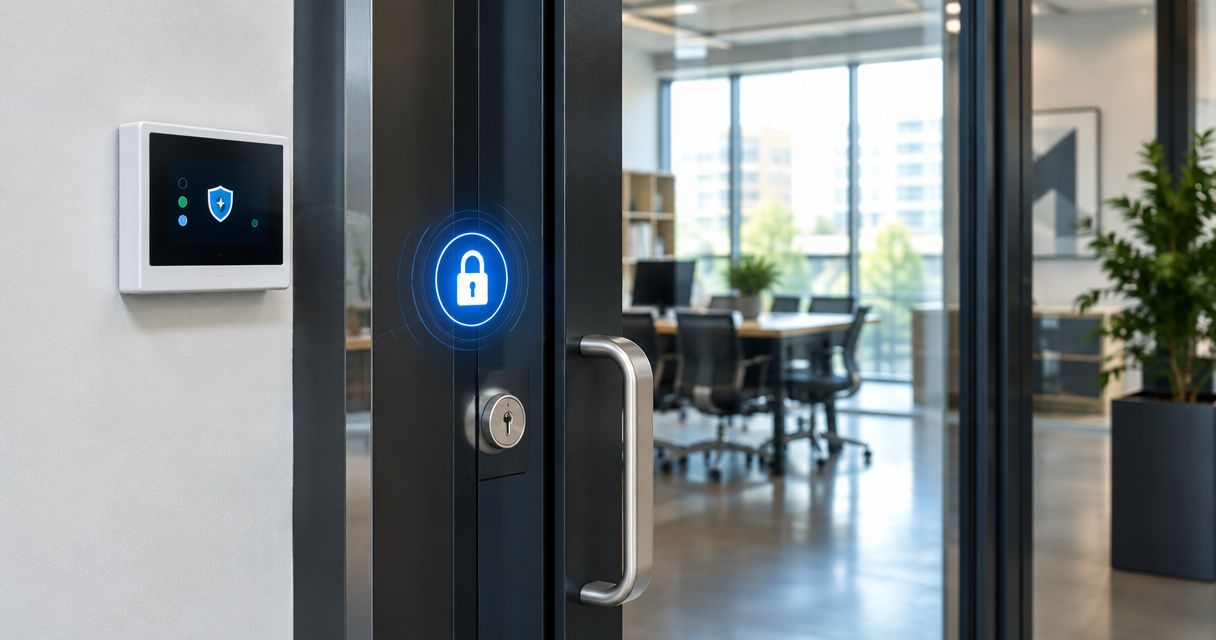
Keypad or card-based access control gives you a log of who entered which door and when — useful for after-hours billing disputes, compliance questions, or simply knowing who was in the building over a weekend. Mechanical keys give you none of that.
Licensing, insurance, and after-hours response
A commercial locksmith working on a law office needs to carry liability insurance and be licensed to operate in Massachusetts — verify both before anyone touches a lock connected to confidential files. Firms also need a locksmith that answers after normal business hours, since lockouts and lock failures don't wait for 9-to-5.
“If your office doesn't have a master key hierarchy, one lost key means rekeying every door in the suite.”
Top picks for law firms and professional offices
The baseline every office needs — ANSI Grade 1 deadbolt rekey. One spec that matters: Grade 1 rating on every exterior and file-room door. This is the floor, not the ceiling, for a firm handling client records in 2026. Full rekeying cost guide is worth reviewing before you budget the project. Buy.
The scalable option for growing partnerships — a documented master key system. One spec that matters: three or more access tiers (partner, associate, staff) tied to a written key-holder log. Firms adding attorneys year over year need this before headcount outpaces the lock plan. Consider if your firm has three or more attorneys sharing a suite.
The compliance play — keypad or card access with audit logging. One spec that matters: time-stamped entry logs retrievable on demand. Useful when after-hours access needs a paper trail for billing, HR, or client confidentiality reviews. Consider for offices with 15+ staff or shared after-hours space.
The overkill — biometric access control. One spec that matters: fingerprint or facial-recognition readers on every door. This solves problems most small professional offices don't have and adds cost and maintenance most don't need. Skip unless the firm handles regulated data requiring biometric-level controls.
The easy add-on — file cabinet and safe locks. One spec that matters: a locking file cabinet or small safe rated for document storage, separate from the room's door lock. A second layer for the most sensitive files, cheap relative to a full room rekey. Buy as a supplement, not a replacement for door hardware.
Get your office locks assessed
Licensed, insured, and available for law firms across Middlesex County.
What to avoid
- Residential-grade doorknob locks on file rooms. They look fine in a walkthrough and fail the moment someone actually tries to force the door.
- Unlicensed "handyman" rekeying. Cheaper up front, but no insurance backing if hardware is installed wrong or a key control breach happens later.
- Master keying without a written key-holder log. A master system with no record of who holds which key defeats the entire point of tiered access.
Verdict comparison
| Criteria | Minimum standard | Priority for law firms |
|---|---|---|
| Master keying | Documented, tiered by role | High for 3+ attorneys |
| Deadbolt grade | ANSI/BHMA Grade 1 | Required, all exterior and file-room doors |
| Rekeying cadence | Triggered by every staff departure | High |
| Access control | Keypad/card with entry logs | Medium-High for 15+ staff |
| Vendor licensing | Verified license and insurance | Required before any work begins |
FAQ
What's the best commercial locksmith setup for a small law firm?
For a firm with two to five attorneys, an ANSI Grade 1 deadbolt on every exterior and file-room door paired with a basic master key system covers most needs in 2026. Add electronic access control only once after-hours staff access becomes routine.
Is a master key system worth it for a professional office?
Yes, once a firm has three or more attorneys or departments needing different access levels. It replaces a full rekey with a single key change whenever staff turnover happens.
How often should a law firm rekey its locks?
Rekey immediately after any staff departure, and at minimum every two to three years regardless of turnover. Firms that skip this after multiple exits are the most common gap professional offices carry.
Do law offices need electronic access control?
Not always. Offices under 15 staff with limited after-hours traffic can run on a well-managed master key system; larger offices or those needing an audit trail benefit from keypad or card access.
What's the difference between Grade 1 and Grade 2 deadbolts?
ANSI Grade 1 is the commercial-duty rating built for higher cycle counts and stronger forced-entry resistance than Grade 2, which is the standard residential grade sold in most hardware stores. File rooms holding client records should carry Grade 1 hardware.
How much does it cost to rekey a law office?
Cost depends on door count and hardware grade — a full cost breakdown for rekeying is covered in Apex Lock N Key's pricing guide, which applies the same logic to office suites as it does to homes.
Should a professional office use a licensed locksmith or a handyman?
A licensed, insured commercial locksmith is the only responsible choice for offices holding confidential client files. Insurance and licensing protect the firm if hardware fails or a key control issue surfaces later.
What locks matter most for a law firm's confidentiality obligations?
Exterior doors, file room doors, and any storage holding physical client records need Grade 1 hardware at minimum. A locking file cabinet or safe adds a second layer for the most sensitive documents.
One last thing
The gap that catches most professional offices isn't the lock hardware — it's the missing key-holder log. A firm can install every Grade 1 deadbolt on the market and still not know, in 2026, exactly how many working keys are floating around from staff who left in 2022. Fix the paperwork alongside the hardware, not after.