
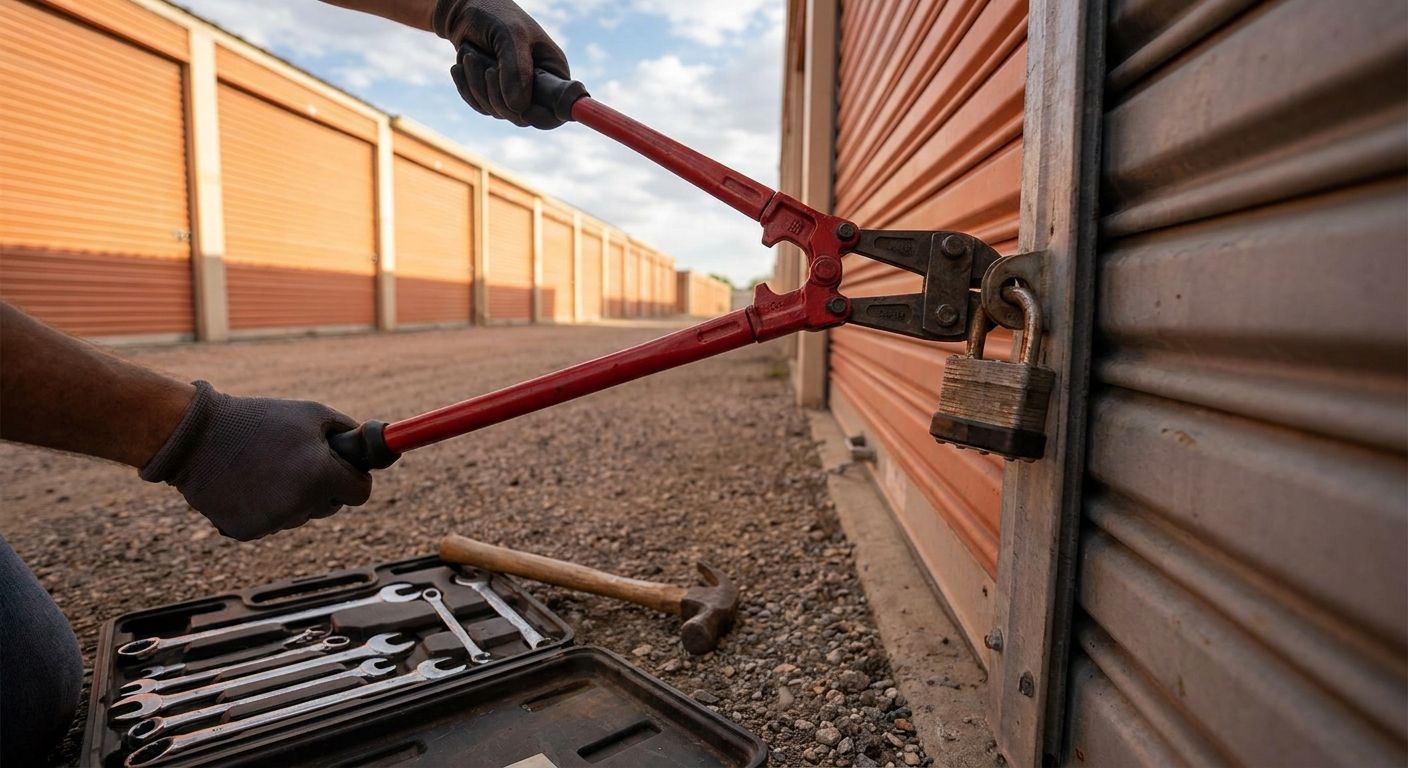
Cutting a lock off a storage unit without a key is legal on your own unit if you own it and can prove it, and it takes about 15 minutes with the right tool for the lock you're facing. This guide walks through the safe way to do it, the tools that actually work in 2026, and when to stop and call a professional instead.
- Bolt cutters with 24-inch jaws handle standard padlocks; disc locks need an angle grinder with a 4.5-inch cutoff wheel.
- Always notify the facility office before you cut anything — most units carry a facility overlock, not just your own.
- Drilling the cylinder is the last resort when you still need the lock body intact for reuse.
- If the shackle won't budge after three tries with bolt cutters, switch tools instead of forcing it — that's how blades snap.
Why this matters
A forgotten combination or a rusted-shut padlock on a storage unit isn't an emergency the way a house lockout is, but it stops you cold when you're mid-move or need something out of the unit before a deadline. Apex Lock N Key fields these calls year-round across Middlesex County, and the pattern is consistent: people try to force a lock with the wrong tool, damage the hasp, and end up paying more to fix that than the original lockout would have cost.
Storage facilities also complicate this. Many units carry a facility-owned overlock in addition to your personal lock, added when a payment is late or a gate code lapses. Cut the wrong lock, or cut one without documentation, and you can end up disputing an access violation with the facility — a bigger headache than the lock itself.
What you'll need
- Bolt cutters with 24-inch or 30-inch jaws (18-inch models struggle on hardened shackles)
- An angle grinder with a 4.5-inch metal cutoff wheel, for disc locks and hardened padlocks
- Safety glasses and leather work gloves — non-negotiable once a grinder is involved
- A cordless drill with a 1/8-inch pilot bit and a 3/8-inch cobalt bit, if you're drilling the cylinder
- Photo ID and your storage lease or rental agreement
- A replacement lock to put on the unit immediately after
The steps
1. Confirm the lock is yours and notify the facility first
Call or walk into the facility office before you touch a tool. Show your ID and lease so staff can confirm the unit number matches your account, and ask whether there's a facility overlock on the door in addition to your padlock. Facilities that manage delinquent accounts routinely add their own lock, and staff will usually cut that one for you once your account is current — you never need to touch it yourself.
2. Identify the lock type before you pick a tool
Disc locks (the round, low-profile locks common on roll-up storage doors) have a hardened steel shackle roughly 10mm thick and will dull or snap standard bolt cutters. Standard padlocks with an exposed shackle are the easier job. Look at what's actually on the door before you decide between bolt cutters and a grinder — guessing wrong wastes 20 minutes and a blade.
3. Try bolt cutters on an exposed-shackle padlock
Position the jaws as close to the lock body as possible, not mid-shackle, since that's where the metal is softest. Close the handles in one steady, full-force motion rather than several partial squeezes.
“If the bolt cutters don't close by the third squeeze, you need bigger jaws or a grinder, not more effort.”
4. Use an angle grinder for disc locks or hardened shackles
Cut through the shackle on both sides of the U, about an inch from the lock body, so the whole loop drops free. Keep the grinder at a low angle to the metal and let the wheel do the work — forcing it burns through cutoff wheels fast and throws more sparks. Expect this to take 1-3 minutes per cut depending on the wheel's condition.
5. Drill the cylinder if you need the lock body intact
If you plan to reuse the lock body once it's off the unit — some disc locks allow shim or cylinder replacement — drill straight into the keyway at the pin line instead of cutting the shackle. Start with the 1/8-inch bit to break the pins, then follow with the 3/8-inch bit to clear the mechanism. This is the slower option but it's the one that doesn't destroy the lock housing.
6. Have the facility cut any lock that isn't yours
If there's an overlock or a second lock you didn't put on, stop and get facility staff to cut it in front of you. Doing this yourself, even on your own unit, can trigger a facility's unauthorized-access policy and complicate your account. A five-minute conversation at the front desk avoids that entirely.
7. Replace the lock the same day
Once the old lock is off, put a new one on before you leave, even if you're only stepping away for an hour. An open storage unit is a target, and most facilities won't take responsibility for contents left unsecured after you've been given access. If the hasp itself is bent or damaged from the removal, note it with the office before you leave — that's the kind of thing that gets disputed later if you don't.
8. Photograph the unit before and after
Take photos of the lock, the hasp, and the unit's contents before you start and again once the new lock is on. If the facility questions the cut lock later, or if anything looks disturbed inside, you'll have a timestamped record instead of a memory.
Skip the cutting and call a pro
Licensed, 24/7 mobile locksmith service across Middlesex County, MA.
Troubleshooting
- Bolt cutters won't close, even on a standard padlock: the shackle is likely hardened steel disguised as a regular lock — switch to the angle grinder rather than keep forcing the handles.
- Grinder throws sparks near boxes or fabric: clear a 3-foot radius around the lock before you start, and keep a fire extinguisher within reach if the unit holds anything flammable.
- The lock turns out to be a facility overlock, not yours: stop immediately and bring it to the office — cutting it yourself can be treated as an access violation even on your own unit.
- You can't find your lease or ID: most facilities can verify your account by name and unit number at the office, but expect a short delay while they confirm it.
- The drilled cylinder still won't turn: the pins may not be fully cleared — a second pass with the 3/8-inch bit at a slightly different angle usually finishes the job.
- A locksmith quote seems inflated for a simple cut: check how to spot a locksmith scam before you get overcharged before you agree to a price over the phone.
Tools and resources
- 24-inch or 30-inch bolt cutters for exposed-shackle padlocks
- An angle grinder with 4.5-inch metal cutoff wheels for disc locks
- A cordless drill with cobalt bits for cylinder removal
- A licensed locksmith on standby for locks that won't yield to any of the above — see how to find a reliable 24-hour locksmith near you
What to do next
Once the old lock is off and a new one is on, think about what you're replacing it with. A cheap disc lock is easy for a facility to force open in an emergency, which sounds convenient until it's your unit being broken into. Read how to prepare for a locksmith visit to save time and money before your next lock swap, so you're not paying for a second trip.
FAQ
How do you remove a storage unit lock without a key?
Bolt cutters handle standard padlocks in one cut; disc locks need an angle grinder with a 4.5-inch cutoff wheel. Always confirm with the facility office first, since many units carry a facility overlock in addition to your own.
Can a storage facility cut my lock for me?
Yes, most facilities will cut a facility-added overlock once you show ID and your lease, and some will assist with your personal lock if you're locked out. Ask at the office before bringing your own tools.
What size bolt cutters do you need for a padlock?
24-inch bolt cutters handle most standard exposed-shackle padlocks in 2026; 18-inch models often can't generate enough leverage on hardened steel. 30-inch bolt cutters give you extra force for thicker shackles.
Is it legal to cut a lock off your own storage unit?
Yes, if you're the account holder and can show ID and a lease matching the unit number, cutting your own lock is legal. Cutting a lock without proof of ownership can be treated as unauthorized access by the facility.
What's the difference between a disc lock and a padlock for storage units?
A disc lock has a low-profile, round body with a hardened shackle around 10mm thick, built to resist bolt cutters. A standard padlock has an exposed shackle that's easier to cut but offers less resistance to force.
How much does a locksmith charge to open a storage unit lock?
Rates vary by lock type and whether it's a same-day or emergency call, and pricing details are best confirmed directly with a licensed locksmith before the visit. Get quotes upfront rather than agreeing to a price after the work starts.
Should you drill or cut a storage unit lock?
Cut the shackle with bolt cutters or a grinder if you don't need the lock body again — it's faster. Drill the cylinder instead if you want to keep the lock housing intact for reuse.
What happens if you can't get into your storage unit at all?
Contact the facility office first, since a lapsed payment or gate code issue is a common cause and staff can usually resolve it on the spot. If the lock itself is the problem, a licensed locksmith can remove it without damaging the hasp or door track.
One last thing
Most people default to bolt cutters for every lock they meet, then wonder why the handles won't close on a disc lock. Match the tool to the lock before you start: bolt cutters for exposed shackles, an angle grinder for anything hardened, and a drill only when you need the lock body back. Skipping that ten-second check is the single biggest reason people end up calling a locksmith anyway, after already ruining a set of bolt cutters.


