
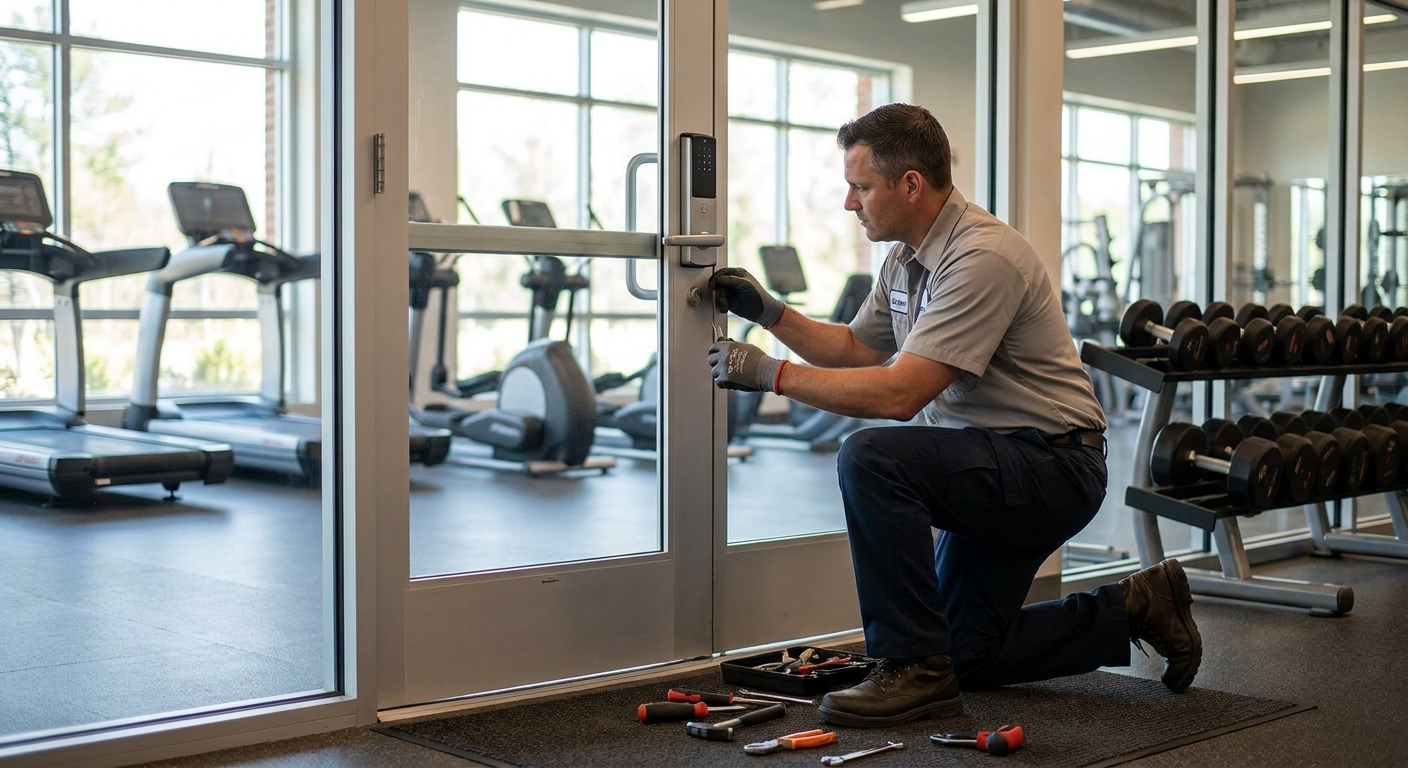
Owning a gym or fitness studio in 2026 means juggling more keyholders than most retail stores: front desk staff on rotating shifts, personal trainers who need after-hours access, cleaning crews at 4 a.m., and members who expect a locker to actually lock. A commercial locksmith for gyms has to solve for volume and turnover, not just a deadbolt.
- Electronic keypad access control beats master keys for gyms with rotating staff schedules — Buy for 2026.
- Panic exit hardware is required on Massachusetts fitness studio doors under state life-safety code.
- Rekeying after a manager or trainer leaves costs far less than replacing hardware — Consider before you Skip it.
- Smart locks work well on locker rooms but need a local commercial locksmith on call for battery failures.
Why This Matters
A gym door cycles hundreds of times a day between 5 a.m. spin class and 10 p.m. close. Residential-grade hardware wears out fast under that load, and a single lost key from a departing employee can force you to rekey every exterior door if you're still running an old-school master key system.
Apex Lock N Key works with fitness facilities across Middlesex County on exactly this problem: matching hardware and access control to how many people actually touch a door in a day. That's a different calculation than a single-tenant office.
Who This Is For
This guide is for gym owners, studio managers, and franchise operators handling security decisions for a facility with staff shift changes, member-facing entry points, and at least one storage or equipment room that needs restricted access. If you're running a single boutique studio with two employees, some of this scales down — but the core criteria hold.
What to Look For in a Commercial Locksmith for Gyms
High-Traffic Door Hardware Rated for Thousands of Cycles
A front door that opens 300+ times a day needs commercial-grade cylinders and closers, not a big-box store deadbolt. Residential hardware rated for a few dozen daily cycles will loosen, stick, or fail within a year in a high-traffic gym entry.
Access Control That Handles Shift Changes and Trainer Schedules
Staff turnover in fitness is high, and personal trainers often need access outside normal business hours. A keypad or fob system that lets you add and remove users in minutes — without rekeying anything — saves both money and headaches.
Master Key Systems for Multi-Room Facilities
Between the main floor, equipment room, office, and mechanical closet, a gym needs a hierarchy: some staff get every door, others get one. A properly cut master key system handles this without forty separate keys on a ring.
Panic Exit Hardware and Life-Safety Code Compliance
Massachusetts fire and building code requires panic hardware on exit doors in assembly-occupancy spaces, which most gym floors qualify as once occupant load crosses code thresholds. This isn't optional hardware — it's a compliance requirement your locksmith should flag if it's missing.
After-Hours Emergency Response
24-hour gyms and studios that open before dawn need a locksmith who actually answers at 5 a.m., not a voicemail. Ask directly: is dispatch available nights and weekends, or just during business hours?
Locker Room and Equipment Storage Security
Locker rooms see constant traffic and equipment rooms hold thousands of dollars in gear. These spaces need lock hardware suited to humidity and heavy use, plus restricted access separate from the general member floor — the same logic Apex Lock N Key applies to warehouse and distribution security for facilities storing high-value inventory.
Top Picks for Gym and Studio Security
Electronic Keypad Access Control — the safe pick
Code-based entry with individual staff codes and a 90-day rotation schedule. One studio manager can add a new trainer's code in under two minutes without touching a single lock cylinder. Buy — this is the default recommendation for any gym with more than five keyholders in 2026.
Master Key System — the workhorse
A graduated key system with 3-5 access tiers (owner, manager, trainer, cleaning crew) cut to a single master key blank. Costs more upfront than loose keys but eliminates the mid-2020s problem of a departing employee holding a key that opens everything. Buy for multi-room facilities without budget for full electronic access yet.
Panic Exit Hardware — the compliance pick
Crash bars and panic hardware on rated exit doors, sized to occupant load. Non-negotiable for any studio classified as assembly occupancy under Massachusetts code. Buy — treat this as a compliance line item, not an upgrade you can defer.
Smart Lock for Locker Rooms — the wildcard
App-controlled or keypad smart locks on staff-only storage and offices, useful for facilities that already run other smart building systems. Battery life runs 6-12 months depending on traffic, and you need a locksmith who services smart hardware, not just traditional cylinders. Consider if you already have supporting infrastructure; Skip if this would be your only smart device in the building.
Rekey Service After Staff Turnover — the budget starter
A straightforward rekey of exterior doors after a manager, trainer, or front-desk lead with full keys leaves. Far cheaper than full hardware replacement and closes the security gap the same day. Buy — this is the minimum move after any keyholder departure, and pricing runs comparable to residential rekeying costs scaled up for door count.
“If a departing employee still has a key that opens every door in the building, you don't have a lock problem, you have an access control problem.”
What to Avoid
- Residential-grade deadbolts on the main entrance. They look identical to commercial hardware in a catalog photo but fail under gym-level daily cycles within months.
- Shared master keys with no log. If every manager carries an identical master key and nobody tracks who has one, you can't audit access after a theft or incident.
- Keypad systems with no local support. A code system is only as good as the locksmith who can reprogram it when the panel glitches at 6 a.m. before open.
Get your gym's security audited
Licensed, insured commercial locksmith service across Middlesex County, MA.
Verdict Comparison
| Security Option | Best For | Approx. Setup Effort | Verdict |
|---|---|---|---|
| Electronic keypad access | High staff turnover | Moderate | Buy |
| Master key system | Multi-room facility | Low-Moderate | Buy |
| Panic exit hardware | Code compliance | Low | Buy |
| Smart lock (locker rooms) | Existing smart infrastructure | Moderate | Consider |
| Rekey after turnover | Immediate post-departure fix | Low | Buy |
FAQ
What's the best commercial locksmith option for a gym with rotating staff?
Electronic keypad access control is the best fit in 2026 because staff codes can be added or removed in minutes without rekeying any door. This matters most for gyms with frequent trainer or front-desk turnover.
Is a master key system better than individual keys for a fitness studio?
Yes, for facilities with more than one restricted room. A graduated master key system lets owners, managers, and cleaning staff carry different access tiers instead of one key that opens everything.
How much does it cost to rekey a gym after an employee leaves?
Rekeying costs scale with door count but run in a similar range per lock as residential rekeying, which is far cheaper than replacing hardware outright. Get exact pricing from a local locksmith based on your door count.
Do gyms need panic exit hardware by law in Massachusetts?
Most fitness studios classified as assembly occupancy under Massachusetts building code require panic exit hardware on rated exit doors. A commercial locksmith familiar with local code should flag this during any security review.
Can a locksmith service smart locks on locker rooms?
Yes, but confirm ahead of time — not every locksmith services app-controlled or keypad smart hardware. Ask specifically before installing smart locks on staff-only storage.
How fast can a commercial locksmith respond to a 24-hour gym lockout?
A locksmith offering true 24/7 dispatch should respond within the hour for an active lockout, not route you to voicemail. Confirm after-hours response time before signing a service agreement.
What's the difference between securing a gym and securing a retail store?
Gyms have higher door-cycle counts and more restricted internal rooms like equipment storage, while retail security focuses more on point-of-entry and cash-handling areas. Both need commercial-grade hardware, but access tiering matters more in a multi-room fitness facility.
Should a 24-hour gym use keyless entry for members?
Many 24-hour gyms use fob or app-based entry for members specifically because keys can't be tracked or revoked individually. Staff access should still run on a separate, higher-security system than the member entry.
One Last Thing
The most overlooked line item in gym security isn't the front door — it's the equipment room. Owners lock down the member floor and the office but leave a storage room with $15,000-$40,000 in cardio and strength equipment on a keyed lock that hasn't been rekeyed since the last equipment vendor visit. Check that room first.


