
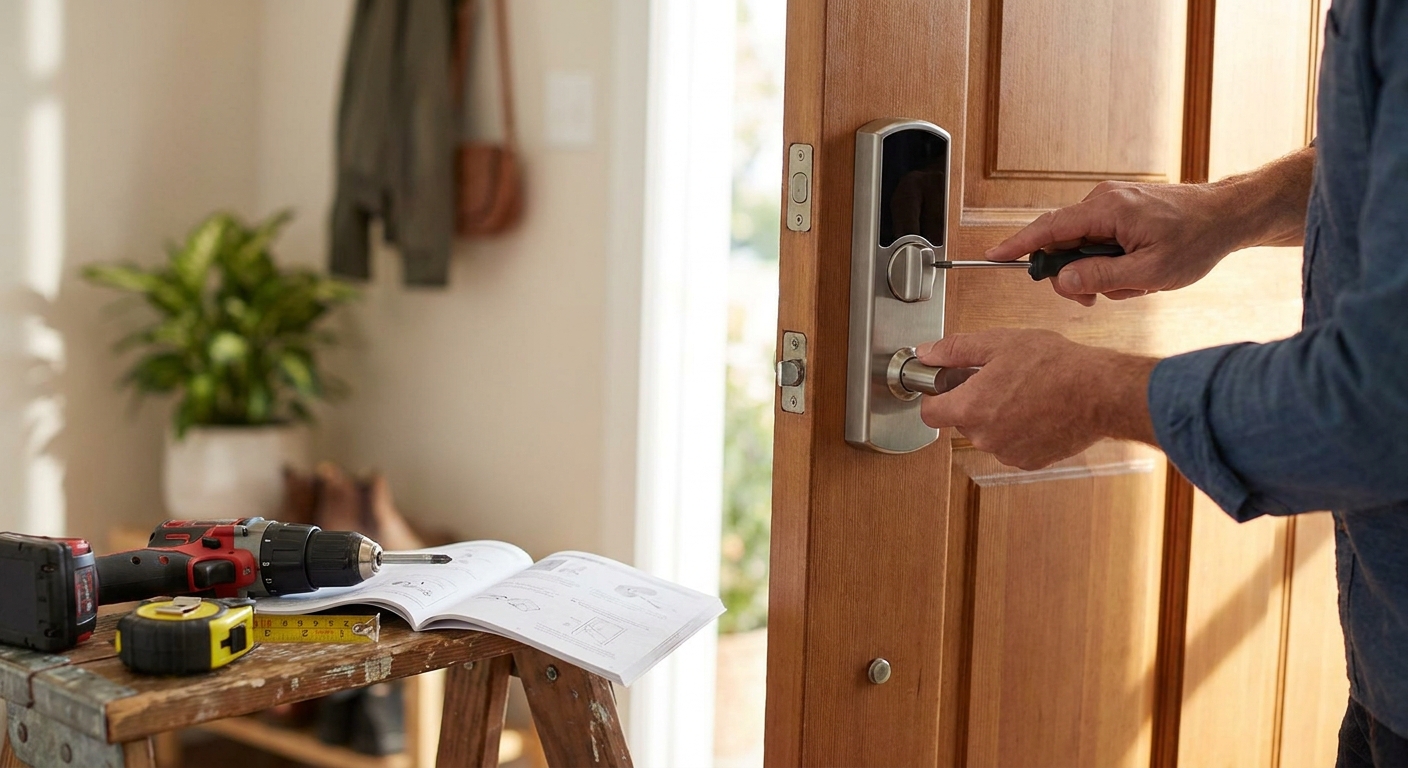
Electronic deadbolt installation for homeowners means matching the right smart lock to your door, your household, and your budget — then getting it mounted so it locks flush and reads codes without a half-second lag every time you walk in.
- Schlage Encode Plus wins for households already on Apple Home or Google Home — Buy.
- Kwikset Halo Touch's fingerprint reader unlocks in under 1 second with no app required — Buy.
- Skip generic sub-$40 smart locks in 2026; anything below ANSI Grade 2 fails on exterior doors.
- Electronic deadbolt installation for homeowners in Middlesex County runs roughly $150-$350 with hardware.
- August Wi-Fi Smart Lock retrofits onto an existing deadbolt but only if that cylinder is already Grade 1 — Consider.
Why this matters
A smart deadbolt is a mechanical lock with electronics bolted on — if the mechanical part is weak, the electronics are decoration. Homeowners shopping in 2026 often pick a lock by app reviews and skip the door prep question entirely, which is how you end up with a $200 deadbolt that still gets kicked in on the first try.
Apex Lock N Key installs and services electronic deadbolts across Middlesex County, and the calls that come in after a bad DIY install almost always trace back to the same three mistakes: wrong backset measurement, mismatched door thickness, or a battery compartment mounted where weather gets to it.
Who this is for
This guide is for homeowners replacing a standard deadbolt with a keyless or app-controlled model — not property managers standardizing access across units, and not renters who need landlord approval first. If you own the door, plan to stay in the house past the return window, and want to stop juggling physical keys for kids, dog walkers, or a cleaning service, keep reading.
What to look for in electronic deadbolt installation for homeowners
Battery life and backup power
Most electronic deadbolts run on 4 AA batteries rated for 6 to 12 months depending on daily unlock count. Look for a model with a 9-volt backup terminal or physical key override — without one, a dead battery in January means calling a locksmith at 11pm instead of swapping batteries yourself.
Connectivity type
Wi-Fi locks talk to your router directly and let you unlock remotely; Bluetooth-only locks need you within about 40 feet. Z-Wave and Zigbee locks need a smart-home hub but drain less battery. Pick based on whether you actually want remote unlock — most homeowners don't use it after the first month.
Door and backset compatibility
Standard doors use a 2-3/8" or 2-3/4" backset and a 1-3/8" to 1-3/4" thickness. A deadbolt built for one backset won't seat correctly in the other without redrilling, which turns a 45-minute job into a door replacement.
Access control features
Code-based entry, fingerprint reading, and app-based temporary codes solve different problems. A fingerprint reader like Kwikset Halo Touch's works when your hands are full of groceries; a temporary code feature matters more if you're managing a dog walker or short-term guest.
Weatherproofing for exterior doors
A lock rated for interior use will corrode fast on a covered porch and fail within a season on an exposed door. Confirm an IP rating or manufacturer weather-resistance claim before buying — this is the spec homeowners skip most often.
Grade rating
ANSI/BHMA Grade 1 locks handle roughly 250,000 cycles and resist a 10-strike force test; Grade 2 handles about 150,000 cycles. Anything ungraded — common on off-brand $40-$60 locks — has no tested resistance to forced entry at all.
Top picks for homeowners in 2026
Schlage Encode Plus — the safe pick. Built-in Apple Home compatibility means no separate hub, and it's rated ANSI Grade 2 with a 1-year battery estimate on standard use. Buy if your household already runs on Apple Home or Google Home.
Kwikset Halo Touch — the no-app pick. The fingerprint sensor stores up to 50 prints and unlocks in under 1 second with no phone required. Buy for households that don't want a smart-home app in the mix at all.
Yale Assure Lock 2 — the modular pick. Swappable connectivity modules (Wi-Fi, Z-Wave, Matter) mean you're not locked into one ecosystem for the life of the deadbolt. Consider if you're not sure which smart-home platform you'll be on in 3 years.
August Wi-Fi Smart Lock — the retrofit pick. It mounts over your existing deadbolt cylinder rather than replacing the whole unit, so install runs closer to 20 minutes. Consider only if your current lock is already Grade 1 — otherwise you're just adding electronics to a weak mechanical base.
Level Lock+ — the low-profile pick. No visible keypad or bulky exterior hardware, fits standard deadbolt prep, and includes a physical key backup. Buy if you want the lock to look like a lock, not a gadget.
Skip the DIY door prep guesswork
Licensed, insured install with same-day scheduling across Middlesex County.
What to avoid
- Ungraded smart locks under $60. They pass a marketing photo shoot, not a forced-entry test — no ANSI rating means no tested resistance data exists.
- Wi-Fi-only locks with no physical key override. A router outage or a dead battery with no backup leaves you standing outside your own house.
- Locks that need custom door prep on a standard 2-1/8" bore hole. If the install requires redrilling, the cost jumps well past the $150-$350 range homeowners expect in 2026.
Verdict comparison
| Model | Connectivity | Battery backup | Grade | Verdict |
|---|---|---|---|---|
| Schlage Encode Plus | Wi-Fi (built-in) | 9V terminal | Grade 2 | Buy |
| Kwikset Halo Touch | Wi-Fi | 9V terminal | Grade 2 | Buy |
| Yale Assure Lock 2 | Modular | Key override | Grade 2 | Consider |
| August Wi-Fi Smart Lock | Wi-Fi | Depends on base lock | Varies | Consider |
| Level Lock+ | Bluetooth | Key override | Grade 1 | Buy |
If you're rekeying instead of replacing hardware entirely, the cost math is different — see the locksmith rekey cost guide for 2026 pricing by lock count.
FAQ
What's the best electronic deadbolt for homeowners in 2026?
Schlage Encode Plus and Kwikset Halo Touch are the top picks for most homeowners in 2026 because both carry an ANSI Grade 2 rating and include a physical backup entry method. Choose Encode Plus for Apple Home integration and Halo Touch if you want fingerprint entry with no app.
Is an electronic deadbolt better than a traditional lock?
An electronic deadbolt adds convenience — keyless entry, temporary codes, remote monitoring — but it isn't automatically more secure than a traditional Grade 1 deadbolt. Security depends on the grade rating, not whether the lock has a keypad.
How much does electronic deadbolt installation cost for homeowners?
Electronic deadbolt installation for homeowners typically costs $150 to $350 including hardware in Middlesex County as of 2026, depending on whether the door needs re-prepping for a different backset.
Can I install an electronic deadbolt myself?
Yes, if your door already has a standard 2-1/8" bore hole and matching backset, most electronic deadbolts install with a screwdriver in under an hour. Doors with nonstandard prep or damaged strike plates need a professional fit.
Do electronic deadbolts work during a power outage?
Battery-powered electronic deadbolts keep working during a home power outage since they don't draw from household electricity. A dead battery, not a blackout, is the actual failure point — always confirm a 9V backup terminal or physical key override before buying.
How long do electronic deadbolt batteries last?
Most electronic deadbolts run 6 to 12 months on 4 AA batteries under normal daily use in 2026 models. High-traffic households with 15+ unlocks a day should expect the shorter end of that range.
Are cheap smart locks safe for exterior doors?
Unbranded smart locks under $60 usually carry no ANSI/BHMA grade rating, meaning no tested resistance to forced entry. For exterior doors, Grade 2 is the practical minimum in 2026.
Will an HOA allow electronic deadbolts?
Many HOAs require exterior hardware to match community aesthetics, so low-profile models without a visible keypad clear approval more easily. Check your HOA's exterior modification policy before buying rather than after installation.
One last thing
The detail most homeowners miss in 2026: a Grade 2 electronic deadbolt on a door with a cheap, unreinforced strike plate is still a Grade 2 lock protecting a weak frame. Upgrading the strike plate to a 3-inch screw box strike costs almost nothing next to the lock itself and does more for actual break-in resistance than any app feature.
If you live in a condo or HOA community, confirm exterior modification rules before you buy — the apartment complex and HOA locksmith guide covers what most associations require for approved hardware.


