
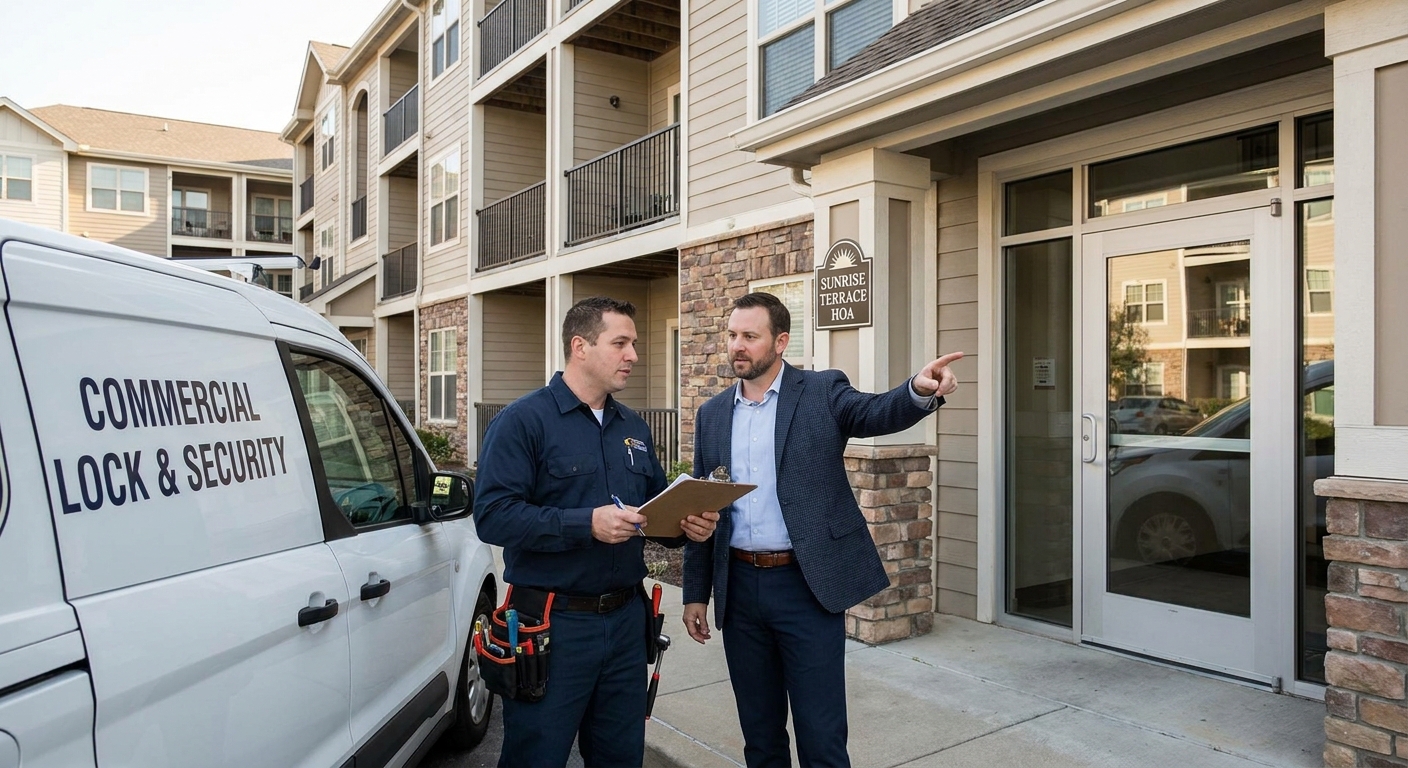
Property managers and HOA boards juggle turnover locks, common-area access, and emergency lockouts across dozens or hundreds of units — this guide breaks down what actually separates a commercial locksmith for apartment complexes from a technician who only handles single-family calls, plus the specific service picks worth your 2026 maintenance budget.
- Master key systems win for complexes over 50 units — rekeying costs less than replacing locks door by door.
- 24/7 response separates a real commercial locksmith for apartment complexes from a residential-only technician.
- Electronic access control pays off at mail rooms and amenity buildings with heavy tenant turnover.
- Skip locksmiths without commercial liability coverage — HOA boards need that paperwork for insurance renewals.
Why this matters
A single-family locksmith call is a 20-minute job. An apartment complex or HOA property is a security system with dozens of moving parts: unit turnover, common-area doors, mailroom clusters, maintenance closets, and sometimes a parking garage or amenity building. Get the vendor relationship wrong and you're re-keying the same building three times a year because nobody set up a proper master key hierarchy.
Apex Lock N Key works Middlesex County properties on this exact model in 2026 — licensed, insured, and built around multifamily turnover schedules rather than one-off residential visits. That distinction matters more than price per call when you're managing 50, 150, or 500 units.
Who this is for
This guide is for property managers, HOA board members, and maintenance supervisors responsible for lock and access security across multi-unit residential buildings — the people who get the 2am lockout call, sign off on the annual rekeying line item, and answer to an insurance carrier when a common-area door doesn't lock properly.
What to look for in a commercial locksmith for apartment complexes
Licensing and commercial insurance
A locksmith working inside your buildings needs a current Massachusetts license and commercial general liability coverage, not a homeowner's policy. HOA boards specifically need that paperwork on file for their own insurance renewals — ask for the certificate before the first job, not after an incident.
Master key and grand master key capability
Apartment complexes need a keying hierarchy: unit keys, building master keys, and a grand master for maintenance staff who service multiple buildings. A locksmith who can only cut single keys one at a time will cost you more in callbacks than in the actual cutting.
Response time for emergency lockouts
Tenant lockouts happen at night and on weekends, not during business hours. A locksmith without genuine 24/7 dispatch means your maintenance staff fields 2am calls themselves — ask what the average response window actually looks like, not just whether they answer the phone.
Access control and fob or keypad experience
Amenity buildings, gyms, and package rooms increasingly run on electronic entry instead of brass keys. A locksmith who's only ever cut traditional keys will quote you a hardware replacement when a keypad reprogram would have solved it in an hour.
Billing that fits property management workflows
HOA and property management accounting runs on purchase orders, net-30 terms, and line-item invoices tied to specific buildings or units. A locksmith who only takes cash on the spot creates a paperwork headache for every job across a 2026 budget cycle.
Top picks for apartment complex and HOA security
1. Master key system for unit turnover — the backbone pick. One key structure covers every unit while letting maintenance access all doors on one ring. Turnover on a 100-unit property with individual rekeys per tenant runs into dozens of separate service calls a year; a master system collapses that into one scheduled visit per vacancy. Verdict: Buy.
2. Grand master key hierarchy for multi-building portfolios — the scale fix. If your HOA or management company covers more than one building, a grand master lets a single supervisor key open every property without carrying a separate ring for each address. This is the pick that saves the most staff time once you're past three buildings. Verdict: Buy.
3. Electronic keypad entry for amenity spaces — the low-maintenance upgrade. Pools, gyms, and laundry rooms see the heaviest tenant traffic and the most lost-key complaints. A keypad or fob system removes the rekeying cycle entirely — codes reset in minutes instead of a locksmith visit. Verdict: Consider, especially for any amenity space with more than 100 active users.
4. Mailroom and package room rekeying — the theft deterrent. Cluster mailboxes and package rooms are the most common theft target in multifamily buildings, and they're often still on the original builder-grade lock years later. A dedicated rekey here, priced separately from unit work on a rekeying cost guide, is one of the cheapest security upgrades available. Verdict: Buy.
5. High-security restricted keyways for board and office access — the paranoid pick. Restricted keyways stop unauthorized key duplication at any hardware store, which matters for HOA board offices, leasing offices, and maintenance shops that resemble small warehouse and distribution center storage more than a typical apartment unit. Verdict: Consider for board rooms and storage areas; Skip for standard tenant units where the cost doesn't match the risk.
Get a locksmith quote for your property
24/7 licensed service across Middlesex County for HOA boards and property managers.
What to avoid
- Residential-only technicians without restricted keyway stock. They'll quote a standard rekey that any tenant can duplicate at a hardware store within a week.
- One-key-per-unit systems on properties over 20 units. It looks simple on paper and turns into a filing cabinet full of loose keys nobody can track by year two.
- Locksmiths who skip proof of commercial insurance. HOA boards get burned here during their own policy renewal, not during the service call itself.
Verdict comparison
| Pick | Best for | Setup effort | Verdict |
|---|---|---|---|
| Master key system | Unit turnover, 50+ units | Moderate | Buy |
| Grand master hierarchy | Multi-building portfolios | Moderate | Buy |
| Electronic keypad entry | Amenity spaces, mail rooms | Low ongoing | Consider |
| Mailroom rekey | Package theft prevention | Low | Buy |
| Restricted keyway | Board offices, storage | High | Consider/Skip |
FAQ
What does a commercial locksmith for apartment complexes actually do?
A commercial locksmith for apartment complexes handles master key systems, unit turnover rekeying, common-area lock installation, and emergency lockouts across multi-unit residential properties. In 2026 this typically includes electronic access control work for amenity buildings and mail rooms as well.
Is a master key system worth it for a small HOA?
Master key systems pay off once a property passes roughly 20-30 units, since the setup cost spreads across every future turnover. Below that size, individual unit rekeying is often simpler and cheaper.
How much does it cost to rekey an apartment complex in 2026?
Cost depends on unit count, hardware condition, and whether you're setting up a new master key hierarchy versus rekeying existing cylinders. A per-unit rekeying cost guide gives a useful baseline before requesting a property-wide quote.
Does an HOA need a licensed locksmith or can maintenance staff handle rekeying?
HOAs should use a licensed, insured locksmith for any master key or access control work, since improperly cut master keys can compromise every unit on the property at once. Maintenance staff can handle simple key duplication but not system-level rekeying.
What's the difference between a master key and a grand master key?
A master key opens every unit within one building, while a grand master key opens every building across a multi-property portfolio. Most single-building HOAs only need a standard master, not a grand master hierarchy.
Can electronic access control replace all the keys in an apartment complex?
Electronic access control commonly replaces keys for common areas, amenity spaces, and mail rooms, but most residential leases still require a physical key or fob for the actual unit door in 2026. Full keyless conversion for every unit is possible but adds hardware cost per door.
Does a commercial locksmith work with property management billing?
A commercial locksmith serving apartment complexes should accommodate purchase orders, net-30 invoicing, and per-building line items rather than requiring cash on the spot. Confirm this before the first job, since it affects how fast a property manager can approve recurring work.
How fast should an emergency lockout response be for a tenant?
A genuine 24/7 commercial locksmith should be dispatchable any time of day or night, not just during business hours. Ask for the actual average response window on a call rather than accepting a vague 'we're available 24/7' answer.
One last thing
Rekey the mailroom cluster boxes on a restricted keyway separate from unit locks — it stops mail theft cold without touching a single tenant's door, and it's usually the cheapest line item on the entire 2026 security budget for a multifamily property.


