
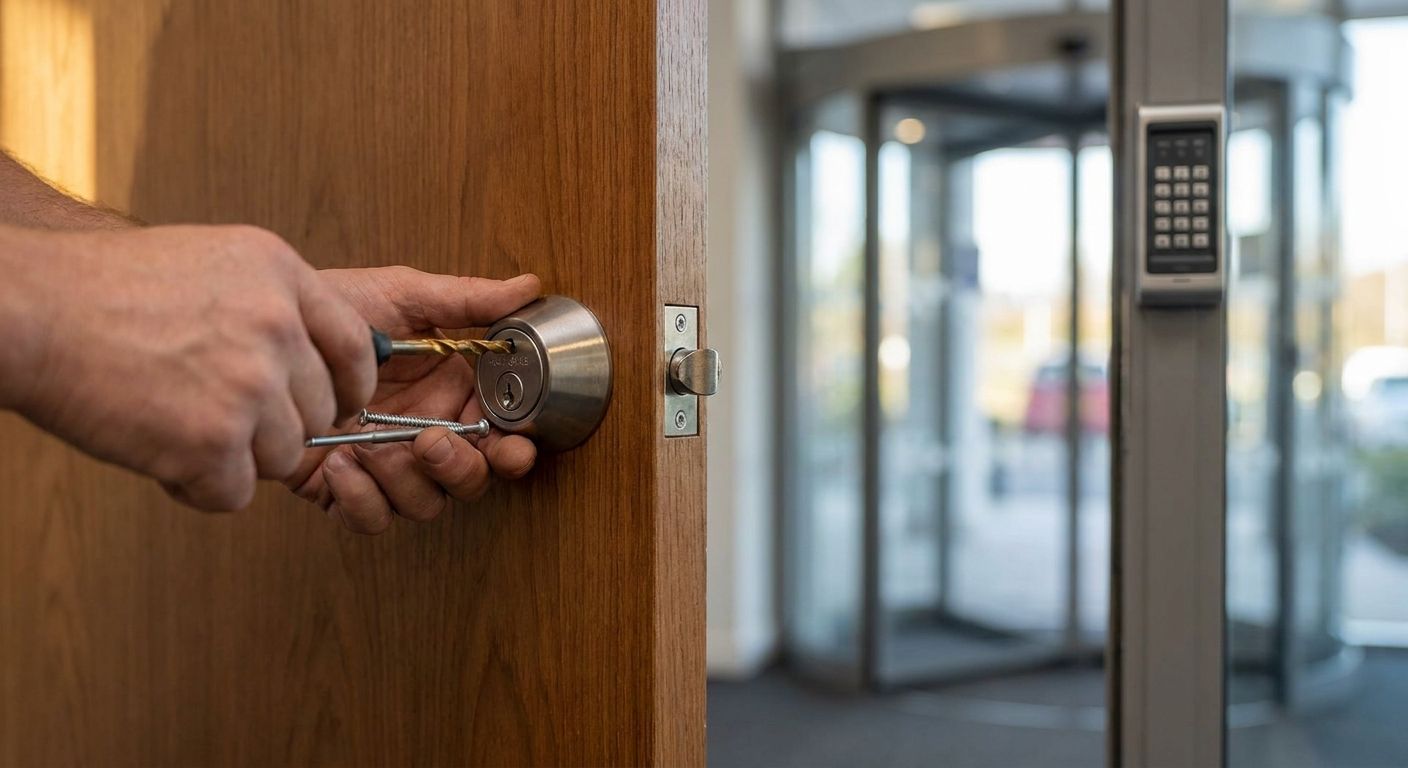
Getting your locks upgraded after a break-in, before a lease renewal, or as part of a commercial buildout means choosing hardware that actually resists forced entry — not just hardware labeled "high-security" on the box. This guide breaks down what separates real high-security lock installation from marketing language, and which lock type fits your situation in 2026.
- ANSI/BHMA Grade 1 deadbolts are the baseline for real high security lock installation on homes and offices in 2026.
- Restricted-keyway cylinders win for homeowners after a break-in — Buy if key control matters.
- Access control systems beat rekeying for retail and office turnover — Buy for businesses with staff changes.
- Master key systems are the right call for landlords managing multiple units — Buy, not Consider.
- Skip big-box smart locks with no ANSI grade behind the electronics — the cylinder is the weak point.
Why this matters
A locked door only protects you if the lock resists the specific attack it's likely to face — kick-ins, bumping, picking, or a duplicated key floating around from a past tenant or ex-roommate. Standard residential builder-grade locks are rated Grade 2 or Grade 3 under ANSI/BHMA A156.36, which means they're built for cost, not resistance. High security lock installation swaps that hardware for Grade 1 mechanisms, restricted keyways, and — for businesses — access control that logs who came and went. Apex Lock N Key installs this hardware across Middlesex County for homeowners, landlords, and business owners who've decided a $30 hardware store deadbolt isn't the last line of defense they want.
Who this is for
This guide is for three buyer types: homeowners upgrading security after a break-in or before moving into a new place, landlords and property managers responsible for multiple units, and business owners — retail, office, medical, or warehouse — who need locks that hold up to daily staff turnover and liability requirements. If you're just replacing a worn-out $20 deadbolt with the same grade of lock, this isn't the guide you need. If you want hardware that actually stops the next attempt, keep reading.
What to look for in high security lock installation
ANSI/BHMA Grade Rating
Grade 1 is the top residential and light-commercial rating under ANSI/BHMA A156.36, and it's the number that separates a real security upgrade from a cosmetic one. Grade 2 and Grade 3 locks look identical on a door but fail faster under kick-in force and repeated use — for a family or a business relying on the lock daily, that gap matters within the first year, not the tenth.
Restricted Keyway / Key Control
A restricted keyway means blanks aren't sold at hardware stores, so a locksmith controls who gets a copy — critical after a break-in, a bad tenant, or a fired employee who might still have a key. Without key control, rekeying a standard cylinder doesn't stop someone with an old duplicate from walking back in through a different door on the same key system.
Reinforced Strike Plates and Door Hardware
A Grade 1 deadbolt installed into a hollow, thin strike plate still fails to a solid kick — the cylinder isn't the only weak point. Reinforced, long-screw strike plates anchored into the door frame stud are what actually stop forced entry, and it's a detail most DIY installs skip entirely.
Access Control Compatibility for Businesses
Businesses with staff turnover need a way to revoke access without rekeying every door — that's what card, fob, or code-based access control solves. A single terminated employee shouldn't mean an emergency locksmith call to rekey the whole building.
Licensed Installation and Code Compliance
Commercial spaces — restaurants, medical offices, daycare centers — carry fire code requirements around panic hardware and egress that a licensed locksmith accounts for during install. A lock that's technically "high security" but violates fire egress code creates liability that outweighs the security gain.
Rekey Path and Long-Term Cost
High-security cylinders should be rekeyable without full hardware replacement when tenants change or keys go missing. Knowing how to choose between rekeying and replacing a lock up front saves money on every future key event.
Apex Lock N Key's high-security lock installation service walks through these six checks on-site before recommending hardware, rather than defaulting to whatever's on the truck.
Top picks for 2026
The baseline pick: ANSI Grade 1 deadbolt
This is the floor for anyone serious about high security lock installation in 2026, not the ceiling. Grade 1 hardware is built to survive far more forced-entry attempts and daily cycles than the Grade 2 or Grade 3 deadbolt most homes ship with from the builder. Verdict: Buy for any homeowner replacing a standard deadbolt after a break-in or before move-in.
The anti-bump pick: restricted-keyway high-security cylinder
A restricted keyway shuts down bumping, picking, and unauthorized duplication because blanks aren't available off the shelf — a locksmith has to cut them. This is the pick for homeowners doing residential rekeying after a break-in or attempted burglary, where you need certainty nobody else has a working copy. Verdict: Buy if a stranger has ever had access to your old key.
The convenience pick: electronic smart deadbolt
A PIN-code or app-controlled deadbolt adds auto-lock timers and code-based entry, which is real convenience — but only pair it with a Grade 1 mechanical core, not a bargain cylinder hidden behind the electronics. Apex Lock N Key's electronic deadbolt installation for homeowners covers this pairing directly. Verdict: Consider for homeowners who want keyless entry alongside real physical security, not instead of it.
The business pick: access control system
For offices, retail, and medical spaces, access control installation for small business offices replaces the rekey-everyone-every-time model with revocable digital credentials and an entry log. That log alone answers the "who was here at 6pm" question that a mechanical key never can. Verdict: Buy for any business with more than a handful of staff or regular turnover.
The multi-unit pick: master key system
Landlords and property managers juggling multiple units need one master key without handing every tenant the same access. Master key systems for multi-unit apartment buildings build that hierarchy in from the start, so a maintenance master doesn't compromise individual unit security. Verdict: Buy for anyone managing three or more rental units.
Get high-security locks installed
Licensed and insured, on call 24/7 across Middlesex County.
What to avoid
- "High-security" deadbolts with a standard keyway. If the key blank is sold at any hardware store, it's not key-controlled, no matter what the packaging claims — that's a Grade 2 lock wearing a security label.
- Smart locks with no ANSI grade behind the electronics. A slick app doesn't matter if the physical cylinder fails a basic bump-pick attempt in under a minute.
- DIY keypad installs on commercial exit doors. Panic bar and egress code requirements apply to restaurants, medical offices, and daycares, and a code-locked exit door can create a fire code violation that costs more than the lock did.
Verdict comparison
| Lock type | Best for | Key security feature | 2026 verdict |
|---|---|---|---|
| ANSI Grade 1 deadbolt | Any home or office replacing builder-grade hardware | Top ANSI/BHMA A156.36 rating | Buy |
| Restricted-keyway cylinder | Homes after a break-in or key loss | No off-shelf key duplication | Buy |
| Electronic smart deadbolt | Homeowners wanting keyless entry | PIN codes, auto-lock, paired with Grade 1 core | Consider |
| Access control system | Retail, offices, medical, staff turnover | Revocable credentials, entry logs | Buy |
| Master key system | Landlords, multi-unit properties | Tiered access without rekeying every unit | Buy |
FAQ
What is high security lock installation?
High security lock installation means fitting doors with ANSI/BHMA Grade 1 hardware and restricted-keyway cylinders instead of standard Grade 2 or 3 locks. In 2026, that combination is the baseline for resisting bumping, picking, and forced entry on homes and businesses.
Is a Grade 1 deadbolt worth it for a home?
Yes, a Grade 1 deadbolt is worth it for any home, especially after a break-in or before moving into a new property. It withstands far more forced-entry attempts than the Grade 2 or 3 hardware most builders install by default.
How much does high-security lock installation cost?
Cost varies by lock type, door count, and whether you're adding access control or just upgrading cylinders, so get a direct quote for your property. A licensed locksmith can price it accurately after seeing your existing hardware.
Is a smart lock as secure as a traditional high-security deadbolt?
A smart lock is only as secure as the physical cylinder behind the electronics, so pair one with a Grade 1 mechanical core rather than treating the app as the security feature. Convenience and physical security are separate questions.
Do businesses need access control instead of standard locks?
Businesses with regular staff turnover benefit from access control because it revokes access instantly without rekeying every door. A standard lock forces a full rekey every time an employee leaves.
What's the difference between rekeying and installing a new high-security lock?
Rekeying changes the internal pins so old keys stop working in the same hardware, while a new high-security lock replaces the entire mechanism with a higher-grade one. Rekeying is cheaper; a full install is necessary when the existing hardware is below Grade 1.
Can landlords install one master key system across multiple units?
Yes, a master key system lets a landlord hold one key for maintenance access while each tenant keeps an individual, non-master key. This is standard for buildings with three or more units in 2026.
How do I know if my current locks are high security?
Check for an ANSI/BHMA Grade 1 stamp on the cylinder and confirm the keyway is restricted, meaning blanks aren't available at hardware stores. If neither applies, the lock is standard-grade regardless of what the listing called it.
One last thing
The strike plate gets ignored more than any other part of a high-security install — a Grade 1 deadbolt screwed into a stock strike plate with 3/4-inch screws still gives way to a hard kick, because the screws never reach the door frame stud. Ask specifically whether reinforced, long-screw strike plates are part of the install; if they're not mentioned, they're probably not included.


