
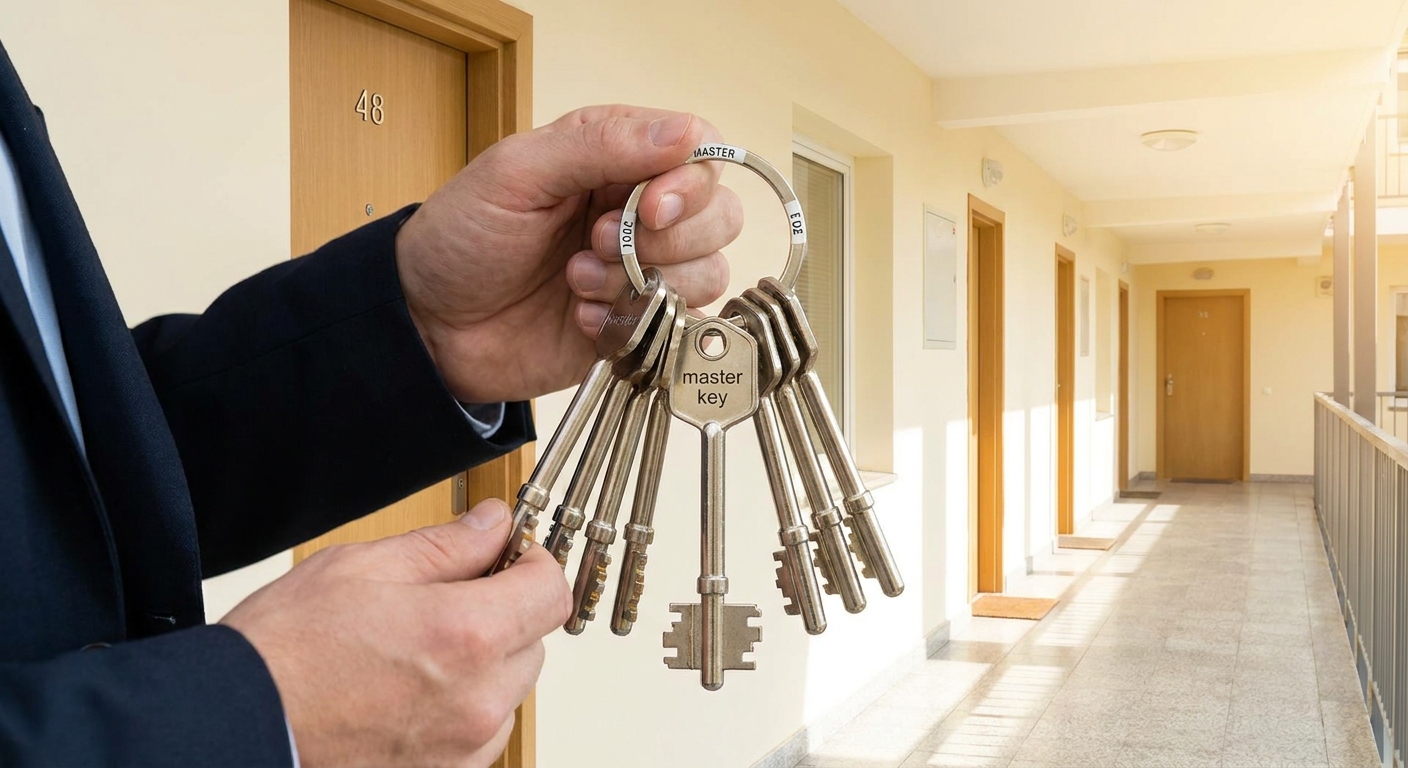
A master key system for an apartment building lets property managers open every unit with one key while each tenant keeps a unique key to their own door — get the hierarchy wrong and a single lost key can force a rekey of the whole property.
- A grand master key system works best for apartment buildings with 20+ units needing tiered staff access. Buy.
- Restricted keyway systems stop unauthorized duplication at hardware stores — critical for high-turnover buildings. Buy.
- High-security cylinders resist bumping and picking; expect roughly $150-$350 per door installed in 2026.
- Electronic access retrofits log every entry but cost more upfront — skip for buildings under 12 units.
Why this matters
A compromised master key isn't a one-door problem. In a 40-door building, one duplicated master means every lock on the property is suspect the moment a tenant reports a break-in or a maintenance worker gets fired.
Property managers who skip the planning step end up with mismatched systems: a few units on old pin tumblers, a few on whatever the last vendor installed, and no clean way to issue a master that actually covers all of them. Fixing that after the fact costs more than doing it right in 2026, before move-ins start.
Apex Lock N Key handles master key installs across Middlesex County apartment buildings and HOAs, and the pattern is consistent: buildings that plan the key hierarchy up front rekey faster, spend less per turnover, and never have to explain to a tenant why a key from three landlords ago still opens their door.
Who this is for
This guide is for property managers, landlords, and HOA boards overseeing 8 or more rental units who need staff, maintenance, and emergency personnel to move through a building without carrying a separate key for every door — while keeping each tenant's unit private and legally secure.
What to look for in a master key system for apartment building
Key hierarchy depth
Most apartment properties need at least three levels: individual tenant keys, a sub-master for a wing or floor, and a grand master for management and maintenance. A shallow, two-level system forces you to hand out the top-level key to anyone who needs floor access, which defeats the point of tiering it.
Duplication control
Standard keyways can be cut at any hardware store for a few dollars, which means a departing tenant or contractor can walk out with a spare nobody logs. A property management companies locksmith relationship built around restricted keyways solves this — blanks are patented and only cut by an authorized shop, so duplication requires your sign-off.
Rekey speed after turnover
Units turn over constantly in multi-family housing, and every move-out is technically a security event. Ask how fast a locksmith can rekey a single cylinder without disturbing the master hierarchy for the rest of the building — a good rekey cost estimate usually runs far cheaper than a full lock replacement, and it should take under an hour per door.
Compatibility with existing hardware
A lot of buildings built before 2010 have mismatched cylinders across units from years of piecemeal repairs. Before committing to a keyway family, confirm the vendor can retrofit existing door hardware instead of replacing every lockset, which is where budgets blow up.
Audit trail and accountability
Mechanical master keys leave no record of who used them or when. If your board or insurer wants to know exactly who entered a unit on a given date, that's a mark in favor of an electronic component layered on top of the mechanical hierarchy.
Vendor licensing and local response time
A master key system is only as good as the locksmith who can service it. Confirm the vendor is licensed in Massachusetts and can respond same-day for a lockout or a compromised cylinder — a system with a two-week wait for a rekey isn't a security system, it's a liability.
Top picks for apartment building master key systems
Grand Master Key System (mechanical) — the workhorse pick. Standard pin tumbler hierarchy with three levels: unit, sub-master, grand master. Works for apartment complexes and HOAs of any size and retrofits onto most existing hardware without replacing door prep. Approximate installed cost runs $80-$150 per cylinder in 2026. Buy for buildings that need dependable, low-maintenance access without a big upfront electronics investment.
Restricted Keyway System — the anti-duplication pick. Uses patented key blanks that only an authorized locksmith can cut, closing the hardware-store-copy loophole that plagues standard keyways. Costs more per cylinder ($150-$250 in 2026) but pays for itself the first time a tenant's ex-roommate can't just walk into a shop for a spare. Buy for any building with turnover above a few units a year.
High-Security Cylinder Upgrade — the drill-resistant pick. Adds hardened inserts, finger pins, and side bars that resist bumping and picking far better than a standard tumbler. Runs $150-$350 per door installed in 2026 and layers on top of either master system above. Consider this for ground-floor units and building entry doors specifically, rather than every interior unit door — it's overkill (and overspend) for a third-floor unit with no street access.
Electronic Access Retrofit — the audit-trail pick. Keypad or fob-based access logs every entry with a timestamp, which matters when a board or insurer asks who was in a unit and when. Installed cost typically starts around $300-$600+ per door in 2026 depending on wiring needs. Consider for common doors and amenity spaces; Skip for individual unit doors in buildings under 12 units, where the cost per door rarely justifies the log data.
Need a master key system installed?
Licensed 24/7 locksmiths for Middlesex County apartment buildings and HOAs.
What to avoid
- A single flat keyway with no hierarchy. It looks simple and cheap, but it means every master key opens every door with zero tiering — one lost key compromises the entire building, not just a wing.
- Big-box store master key kits. These use non-restricted keyways that anyone can duplicate at a kiosk, which defeats the entire point of controlling who holds a master.
- Mixing vendors mid-system. Adding a second locksmith's cylinders to an existing master hierarchy without cross-checking pinning specs often means the new units simply don't respond to the master at all — you find out during an emergency, not during install.
Verdict comparison
| System | Duplication Risk | Retrofit Compatibility | Approx. Cost/Door (2026) | Verdict |
|---|---|---|---|---|
| Grand Master Key System | Moderate | High | $80-$150 | Buy |
| Restricted Keyway System | Low | Moderate | $150-$250 | Buy |
| High-Security Cylinder | Very low | Moderate-High | $150-$350 | Consider |
| Electronic Access Retrofit | None (digital) | Low (needs power/wiring) | $300-$600+ | Consider |
FAQ
What is a master key system for an apartment building?
A master key system for an apartment building is a tiered lock hierarchy where one master key opens every unit and individual tenant keys only open their own door. Most multi-unit properties use three levels: unit key, sub-master, and grand master for management access.
How much does a master key system cost for a 20-unit building in 2026?
A mechanical grand master key system typically runs $80-$150 per door installed in 2026, so a 20-unit building lands roughly in the $1,600-$3,000 range for cylinders alone. Restricted keyways and high-security upgrades add to that per-door cost.
Is a master key system a security risk?
A master key system carries risk only if duplication isn't controlled — a standard keyway can be copied at any hardware store. Restricted keyways solve this by requiring locksmith authorization for every duplicate cut.
Can a locksmith rekey just one unit without touching the master?
Yes, a properly cut master key system lets a locksmith rekey a single unit's cylinder without affecting the master or any other unit. This typically takes under an hour per door and costs far less than replacing the whole lockset.
What's the difference between a grand master and a sub-master key?
A grand master key opens every lock on the property, while a sub-master opens only a defined group, such as one floor or wing. Buildings use sub-masters so maintenance staff assigned to one area never need full-property access.
Do apartment buildings need restricted keyways?
Buildings with regular tenant turnover benefit most from restricted keyways because they stop unauthorized copies at retail key kiosks. Buildings with very low turnover and tight staff control can sometimes get by with a standard keyway at lower cost.
How long does it take to install a master key system?
A straightforward mechanical master key system for a 20-30 unit building typically installs in one to two days once cylinders and keys are cut. Electronic retrofits take longer due to wiring and access-control programming.
Can smart locks work with a master key system?
Some smart locks include a mechanical key override that can be integrated into a master hierarchy, but most electronic access systems run as a separate log-based layer over the mechanical master. Ask your locksmith to confirm compatibility before mixing the two on the same door.
One last thing
Most master key compromises don't trace back to a locksmith mistake — they trace back to a maintenance worker's key ring left in a golf cart or a front-office drawer nobody locks. The strongest master key system for apartment building security still fails if the grand master itself isn't tracked, so put a sign-out log on it before you ever hand it to a second person.


