
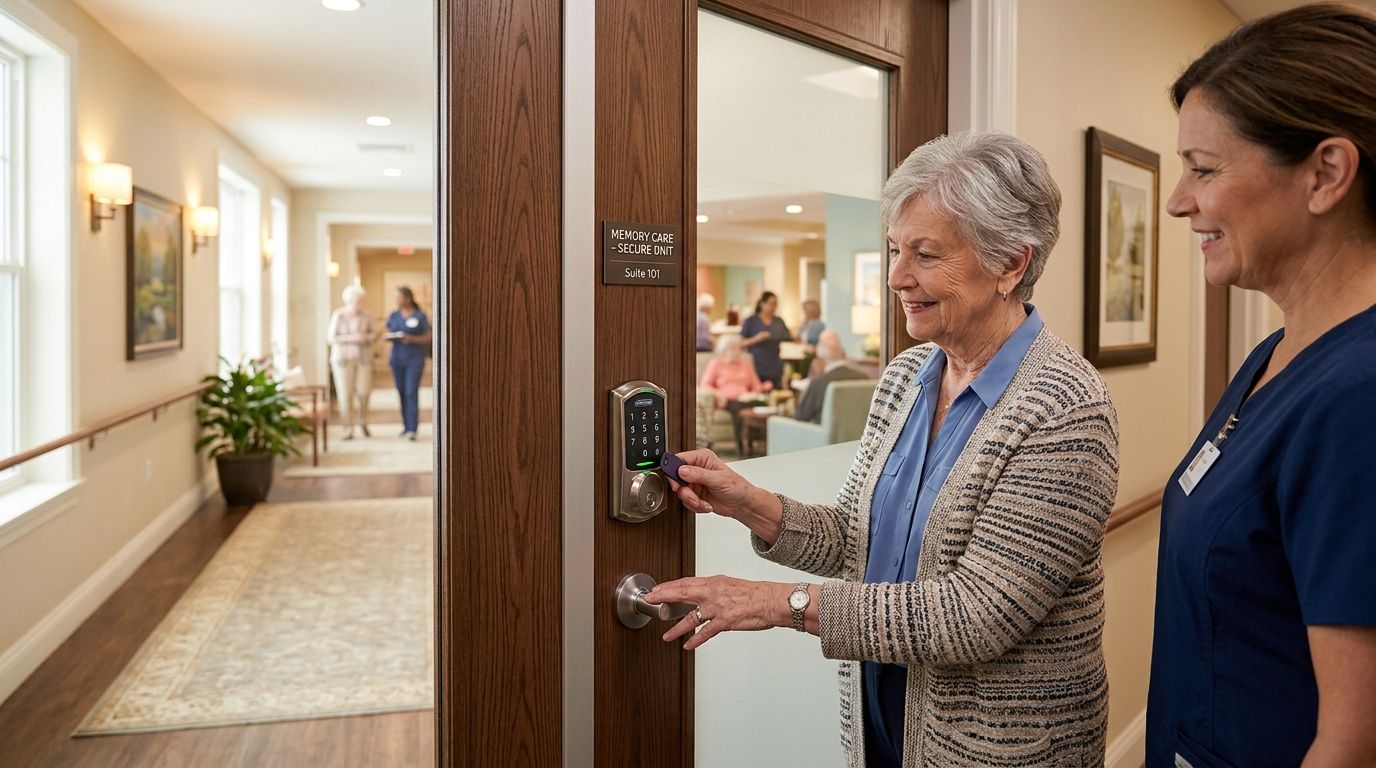
Keyless entry for memory care units is access-controlled door hardware — keypads, credential readers, and delayed-egress locks — installed to stop wandering residents from leaving unsupervised while letting staff, families, and inspectors move through doors without a metal key. A locked door in a memory care unit isn't inventory protection like it is in a retail shop; it's a life-safety control tied directly to elopement risk and fire code, which means the hardware decisions here carry more weight than a standard commercial install.
- Keyless entry for memory care units works best when it pairs individualized staff codes with delayed-egress hardware on exterior exits.
- Standalone keypad locks solve staff turnover cheaply; biometric readers and monitored fob systems solve accountability.
- NFPA 101 caps delayed-egress locking at 15 seconds, extendable to 30 seconds only with local fire marshal approval.
- Apex Lock N Key installs and audits access control for assisted living and memory care facilities across Middlesex County, MA in 2026.
- Shared PIN codes and unmonitored elevator doors are the two most common gaps in memory care access control.
Why keyless entry matters for memory care units
A memory care unit runs on a different risk profile than an office or a warehouse. The best commercial locksmith for assisted living facilities gets called for two reasons over and over: a resident got through an exterior door unsupervised, or a former employee's key was never collected. Both problems are solved the same way — by replacing physical keys with credentials that can be issued and killed in seconds.
The Alzheimer's Association has reported for years that roughly six in ten people living with dementia will wander at least once, and many do it repeatedly. That single fact is why memory care doors aren't optional upgrades — they're the control that keeps a facility out of an incident report. On top of that, staff turnover in assisted living is high, and every departed aide who still has a physical key is a liability sitting in a coat pocket somewhere.
Fire code adds the other constraint. NFPA 101 allows delayed-egress locking on doors, but the delay is capped at 15 seconds before the door must release once someone pushes against it, extendable to 30 seconds only with the local fire marshal's written approval. Any keyless system for a memory care unit has to satisfy both the wandering problem and the egress rule at the same time, which is exactly where a lot of facilities get it wrong.
Step-by-step: setting up keyless entry for a memory care unit
Map every exit against fire and life-safety code before you buy hardware
Start with a walk of the building, not a hardware catalog. A door that looks like a security risk on paper might be a required emergency exit that can't be locked the way you want.
- Identify every door classified as a required means of egress
- Confirm with the local fire marshal whether 15-second or 30-second delayed egress is approved for your building
- Flag doors that cannot be locked under any circumstances during occupied hours
- List secondary exits — patios, courtyards, loading doors — that residents can reach unsupervised
- Note which doors already have working door closers and which need repair first
Choose a keyless credential type built for staff turnover
The cheapest fix is also the fastest: a standalone keypad lock with a programmable PIN lets you delete a departing aide's code the same shift they leave, no rekeying and no locksmith visit required for that step alone. That's the manual, low-cost starting point for a single door or a back office.
For doors where accountability matters more than convenience — medication rooms, staff-only exits, the main resident wing — a biometric reader closes the gap that shared PINs leave open, since a fingerprint can't be handed off to a coworker. Biometric lock installation for high-security facilities covers what that install looks like for a facility this size.
- Standalone keypad locks for low-traffic interior doors and quick staff changes
- Fob or card readers tied to a central log for shift-based staff
- Biometric readers for medication rooms and staff-only exits
- Door contacts with wander alerts on every exterior exit
- Delayed-egress magnetic locks on the main resident-wing doors
Set individualized access schedules, not one shared code
One PIN for the whole floor is the single most common mistake in memory care access control, and it defeats the entire point of going keyless. Every staff member needs their own code so a propped door or a missed lock-up traces back to a person, not a guess.
- Issue a separate code or credential per staff member, not per shift
- Set time-restricted access windows tied to actual work schedules
- Create temporary, expiring codes for visiting family or contractors
- Disable a departing employee's code the same day, not at the next audit
- Review the access log weekly, not just after an incident
Add monitoring layers to the doors that matter most
A lock alone tells you a door is secured. It doesn't tell you who used it or whether it was propped open by a staff member on a break. Pair the main entrance with video and monitor the exits that residents are most likely to test.
- A monitored video intercom at the main entrance for visitor screening and after-hours arrivals — see video intercom and lock installation for commercial buildings
- Door-position sensors on every exterior exit, wired to alert staff if a door stays open past a set number of seconds
- Alarm integration so a propped door triggers a notification, not just a log entry
- Camera coverage at stairwells and secondary exits, not just the lobby
Build a backup plan for power and network outages
A keyless system that fails locked or fails open during a power outage creates a new emergency on top of whatever caused the outage. Plan the backup before the install, not after the first blackout.
- Battery backup on every keyless lock, tested on a fixed schedule
- A mechanical key override stored in a controlled, logged lockbox
- A tie-in to any facility generator for the doors classified as critical egress
- A sealed emergency code sheet available to first responders on arrival
Train staff and document every access change
Hardware doesn't fix behavior. A facility with the best delayed-egress locks on the market still has a gap if new hires never learn the code-issuance process.
- Add code issuance and revocation to the standard onboarding checklist
- Run a quarterly access audit against the current staff roster
- Set a rekey-or-reprogram protocol that triggers automatically after any incident
- Require a sign-off sheet for every access change, not a verbal update
Get keyless entry installed the right way
Apex Lock N Key handles access control installs for assisted living and memory care facilities in Middlesex County, MA.
Comparing keyless entry options for memory care units
| Option | Best for | Key limitation |
|---|---|---|
| Standalone keypad lock | Single doors, fast staff turnover | No central log without an add-on hub — Buy for interior doors |
| Fob or card reader system | Multi-door facilities with shift-based staff | Cards can be lost, borrowed, or shared — Hold for high-turnover units |
| Biometric reader | Medication rooms and staff-only exits | Slower enrollment, poor fit for visitor doors — Buy for restricted access points |
| Delayed-egress magnetic lock | Main exterior exits with elopement risk | Delay is capped by NFPA 101 and local fire code — Buy where the fire marshal approves it |
| Video intercom entry | Staffed front desk during business hours | Not a standalone lock, needs active monitoring — Hold as a supplement, not a replacement |
Common mistakes memory care facilities make with keyless entry
- Sharing one PIN across the entire staff — kills the audit trail the whole system was installed to create.
- Installing delayed-egress locks without fire marshal sign-off — a code violation is worse than the elopement risk it was meant to solve.
- Skipping battery backup planning — a power outage that locks staff out is a second emergency layered on the first.
- Hardening the front door and forgetting the rest — elevators and stairwell exits need the same attention; see elevator and access lock service for commercial buildings.
- No audit cadence after staff turnover — codes for staff who left months ago stay active until someone finally checks.
FAQ
What is keyless entry for memory care units?
It's access-controlled door hardware — keypads, card or fob readers, biometric scanners, and delayed-egress locks — used in place of metal keys to manage staff access and reduce resident elopement risk. It ties door activity to a specific credential instead of a key that anyone can hold.
Are delayed-egress locks legal in memory care facilities?
Yes, under NFPA 101 Life Safety Code, with a standard 15-second release delay that can extend to 30 seconds only with written approval from the local fire marshal. Installing one without that approval is a code violation regardless of the resident safety intent.
Is a keypad lock enough, or does a memory care unit need biometric access?
A standalone keypad lock is enough for low-traffic interior doors, but medication rooms and staff-only exits benefit from biometric readers since a fingerprint can't be shared the way a PIN can. Most facilities use a mix rather than one credential type across every door.
How does keyless entry reduce elopement risk in memory care?
It replaces doors residents could open on their own with credentialed locks that only staff can operate, paired with door alerts on exterior exits. The Alzheimer's Association reports roughly six in ten people with dementia wander at least once, which is why exterior doors carry the most weight in this decision.
What happens to keyless entry systems during a power outage?
A properly planned install has battery backup on every lock and a controlled mechanical key override stored in a logged lockbox. Facilities that skip this step risk being locked out of, or locked into, doors during an outage.
How often should access codes be audited in a memory care facility?
Review the access log weekly and run a full audit against the current staff roster quarterly, with an additional review after any incident or termination. Codes for former employees are one of the most common gaps found during an audit.
Can one company install and service keyless entry for a memory care unit?
Yes — Apex Lock N Key installs and services keyless entry and access control hardware for assisted living and memory care facilities across Middlesex County, MA. A single licensed provider handling install, rekey, and audit work keeps the access log and hardware history consistent.
One last thing
The biggest failure point in memory care access control in 2026 isn't the hardware — it's the exterior door propped open by staff on a break, which defeats every keyless lock installed on the building. Budget for door-position alerts on those specific doors before spending more on premium credential readers elsewhere.


