
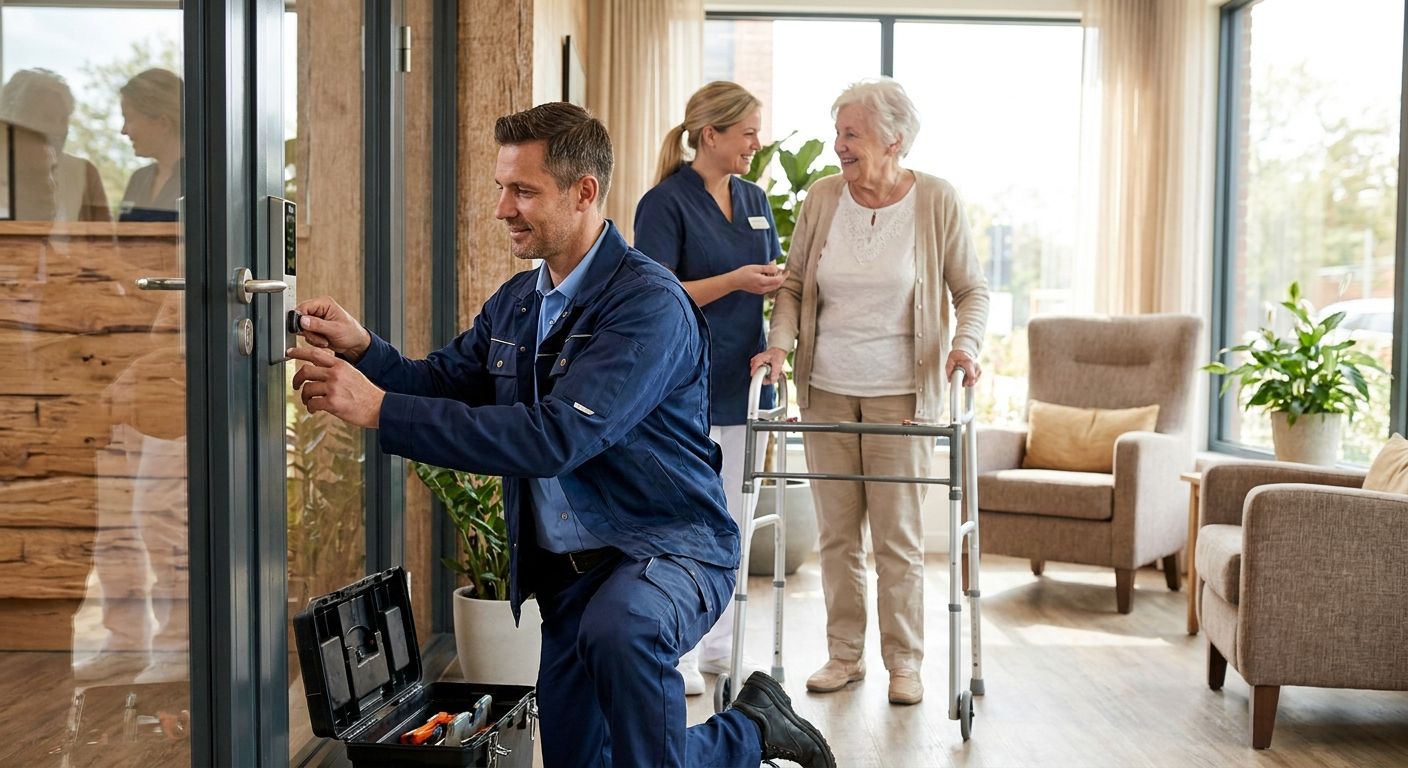
Best overall for assisted living facilities in 2026: electronic access control systems, installed and managed by Apex Lock N Key across Middlesex County. Best for staff-only access across multiple wings: master key systems. Best for memory care life-safety compliance: delayed egress panic hardware. Best budget option for single-door retrofits: high-security mechanical deadbolts.
- Electronic access control is the best commercial locksmith for assisted living facilities that need a facility-wide entry log in 2026.
- Master key systems let RNs, aides, and housekeeping share tiered access without rekeying every door.
- Delayed egress hardware satisfies NFPA 101 life-safety code in memory care wings with a 15-30 second door hold.
- High-security mechanical deadbolts are the budget pick for single-door retrofits with no wiring required.
- Apex Lock N Key installs and services all four solutions 24/7 across Middlesex County, MA.
Why this matters
Assisted living facilities aren't offices with a deadbolt and a spare key under the mat. A single stuck door in a memory care wing is a life-safety issue, not an inconvenience, and Massachusetts licensing inspectors check hardware the same way fire marshals do.
Picking the wrong lock type creates two failure modes: residents get out when they shouldn't, or staff can't get in fast enough during a medical event. Apex Lock N Key works with facility administrators across Middlesex County to match hardware to the actual risk in each wing, not a one-size-fits-all lock package sold to every commercial building on the street.
The right answer usually isn't one product. It's a mix — one system on the front door, a different one on the medication room, and something simpler on the supply closet.
What makes the best commercial locksmith for assisted living facilities
- Life-safety code compliance — hardware that meets NFPA 101 delayed-egress and fire-door rules, not just a lock that closes.
- 24/7 response — a lockout or hardware failure at 2 a.m. still needs a licensed technician on-site fast.
- Healthcare-adjacent licensing and insurance — proof the locksmith can work inside a facility that houses vulnerable residents.
- Integration with existing systems — fire alarm ties, nurse call panels, and video intercoms need to work with the lock, not fight it.
- Staff-tiered access — RNs, aides, housekeeping, and outside contractors each need a different level of access, not one master key for everyone.
- Low disruption during installation — work scheduled around resident routines and medication rounds, not during them.
Commercial locksmith solutions for assisted living, at a glance
| Solution | Best for | Standout feature | Key limitation |
|---|---|---|---|
| Electronic Access Control | Facility-wide entry and exit control | Real-time audit trail on every door | Needs ongoing credential management |
| Master Key Systems | Staff access hierarchy across wings | One key tier opens multiple zones without rekeying everyone | Lost master key forces a full system rekey |
| Delayed Egress / Panic Hardware | Memory care wandering prevention | 15-30 second door hold buys staff response time | Must integrate with the fire alarm to stay code-compliant |
| Video Intercom Entry | Visitor and family screening | Staff verify and unlock remotely | Needs reliable power and network wiring |
| High-Security Mechanical Deadbolts | Budget retrofit for single doors | Pick- and bump-resistant, no batteries or software | No audit trail, no remote lockout |
| Biometric Locks | Medication rooms and records storage | Access log tied to one staff member's fingerprint | Higher cost per door; sensors need regular cleaning |
1. Electronic Access Control Systems: best commercial locksmith solution for facility-wide entry control
Electronic access control replaces individual keys with credentials — fobs, key cards, or PIN codes — tied to a central system that logs every door event. Apex Lock N Key installs and programs these systems on entry doors, medication rooms, and staff-only corridors across assisted living facilities in Middlesex County. The system scales as a facility adds wings, shifts, or contractors without touching the physical hardware.
Electronic access control pros:
- Every entry and exit gets a timestamp, useful during incident review or a state inspection
- Lost credentials get deactivated instantly instead of requiring a full rekey
- Staff can be added or removed from access lists in minutes, not days
Electronic access control cons:
- Depends on power and a working network connection
- Upfront installation costs more than mechanical locks
- Requires someone on staff to manage the credential list
Best for: facilities that need one system covering every door, wing, and shift. Verdict: Buy.
2. Master Key Systems: best commercial locksmith solution for staff access hierarchy across wings
A master key system uses a hierarchy of cut keys — grand master, master, and individual — so a director of nursing can open every door while a night aide only opens the ones assigned to their shift. Apex Lock N Key designs these systems for multi-wing assisted living buildings the same way it does for multi-unit apartment buildings, just adjusted for clinical access tiers instead of tenant units. No wiring, no software, no batteries to check during a shift change.
Master key system pros:
- No batteries, wiring, or software to maintain
- Staff already understand how keys work; no training curve
- Cheaper per door than electronic hardware
Master key system cons:
- No audit trail — a key doesn't log who used it or when
- A lost master key means recutting and rekeying the entire hierarchy
- Doesn't scale well if the facility later wants remote lockout capability
Best for: facilities that want simple, reliable staff access without electronics. Verdict: Buy for facilities on a hardware budget; skip if audit logs are required.
3. Delayed Egress and Panic Hardware: best commercial locksmith solution for memory care life-safety compliance
Delayed egress hardware locks an exit door for a set interval — typically 15 to 30 seconds under NFPA 101 — before it releases, giving staff time to intervene when a resident with dementia approaches an exit. Panic hardware on the same doors still allows immediate emergency egress the moment a fire alarm activates, which keeps the installation code-compliant instead of a liability waiting for an inspection.
Delayed egress hardware pros:
- Reduces wandering incidents in memory care wings
- Satisfies state licensing inspections that check exit hardware specifically
- Pairs with existing fire alarm systems for automatic release
Delayed egress hardware cons:
- Must be wired into the fire alarm panel; a standalone install fails inspection
- Requires periodic testing to stay compliant
- Not appropriate on every exit — some doors must remain immediate-release by code
“A memory care exit that fails delayed-egress testing during a state inspection is a licensing problem, not a maintenance ticket.”
Best for: memory care and dementia units required to prevent elopement without blocking fire egress. Verdict: Buy, and treat the fire alarm integration as non-negotiable.
4. Video Intercom Entry Systems: best commercial locksmith solution for visitor and family screening
A video intercom pairs a camera and speaker at the main entrance with a release button at the front desk or nursing station, so staff can see and talk to a visitor before unlocking the door. Apex Lock N Key installs these on main entrances the same way it does for commercial buildings that need controlled visitor flow, and it pairs cleanly with the access control system already on the door.
Video intercom pros:
- Staff screen visitors without leaving a desk or nursing station
- Deters unauthorized entry better than a buzzer with no camera
- Works alongside electronic access control on the same door
Video intercom cons:
- Needs reliable power and, on some models, network wiring
- Doesn't replace access control on interior doors
- Image quality and low-light performance vary by unit
Best for: main entrances where staff need to see who's asking to come in before buzzing them through. Verdict: Buy for front-door coverage.
5. High-Security Mechanical Deadbolts: best budget commercial locksmith solution for single-door retrofits
High-security mechanical deadbolts use pick- and bump-resistant cylinders on doors that don't need an audit trail — think a supply closet, a maintenance room, or a single side entrance. Apex Lock N Key installs these as high-security lock upgrades on doors where electronics aren't worth the added cost.
High-security deadbolt pros:
- No batteries, wiring, or software to fail
- Lowest cost per door among the options here
- Easy to service or rekey on a standard locksmith visit
High-security deadbolt cons:
- No log of who used the door or when
- No remote lockout if a key goes missing
- Doesn't scale to facility-wide access management
Best for: low-traffic doors that need hardened security without the overhead of a system. Verdict: Buy for supplementary doors; hold off using it as a facility-wide solution.
6. Biometric Locks: best commercial locksmith solution for medication rooms and high-security storage
Biometric locks use a fingerprint or similar credential to open a door, tying every entry to a specific person instead of a card that can be shared or lost. In assisted living settings, they typically go on medication rooms, narcotics cabinets, and records storage where regulators expect a tighter access record than a standard key provides.
Biometric lock pros:
- Access ties directly to an individual, not a shareable credential
- Hard to duplicate or lend to someone else
- Works well combined with a broader access control system
Biometric lock cons:
- Higher cost per door than card-based access control
- Sensors need regular cleaning in a clinical environment
- A cut or bandaged finger can cause read failures
Best for: the handful of doors where the facility needs the tightest possible access record. Verdict: Buy for medication and narcotics storage; skip it for general staff doors.
Get Your Facility Security Assessed
Licensed, insured 24/7 commercial locksmith service in Middlesex County, MA.
How we ranked these solutions
Each option above gets measured against the six criteria listed earlier: life-safety code compliance, 24/7 response, healthcare-adjacent licensing, system integration, staff-tiered access, and low-disruption installation. Electronic access control and delayed egress hardware score highest because they're the two categories Massachusetts licensing inspectors check first. Master key systems and mechanical deadbolts rank lower on integration and audit trail but stay in the mix because not every door in a facility needs the same tier of security.
Which commercial locksmith solution should you choose for your assisted living facility?
If you're deciding between one system for the whole building, start with electronic access control — it covers the audit trail requirement that shows up in almost every licensing review, and it scales as the facility adds wings or staff. Layer delayed egress hardware onto memory care exits specifically, and put a biometric lock on the medication room door. Everything else — master keys, mechanical deadbolts, video intercoms — fills in the doors that don't need the top-tier system.
Apex Lock N Key installs and services all of these as a licensed commercial locksmith for assisted living facilities across Middlesex County, and a walk-through of the building is the fastest way to find out which doors need which hardware in 2026.
FAQ
What's the best commercial locksmith for assisted living facilities in Middlesex County?
Electronic access control is the best overall commercial locksmith solution for assisted living facilities because it logs every door event and scales across wings. Apex Lock N Key installs and services these systems along with master keys, delayed egress hardware, and biometric locks for facilities across Middlesex County.
Is electronic access control better than a master key system for a nursing wing?
Electronic access control wins on audit trail and instant credential changes; master key systems win on simplicity and lower upfront cost. Facilities that need to log who opened which door should choose electronic access control over a master key system.
How does delayed egress hardware work in memory care units?
Delayed egress hardware holds an exit door closed for 15 to 30 seconds under NFPA 101 before it releases, giving staff time to intervene with a wandering resident. Panic hardware on the same door still allows instant egress if the fire alarm activates.
Do assisted living facilities need panic hardware by law?
Life-safety codes such as NFPA 101 require specific egress hardware on fire exits in licensed care facilities, and inspectors check this during licensing reviews. The exact hardware required depends on the door's function and the facility's occupancy classification.
How much does it cost to install access control in an assisted living facility?
Cost depends on the number of doors, whether wiring already exists, and which hardware brand is specified. Request a walk-through quote from a licensed commercial locksmith to get an exact number for your building.
Can biometric locks be installed on medication room doors?
Yes, biometric locks work well on medication rooms and narcotics storage because they tie every entry to a specific staff member's fingerprint rather than a shareable card or key. They cost more per door than card-based access control.
What happens if a master key is lost in a multi-wing facility?
A lost master key typically forces a rekey of every lock in that key's hierarchy, not just the one door. This is the main tradeoff facilities accept when they choose a master key system over electronic access control.
How fast can a locksmith respond to a lockout at an assisted living facility?
Apex Lock N Key operates a 24/7 mobile locksmith service across Middlesex County, so lockouts affecting resident or staff access get a same-visit response regardless of the hour.
One last thing
The door most facilities forget to upgrade is the one between the kitchen and the dining room. It's not a resident exit, so it gets skipped during security planning, but it's often the door staff prop open during meal service — which defeats every other access control decision made for the building. Check that door specifically before signing off on any new system in 2026.


