
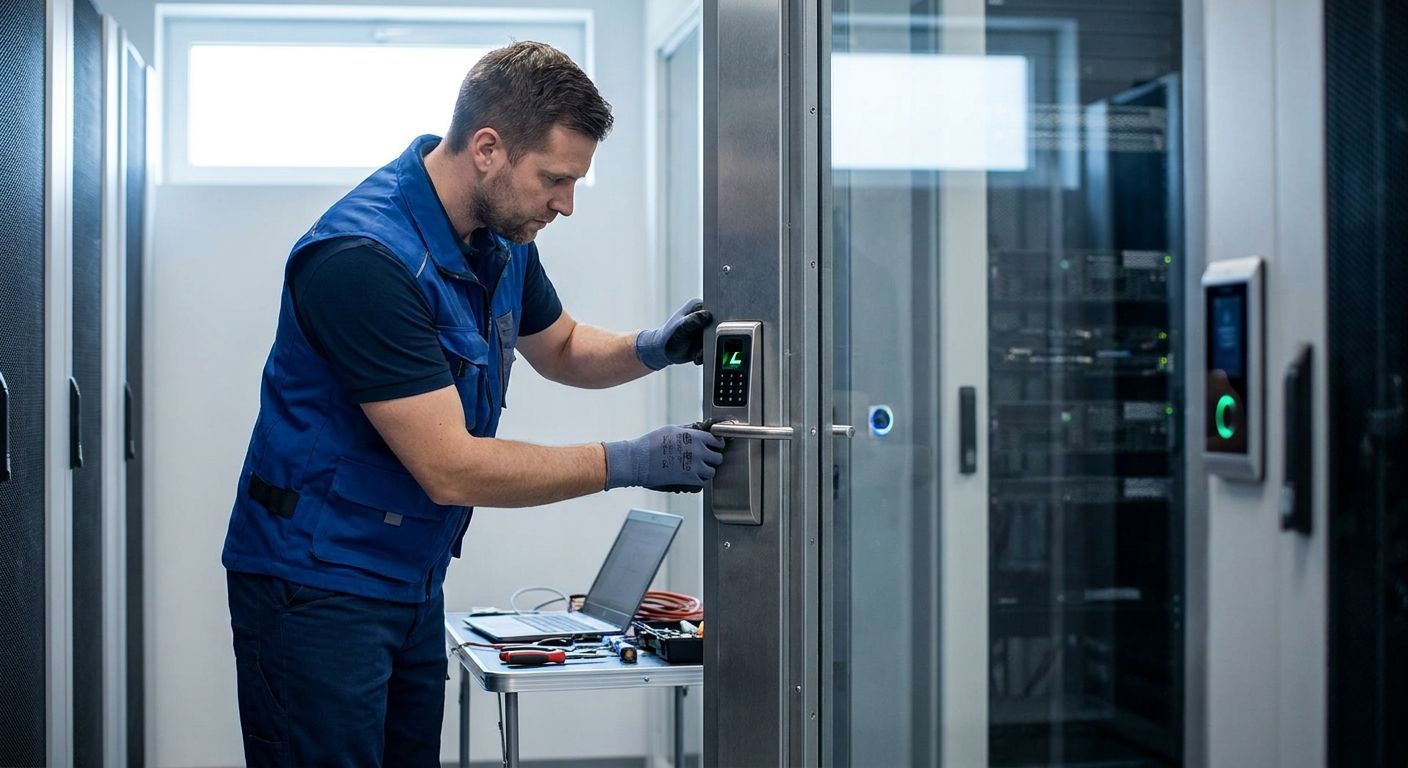
Biometric lock installation for high-security facilities means matching fingerprint, palm, or facial-recognition hardware to the specific risk profile of a medical office, law firm, warehouse, or server room — not just bolting a fingerprint reader onto whatever door happens to need it. Get the match wrong and you end up with a locked-out staff and an audit trail full of gaps.
- Biometric lock installation works best when paired with a PIN or badge as backup — never as the only credential.
- Medical and dental offices need audit-logged access control; Apex Lock N Key builds that in from day one. Buy.
- Cloud-only biometric systems without local fallback fail during outages — Skip for facilities that cannot afford downtime in 2026.
- Fingerprint-only smart locks sold for home use lack the audit trail high-security facilities need. Skip.
- Warehouses with multiple loading docks need centralized management, not standalone readers per door. Consider.
Why this matters
A standard deadbolt tells you a door was locked. It doesn't tell you who opened it, when, or whether they were supposed to be there. High-security facilities — medical practices with controlled-substance cabinets, law firms with client files, warehouses moving inventory around the clock — need that second piece of information as much as the lock itself.
Biometric lock installation solves that by tying a physical identity (fingerprint, face, palm) to every access event. In 2026, that data matters more than ever for insurance audits, compliance reviews, and simple liability after a break-in. Apex Lock N Key installs and services this hardware across Middlesex County, Massachusetts, and the calls that come in after a bad install almost always trace back to the same handful of mistakes.
Who this is for
This guide is for facility managers, office administrators, and business owners responsible for securing a space where a lost key or a shared code isn't good enough — medical and dental practices, law firms, warehouses, and multi-tenant commercial buildings where regulators, insurers, or clients expect a documented access trail. If your current security is a single master key passed between employees, biometric lock installation is the next step up, not the last one.
What to look for in biometric lock installation for high-security facilities
Access logs and audit trails
A biometric reader that doesn't log who accessed what and when defeats the point of installing one. For medical offices and law firms, the audit trail is often the actual compliance requirement — the fingerprint is just the mechanism that generates it.
Fail-safe vs. fail-secure operation
High-security doors on fire-rated exit paths must fail safe (unlock) during a power loss so people can get out; storage rooms and file vaults often need to fail secure (stay locked). Getting this backwards is a life-safety code violation, not a preference.
Multi-factor stacking
Biometric-only entry is easier to spoof than most facility managers assume — a lifted print or a printed photo can beat a cheap sensor. Stacking a fingerprint or face scan with a PIN or badge cuts that risk sharply and is standard practice for enterprise-grade installs in 2026.
Enrollment and template management
Someone has to add and remove employees from the system as staff turns over. A facility with 40 employees and no central management console means someone re-enrolling fingerprints by hand every time a hire or termination happens.
Backup access and mechanical override
Sensors fail — cold fingers, dirty glass, a bandaged hand. Every biometric install for a high-security facility needs a backup PIN (typically 4 to 8 digits) or a physical key override that doesn't defeat the security the biometric layer was supposed to add.
Licensed installation and local response
Biometric hardware wired into a commercial door involves the same door prep, strike alignment, and access-control installation work as any electronic lock — done wrong, the sensor is the least of your problems. A licensed, insured installer who can respond locally matters more here than brand name on the reader.
Get a biometric access assessment
Apex Lock N Key evaluates your doors before recommending hardware.
Top picks by facility type
Medical and dental offices — the compliance pick. Controlled-substance storage and patient record rooms need per-person audit logs, not a shared code. A fingerprint-plus-PIN setup on the medication room and record archive covers both entry points that matter most. Facilities in this category should pair biometric readers with the access-control work covered on the medical and dental office locksmith page. Buy.
Law firms and professional offices — the confidentiality pick. Client file rooms and partner offices benefit from logged, individual access rather than a master key that every associate carries. Facial-recognition or fingerprint readers on file rooms, standard electronic locks elsewhere, keeps cost proportional to risk. See how this fits into a broader setup on the law firm and professional office locksmith page. Buy.
Warehouses and distribution centers — the perimeter pick. Multiple loading docks and after-hours shift changes make standalone door-by-door readers a management headache. A centralized system that logs every dock door beats five disconnected fingerprint units that nobody checks. Consider — worth the investment only once dock count and shift volume justify centralized management.
Retail stockrooms and back offices — the budget-conscious pick. A single stockroom door with low staff turnover rarely needs full biometric infrastructure; a quality electronic deadbolt with individual codes often covers the same risk at a fraction of the install complexity. Skip biometric here unless the stockroom holds high-value inventory.
What to avoid
- Fingerprint-only smart locks marketed for residential use. They skip the audit-log and multi-factor features that make biometric installation worthwhile for a business, and most can't integrate with a facility-wide access-control system.
- Cloud-only biometric systems with no local database. If the internet connection drops, staff get locked out of their own building. High-security facilities need a system that authenticates locally even when the network doesn't cooperate.
- Standalone battery keypads relabeled as "biometric." Some products bolt a low-grade fingerprint sensor onto a basic keypad with no logging and no central management — read the spec sheet before assuming a fingerprint icon means enterprise-grade security.
Verdict comparison table
| Facility type | Primary risk | Recommended stack | Backup access | Verdict |
|---|---|---|---|---|
| Medical/dental office | Controlled substances, patient records | Fingerprint + PIN, logged | 4-8 digit PIN | Buy |
| Law firm/professional office | Client confidentiality | Fingerprint or face + badge | Key override | Buy |
| Warehouse/distribution center | Multiple entry points, shift turnover | Centralized biometric + badge | Master key | Consider |
| Retail stockroom | Inventory shrink | Electronic deadbolt with codes | Key override | Skip biometric |
Enterprise-grade fingerprint sensors commonly publish false-acceptance rates under 0.001% — a meaningful gap over the consumer-grade sensors sold in most residential smart locks, and one reason the hardware choice matters as much as the installation itself.
FAQ
What is biometric lock installation for high-security facilities?
It's the process of fitting fingerprint, palm, or facial-recognition readers to commercial doors, wired into an access-control system that logs every entry. High-security facilities use it to replace shared keys and codes with individually traceable access.
How much does biometric lock installation cost in 2026?
Cost depends on door count, hardware tier, and whether the building needs new wiring or an upgrade to existing access control. Apex Lock N Key evaluates each facility on-site before quoting, since a single-door retrofit and a multi-door enterprise system are not comparable jobs.
Is biometric lock installation better than keycard access control?
Biometric access removes the risk of a lost or shared keycard, since a fingerprint or face can't be handed to someone else. Most high-security facilities in 2026 combine both — biometric for sensitive rooms, badges for general staff areas.
Do biometric locks work during a power outage?
A properly installed system has a battery backup or fail-safe wiring that keeps critical doors operational, and fire-rated exit doors must unlock automatically during a power loss. This is a code requirement, not an optional feature, and it needs to be specified before installation.
Are fingerprint locks secure enough for a law firm or medical office?
Enterprise-grade fingerprint readers are secure enough when paired with a PIN or badge as a second factor and backed by an audit log. Fingerprint-only consumer smart locks are not the same product and shouldn't be treated as equivalent for a compliance-sensitive space.
How long does biometric lock installation take?
A single-door install is typically a same-day job once hardware is on hand; multi-door systems with centralized management take longer because of wiring and enrollment. Apex Lock N Key schedules an on-site assessment first to give an accurate timeline.
What happens if the biometric sensor fails to recognize someone?
Every properly designed system includes a backup credential, usually a 4 to 8 digit PIN or a physical key override, so a dirty sensor or a bandaged finger doesn't lock an employee out. A system without this fallback is a design flaw, not a feature.
Can biometric locks integrate with an existing video intercom system?
Most enterprise-grade biometric readers integrate with video intercom and access-control platforms already installed in a building, which is why the door hardware and the reader should be specified together rather than purchased separately.
One last thing
The part of biometric lock installation that fails most often isn't the sensor — it's the door behind it. A fingerprint reader wired into a hollow-core door with a residential-grade strike plate gives up before the sensor ever does, no matter how good the false-acceptance rate on the spec sheet looks. Get the door hardware and frame reinforced first in 2026, then add the biometric layer on top of it.


