
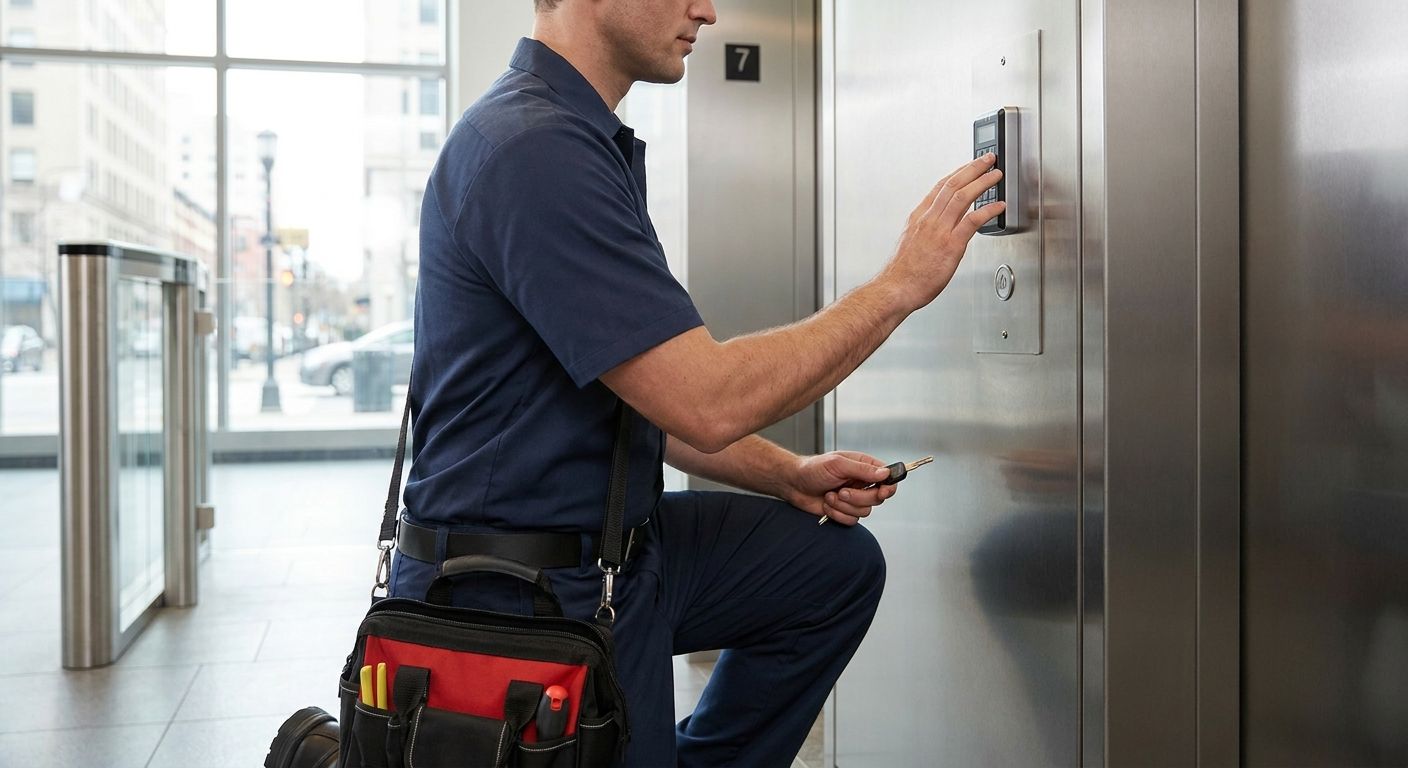
Elevator lock service for commercial building owners covers fire service key control, key-switch repair or replacement, lockout devices for restricted floors, and integration with the building's card or keypad access system. Unlike a single-tenant office door, an elevator lock touches life-safety code, multiple tenants, and first-responder access all at once.
- Apex Lock N Key handles elevator lock service across Middlesex County, MA, covering fire service key switches through full access control integration in 2026.
- Worn Fire Service Phase I and II key switches are the top cause of elevator lockouts commercial buildings report — test them on a schedule, not after a failure.
- Mechanical key switches alone don't log who used the elevator after hours; card or fob integration does.
- Rekey elevator lobby and mechanical room doors every time a tenant with elevator-level access moves out.
Why elevator lock service matters for commercial building owners
A broken elevator key switch does not just strand a tenant on the fourth floor. It creates a fire-code problem the moment an inspector or fire marshal tests Fire Service Phase I recall and the key won't turn cleanly. Commercial building owners and the property management companies that run day-to-day operations answer for that gap, not the elevator manufacturer.
Multi-tenant buildings add a second problem: floor restriction. An elevator that lets any visitor ride to every floor after 6pm is an access control failure, not a lock failure. Elevator lock service in 2026 covers both — the mechanical key switch fire crews use and the card or keypad restriction that keeps tenants off floors they don't lease.
Audit your elevator key control setup
Start with a walk-through, not a work order. Most buildings that call for emergency elevator lockout service in 2026 skip the audit and pay for a rush visit instead.
- Pull the current key list and cross-reference it against active tenants and staff
- Test the Fire Service Phase I key switch at the lobby car call station
- Check for a Phase II key switch inside the cab, required for firefighter operation once inside
- Inspect the key switch cylinder for play, sticking, or a key that needs more than one try to turn
- Confirm the elevator mechanical room door lock matches the building's master key system
- Note which vendor last serviced the elevator controller and whether locksmith work was ever documented separately from the elevator contract
Replace or rekey worn elevator key switches
A key switch that needs jiggling is a switch that will fail during an inspection or a real fire call.
- Rekey the switch cylinder to match your current master key system instead of issuing a stand-alone key
- Replace the cylinder outright if the cam shows wear from years of key insertion
- Match switch hardware to the elevator manufacturer's fire service listing — a mismatched switch can void the inspection
- Log the rekey date so the next tenant turnover doesn't trigger a duplicate service call
- Test the switch under load, with the car running, not just at rest
Set fire service key protocols for Phase I and II
Building and fire codes require elevators to support Fire Service Phase I and II key-operated recall so first responders can take manual control during an emergency. Getting this wrong is a liability problem, not a convenience problem.
- Store a labeled fire service key in a lockbox accessible to first responders, per your local fire department's requirement
- Train building staff and fire wardens on where the Phase I switch sits and how recall works
- Coordinate with the fire department during annual elevator inspection so the key is tested under real conditions
- Keep a spare key secured off-site or with property management in case the primary is lost
- Document every person who holds a fire service key, and update the list every time staff changes
“If the fire department can't turn the key on Phase I recall, the elevator becomes a liability instead of an evacuation tool.”
Integrate elevator access with your building's card or keypad system
Mechanical fire service keys and everyday floor access are two different problems. Access control installation at the elevator level restricts which floors a card or fob can reach, on top of the fire override that never changes.
- Program floor restriction by tenant, not by building, so a fourth-floor lease can't reach the sixth floor after hours
- Sync elevator readers with your existing keypad or fob system instead of running a second, separate credential
- Set different access windows for cleaning crews, deliveries, and after-hours staff
- Pull access logs monthly and flag any card used outside its assigned floor range
- Test the override that lets fire service recall bypass floor restriction entirely during an alarm
Add lockout devices for restricted floors and off-hours
Card restriction handles who gets a floor. A lockout device handles the floor itself when it needs to go fully dark.
- Install a hall call disable switch for floors under construction, in a data room, or unoccupied post-move-out
- Use a keyed hall lantern lockout for floors leased but not yet fitted out
- Combine mechanical lockout with the card system so a lost fob can't override a disabled floor
- Test the lockout monthly — a device that's sat idle for a year sometimes won't re-engage cleanly
Coordinate elevator lock service with your rekey and turnover schedule
Elevator access should move on the same schedule as your building's lock changes, not a separate one.
- Rekey lobby, mechanical room, and elevator machine room doors every time a tenant with elevator-level access vacates
- Update floor restriction the same day a lease ends, not at the next scheduled service visit
- Bundle elevator lock service with your regular commercial locksmith visit instead of scheduling it separately
- Keep one key control log for the whole building, elevator included, instead of a separate spreadsheet per system
Choose high-security cylinders for lobby and mechanical room doors
The elevator machine room and the lobby key switch box are two of the most overlooked doors in a commercial building, and standard pin tumbler cylinders on either one make bumping and picking easy. High-security lock brands resist bumping, drilling, and unauthorized key duplication far better than hardware-store cylinders.
- Upgrade the mechanical room door to a restricted keyway cylinder that can't be copied at a hardware store
- Match the lobby key switch box lock to the same restricted system as the rest of the building
- Request key control cards for any restricted cylinder so duplicates require signed authorization
- Confirm the cylinder is rated for commercial cycle counts, not residential-grade hardware
Document, test, and schedule ongoing maintenance
An elevator lock system that isn't tested is a system you're guessing about.
- Set a semiannual test for Phase I and Phase II key switches, timed with elevator inspection when possible
- Keep a single access log covering card, keypad, and mechanical key holders
- Re-audit floor restrictions any time a tenant expands, contracts, or subleases space
- Schedule elevator lock service with a licensed commercial locksmith who can handle both the mechanical switch and the access control side
Elevator access options for commercial buildings, compared
| Option | Best for | Key limitation |
|---|---|---|
| Mechanical fire service key switch | Every commercial elevator, code compliance | No usage log; key can be lost or copied |
| Keypad floor restriction | Small buildings without a card system in place | Codes get shared between tenants over time |
| Card or fob floor restriction | Multi-tenant buildings already using fob access elsewhere | Needs integration work with the elevator controller |
| Biometric floor access | High-security floors, data rooms, executive suites | Higher setup effort; not needed for most tenant floors |
Get elevator lock service scheduled
Licensed, 24/7 commercial locksmith coverage across Middlesex County, MA.
Common mistakes commercial building owners make with elevator locks
- Treating the elevator key switch as a maintenance item instead of a life-safety component that needs the same audit trail as a fire panel
- Letting the elevator vendor's service contract cover the mechanical key while nobody tracks who actually holds a copy of it
- Restricting floor access by building instead of by tenant, so every fob can ride to every floor regardless of lease
- Skipping the rekey when a tenant moves out because the lease never mentioned the elevator specifically
- Assuming Phase I and Phase II testing during elevator inspection also verifies the physical key switch hardware — inspectors test function, not whether the cylinder is worn
FAQ
What is elevator lock service?
Elevator lock service covers the fire service key switches, mechanical room door locks, and lockout devices tied to an elevator, plus any integration with the building's card or keypad access control. It's separate from elevator mechanical repair, which is handled by the elevator company.
How much does elevator lock service cost?
Cost depends on the building's size, the number of key switches, and whether access control integration is involved. Request a quote from a licensed commercial locksmith after describing the scope rather than estimating from a general number.
What is Fire Service Phase I and Phase II?
Phase I is the lobby-level key switch that recalls the elevator to a designated floor during a fire alarm. Phase II is the key switch inside the cab that lets firefighters take manual control once the car has been recalled.
How often should elevator key switches be tested?
Test Fire Service Phase I and II switches at least twice a year, ideally timed with the elevator's scheduled inspection. A switch that sits untested for a year is more likely to stick or fail when it's actually needed.
Can elevator access be restricted by floor?
Yes. Card, fob, or keypad systems can restrict which floors a credential reaches, separate from the mechanical fire service override that always allows full access during an emergency.
Do all commercial elevators need a fire service key?
Commercial elevators are generally required to support Fire Service Phase I recall under building and fire code. Confirm the specific requirement with your local fire department and elevator inspector, since local enforcement varies.
Is elevator lock service different from a regular commercial locksmith visit?
It overlaps but isn't identical. A standard commercial locksmith visit covers doors and access control; elevator lock service adds the fire service key switch and mechanical room lock, which need code-specific handling.
Who should hold the fire service key for a commercial building?
A small, documented list of building staff and fire wardens, with a labeled key also accessible to first responders in a lockbox per local fire department requirements. Fewer holders means fewer lost or copied keys.
One last thing
The mechanical room door gets forgotten more than any other door in the building. It sits behind the elevator, out of daily traffic, and most walkthroughs never open it — but that door protects the elevator controller itself. Anyone who gets a key or picks that lock can disable the elevator or interfere with safety circuits. Put it on the same rekey schedule as the lobby in 2026, not on a separate list nobody checks.


