
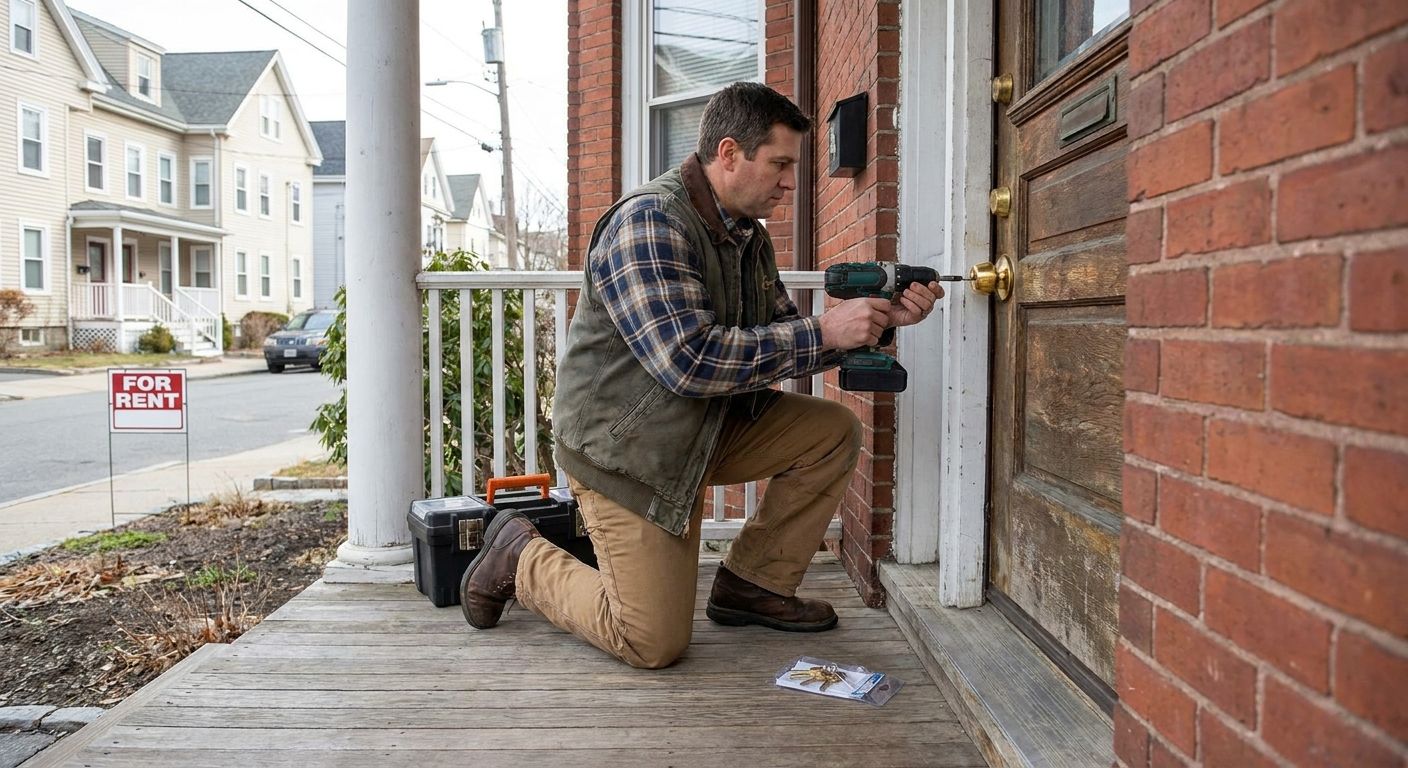
Massachusetts landlords can only change locks after an eviction once a court-issued execution for possession has been physically enforced by a sheriff or constable and the unit is fully vacated — never before. Skip that step and you've committed a self-help eviction, which is illegal under Massachusetts law even after you've won the case.
- Change locks after eviction in Massachusetts only once the sheriff's execution is enforced — not on judgment day.
- Self-help eviction (changing locks before enforcement) violates M.G.L. c. 184, §18 in Massachusetts.
- Apex Lock N Key rekeys every exterior lock for landlords across Middlesex County the same day the unit clears in 2026.
- Rekeying costs less than full replacement and works for most standard tenant turnovers in 2026.
- Multi-unit buildings often need the master key system updated, not just the individual unit lock.
Why this matters
Landlords who jump the gun on lock changes expose themselves to real legal risk, not just an angry tenant. A tenant locked out before the sheriff executes the judgment can sue for illegal eviction, and Massachusetts courts have sided with tenants in exactly this scenario for decades. The judgment date and the execution date are two different dates, and only the second one lets you touch the locks.
Once the unit is actually empty, changing locks isn't optional from a security standpoint. A former tenant still holds a working key to your property until you rekey it for the next tenant, and that's true whether the eviction was contested or the tenant simply skipped town.
How to change locks after evicting a tenant in Massachusetts
Follow these steps in order — skipping ahead is what creates legal exposure:
- Confirm the execution has issued. The court clerk's office or your attorney confirms the execution for possession is active; a judgment alone does not authorize a lockout.
- Wait for the sheriff or constable to complete the physical move-out. Only a sheriff or constable can lawfully remove a tenant in Massachusetts — landlords cannot do this themselves.
- Verify the unit is fully vacated. Walk through with the constable's paperwork in hand; note the date and time for your records.
- Call a licensed locksmith to rekey or replace every exterior lock. Don't stop at the front door — side entries, garage service doors, and basement bulkheads all need new key control.
- Photograph the completed lock change with a timestamp, in case the eviction is later disputed.
- Handle any property left behind according to Massachusetts rules for abandoned tenant belongings before you dispose of anything.
Most single-family rentals in Middlesex County have two to three exterior entry points that need new cylinders, and each one should get the same key so the new tenant isn't juggling separate keys for the same house.
Rekeying vs. replacing locks after eviction
| Option | What it does | Best for |
|---|---|---|
| Rekeying | Reuses existing hardware, changes the pin configuration so old keys stop working | Locks under 10 years old with no visible damage — Best for standard turnovers |
| Full replacement | Swaps the entire lock body and cylinder | Damaged, drilled, or outdated hardware, or an upgrade to a higher security grade — Best for units with forced-entry damage |
Rekeying is the faster, lower-cost path for a routine turnover where the door hardware is intact. Full replacement makes more sense when the former tenant damaged the lock on the way out, or when you're using the vacancy as a chance to move to better hardware. Read the full breakdown in choosing between rekeying and replacing a lock before you decide.
Why timing varies from one eviction to the next
- Court backlog — the gap between judgment and execution can stretch depending on the county docket.
- Sheriff or constable scheduling — enforcement dates depend on their calendar, not yours.
- Whether the tenant appeals or files a stay — either can pause the execution even after it issues.
- Number of doors and hardware type — a single-family rental takes far less time than a multi-unit building.
- Whether it's a multi-unit property — buildings on a shared master key system need the whole system re-keyed, not just one unit's lock, so the old key can't open any door in the building.
- Property left behind — landlords generally can't dispose of a tenant's belongings on their own schedule; that adds a step before the unit is truly ready to turn over.
If you manage a building with a shared key system, coordinate the eviction lock change with an update to the master key system for the whole building — otherwise the departed tenant's key may still open common areas even after their unit is rekeyed.
“If the sheriff hasn't executed the eviction yet, changing the locks is illegal — not a gray area.”
Can a landlord change locks before an eviction is finalized in Massachusetts?
No — changing locks before the sheriff or constable executes the court order is illegal in Massachusetts, regardless of how strong the landlord's case is. This is called a self-help eviction, and it can expose the landlord to tenant lawsuits even after winning the underlying case.
What happens to a tenant's belongings left in the unit?
Landlords generally can't just throw out or sell a former tenant's belongings the moment the locks change. Photograph and document what's left behind and follow Massachusetts guidance on abandoned tenant property before disposing of anything, since mishandling it can create a separate legal problem on top of the eviction itself.
How soon can locks be changed after the sheriff completes the eviction?
Locks can be changed immediately once the sheriff or constable confirms the physical move-out is complete in 2026 — there's no mandatory waiting period after that point. Most landlords schedule the locksmith for the same day as the enforcement to close the security gap as fast as possible.
FAQ
Can a landlord change locks before an eviction is finalized in Massachusetts?
No, changing locks before the sheriff or constable executes the court order is illegal in Massachusetts. This applies even after a landlord wins the underlying eviction case in court.
Is it legal to lock out a tenant without a court order in MA?
No, locking out a tenant without a court-ordered execution is a self-help eviction and it's illegal under Massachusetts law. Landlords who do this can face tenant lawsuits regardless of the reason for the eviction.
What happens to a tenant's belongings left behind after an eviction?
Landlords can't simply dispose of belongings left in the unit the moment locks change. Massachusetts has specific rules for handling abandoned tenant property that landlords should follow before removing or discarding anything.
Should I rekey or fully replace locks after an eviction?
Rekey the existing hardware if the locks are under 10 years old and undamaged; replace the locks if there's forced-entry damage or you're upgrading security. Rekeying is faster and reuses the current lock body.
How much does it cost to rekey a rental unit in 2026?
Cost depends on the number of locks and the hardware grade involved in 2026. Check the current locksmith cost guide for a rekey-versus-replace price comparison before booking.
Do multi-unit buildings need a new master key after an eviction?
Yes, if the building uses a shared master key system, the whole system should be updated, not just the vacated unit. Otherwise the former tenant's key may still open common doors.
What if the former tenant kept a copy of the key?
Rekeying makes any copy the former tenant kept useless, since the internal pin configuration changes even though the lock body stays the same. This is the main reason to rekey every unit between tenants, not just the ones where a key was reported lost.
How fast can a locksmith rekey a house after an eviction?
A licensed locksmith can typically rekey all the exterior doors on a single-family rental in one visit the same day the unit clears in 2026. Multi-unit buildings with shared master key systems take longer since every door on the system needs updating.
Rekey the unit before the next tenant moves in
Licensed, same-day rekeying for landlords across Middlesex County.
One last thing
The part landlords miss most often isn't the lock change — it's the paperwork trail. Photographing the completed rekey with a timestamp, and keeping the constable's move-out confirmation on file, is the single cheapest way to shut down a former tenant's claim that they were locked out illegally. If you manage several rental properties, it's worth pairing every eviction lock change with a call about emergency locksmith support for tenant lockouts so you have one number to call for both the planned turnover and the surprise 2 a.m. call. And before you book anything, check current pricing against the locksmith cost guide for rekeying a house so there's no surprise on the invoice.


