
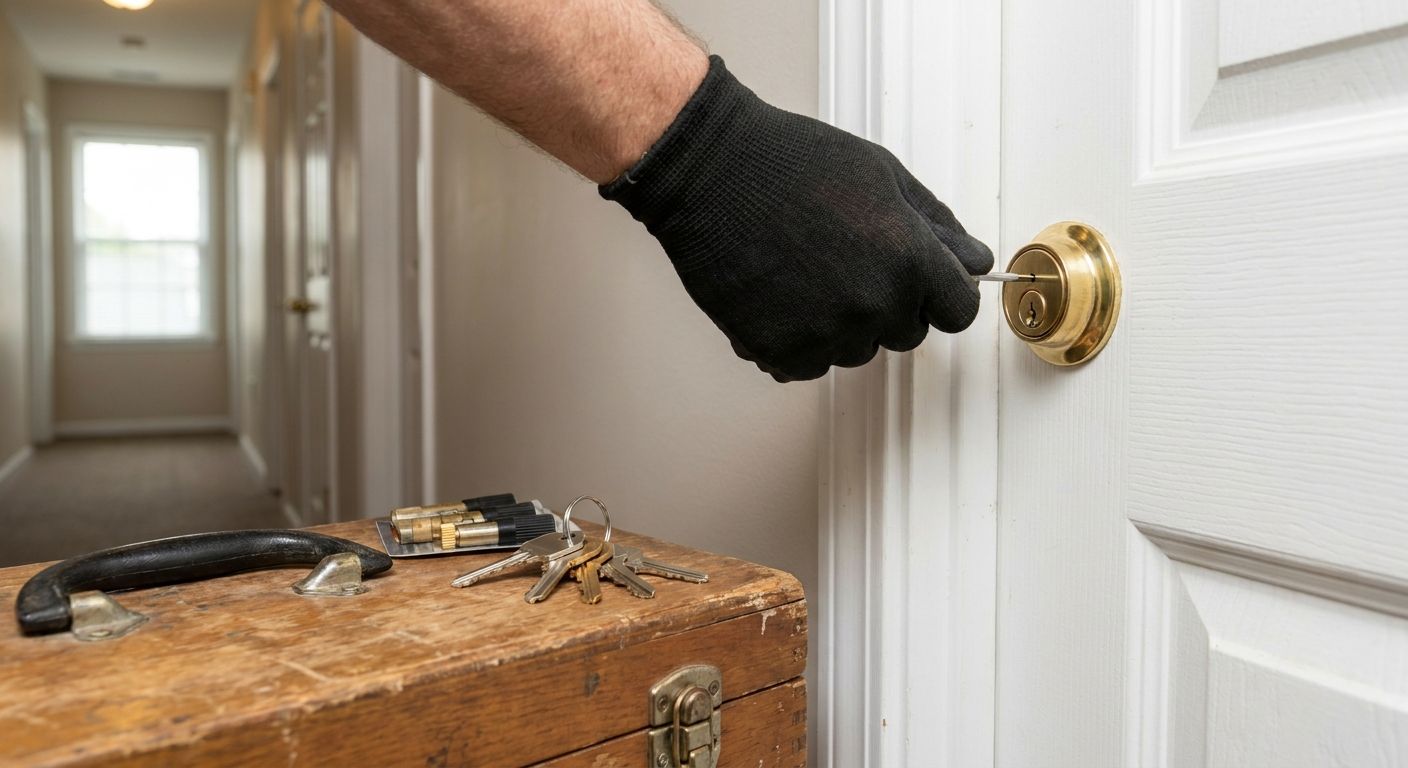
Turning over a rental unit without rekeying the locks is a liability landlords in Middlesex County can't afford in 2026 — a former tenant, contractor, or dog walker could still hold a working key. This guide breaks down what actually matters when you rekey locks between tenants, what to skip, and which service tier fits your property size.
- Standard pin-tumbler rekey runs 15-20 minutes per door and costs less than full cylinder replacement — the default move between tenants.
- Master key systems pay off once you manage 4+ units, cutting keyring chaos for maintenance staff.
- Electronic deadbolts eliminate physical keys entirely, useful for landlords who churn tenants often.
- Skip DIY rekey kits on multi-unit buildings — one miscut pin locks out the next tenant on move-in day.
- Apex Lock N Key rekeys same-day in most Middlesex County jobs when scheduled ahead of a lease turnover.
Why this matters
A lease ending doesn't erase every copy of the key that's floating around. Former tenants, roommates who moved out mid-lease, cleaning crews, and even a prior owner's contractor can hold a working copy years later. Rekeying between tenants resets who has access without the cost of replacing hardware — the lock body stays, the internal pins change.
For landlords managing more than one door, the math changes fast. A single-family rental might need one rekey. A 12-unit building needs a system that doesn't require the property manager to carry two dozen loose keys. That's where the decision moves from "call a locksmith" to "pick the right access setup."
Who this is for
This guide is built for landlords and property managers handling turnover on single-family rentals, duplexes, or small-to-mid-size apartment buildings in Massachusetts — anyone who needs a repeatable process for securing a unit between one tenant moving out and the next moving in, without paying for a full lock replacement every time.
What to look for in rekeying between tenants
Turnaround speed
A vacant unit sitting unsecured for days is money lost and a liability if anyone re-enters before the new lease starts. Same-day or next-day rekeying between the move-out inspection and the new tenant's key handoff keeps the unit locked down the entire gap. Confirm the locksmith can schedule around your actual lease dates, not just "this week."
Cost per door at scale
One rekey on a single-family home is a flat visit. A 20-unit building is a volume job, and pricing should reflect that — per-door rates should drop as the count goes up. Ask for a multi-unit quote before assuming the per-door price scales linearly; it usually doesn't once a locksmith is already on-site for the whole building.
Compatibility with existing hardware
Rekeying only works if the lock cylinder itself is in decent shape — worn or damaged cylinders sometimes need full replacement instead. A locksmith should check hardware condition on the walkthrough, not assume every deadbolt on the property takes a standard rekey.
Key control and duplication risk
Standard hardware-store keys get duplicated at any kiosk for a few dollars. If you've had tenant turnover issues before — subletting, unauthorized copies — restricted keyway systems that can't be duplicated without your authorization close that gap for good.
Scalability across the portfolio
If you manage more than one property, a master key system lets maintenance staff carry one key for common access while each unit keeps its own tenant-specific key. This matters more every year you add doors — retrofitting it later costs more than building it in during a turnover cycle.
Documentation and paper trail
A rekey record — date, unit, who was on-site — protects you if a security dispute comes up later. Ask whether the locksmith provides a service record for your files; it's the kind of thing that matters in a security deposit dispute, not on move-in day.
Schedule a turnover rekey
Get same-day rekeying between tenants across Middlesex County, MA.
Top picks for landlords between tenants
The default move — Standard pin-tumbler rekey
The hardware stays, the pins inside get swapped, and every old key stops working. This is the right call for the vast majority of single-family and small multi-family turnovers, and it typically takes 15-20 minutes per door on-site. Verdict: Buy — this is the baseline every landlord should be doing between every tenant, no exceptions.
The upgrade — Full cylinder replacement
When a lock is worn, damaged, or was never rekeyable to begin with, the whole cylinder gets swapped instead of just the pins. It costs more than a standard rekey but resolves hardware issues a rekey alone can't fix. Verdict: Consider — reserve this for units where the lock itself failed an inspection, not as a default across the portfolio.
The scale play — Master key system
One key opens every unit for maintenance and management, while tenants keep unit-specific keys that don't open anyone else's door. This is built for multi-unit buildings — property managers juggling 20+ keys on a ring lose time and risk mislabeling. Verdict: Buy for any portfolio at four units or more; Skip for a single duplex where a master system adds cost without solving a real problem.
The tech pick — Electronic deadbolt
Code-based entry eliminates the physical key entirely — reset the code between tenants instead of scheduling a locksmith visit at all. Electronic deadbolts run on batteries that typically last 6-12 months depending on use, and installation is comparable in time to a standard deadbolt swap. Verdict: Consider for landlords who churn tenants frequently and want to cut the recurring rekey cost; Skip if you rarely turn over units and don't want to manage battery replacement.
The safety net — Emergency lockout coverage
Even with a perfect rekey process, someone eventually gets locked out mid-lease — a tenant, a contractor, or you during a move-in walkthrough. Having a locksmith on call for tenant lockouts means you're not the one driving over at 11pm with a spare key. Verdict: Buy as a standing arrangement if you self-manage more than two units.
What to avoid
- DIY rekey kits on multi-unit buildings. They work fine for a single door, but one miscut pin on unit 4 locks out the new tenant on move-in day — and you find out after they're already standing outside with a truck full of boxes.
- Skipping the rekey because "the last tenant seemed fine." Trustworthiness has nothing to do with whether a spare key exists somewhere. Rekey on every turnover, without exception.
- Mixing keyed-alike and keyed-different systems without a plan. A property that grows unit by unit without a master key strategy from the start ends up with a keyring that makes no sense two years in.
Verdict comparison
| Option | Best for | Turnaround | Verdict |
|---|---|---|---|
| Standard pin-tumbler rekey | Every single-unit turnover | 15-20 min/door | Buy |
| Full cylinder replacement | Damaged or non-rekeyable locks | Comparable to a swap | Consider |
| Master key system | Portfolios of 4+ units | Set up once, scales | Buy (multi-unit) |
| Electronic deadbolt | High-turnover landlords | Same as deadbolt install | Consider |
| On-call emergency lockout service | Any self-managed rental | Same-day response | Buy |
FAQ
Do I have to rekey locks between every tenant?
You don't have a blanket legal requirement in most cases, but skipping it means every prior tenant, roommate, or contractor could still hold a working key. Rekeying between every tenant is standard landlord practice for a reason — it's cheaper than dealing with an unauthorized entry later.
What's the difference between rekeying and replacing a lock?
Rekeying changes the internal pins so old keys stop working while the same lock body stays in place. Replacing the lock swaps the entire hardware, which only makes sense when the cylinder is damaged or too old to rekey.
How much does it cost to rekey locks between tenants?
Cost depends on the number of doors and lock type, and pricing usually drops per door on multi-unit jobs. A locksmith quote should reflect the full scope of a turnover, not just a single-door rate multiplied out.
Is a master key system worth it for a small landlord?
It usually pays off once you're managing four or more units, since it lets maintenance staff carry one key instead of a dozen. Below that threshold, a standard rekey per unit is simpler and cheaper.
Can I rekey a lock myself?
You can rekey a single residential lock yourself with a kit if you're comfortable with it, but multi-unit buildings are where DIY mistakes get expensive fast. A miscut pin can lock a new tenant out on move-in day.
How long does it take to rekey a rental unit?
A standard pin-tumbler rekey takes about 15-20 minutes per door once the locksmith is on-site. Multi-door jobs on the same building move faster per door since setup only happens once.
Should I switch to electronic deadbolts instead of rekeying?
Electronic deadbolts let you reset an access code between tenants instead of scheduling a rekey visit every time, which saves time on high-turnover properties. They cost more upfront and need periodic battery changes, so they make more sense for landlords who turn units over often.
What happens if I don't rekey and something goes missing later?
Without a rekey record, it's harder to prove who had access to the unit when an incident happens. A documented rekey between every tenant gives you a paper trail if a security dispute ever comes up.
One last thing
The cheapest mistake landlords make isn't skipping the rekey — it's rekeying the front door and forgetting the back entrance, the garage service door, or the shed the maintenance crew uses. A former tenant with a spare garage key is just as much of a liability as one with a spare front door key. Walk every entry point on the property before calling the job done, not just the one the new tenant will use on day one.


