
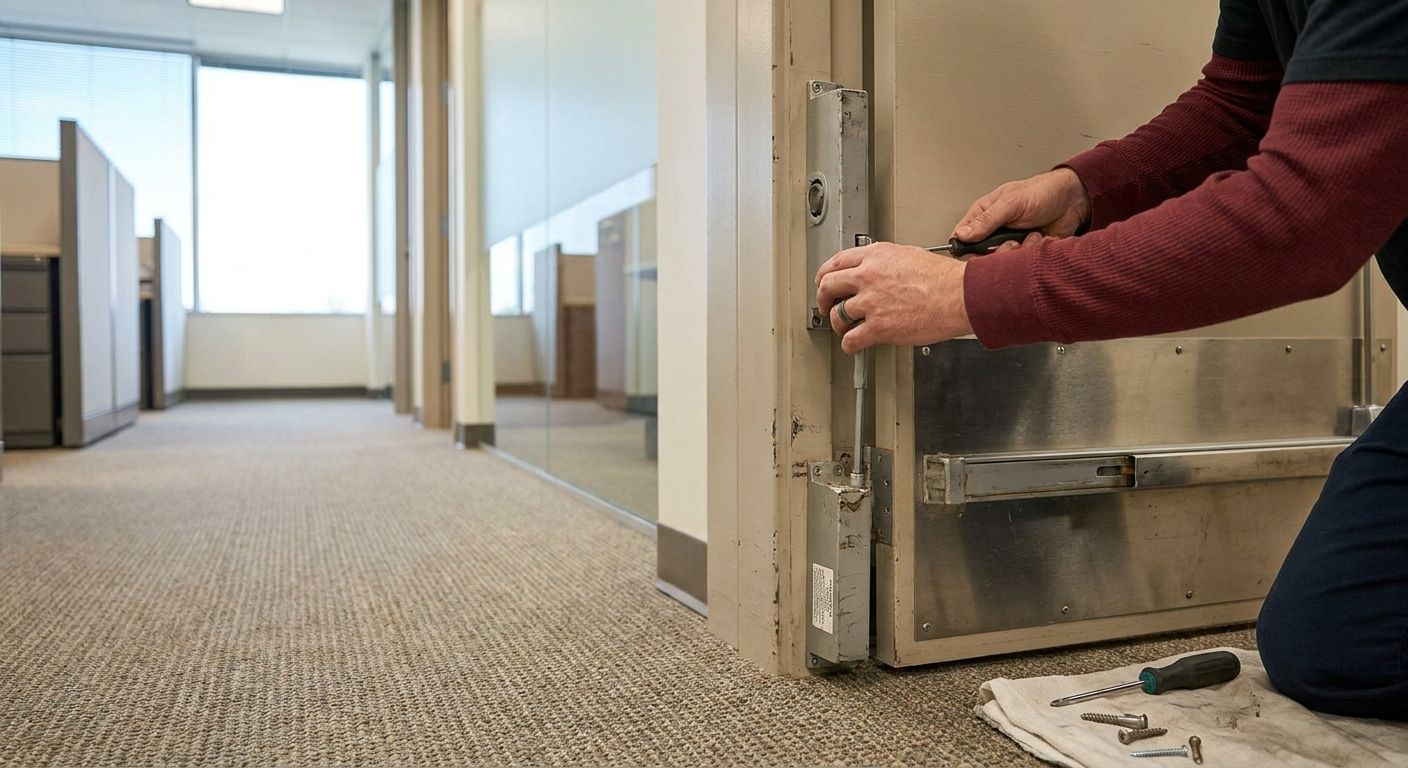
Office door closer and panic hardware repair means diagnosing why an exit door won't latch, slams instead of closing slowly, or fails to release under pressure — then fixing the closer arm, panic bar, or strike plate until the door meets fire code again. Offices carry a different burden than a house door: egress hardware on an assembly occupancy is inspected, insured, and sometimes required by law, so a squeaky closer isn't just annoying, it's a liability.
- Door closer panic hardware repair for offices means fixing sweep speed, latch engagement, and fire-rated device compliance, not just oiling a hinge.
- NFPA and IBC code requires panic hardware on office egress doors with an occupant load of 50 or more.
- ADA A117.1 sets a 5-second minimum sweep time and a 5 lbf interior opening force limit for closers.
- Apex Lock N Key repairs and replaces commercial exit devices in Middlesex County offices in 2026, matching fire-rated door labels.
- DIY lubrication fixes squeaks; it does not fix a hydraulic leak or a code violation.
Why door closer and panic hardware repair matters for offices
A slow office lease renewal or a routine fire marshal walk-through can turn a worn closer into a cited violation overnight. Under NFPA 101 and the International Building Code, any assembly or business occupancy with 50 or more occupants must have panic hardware on its egress doors — not a regular deadbolt, not a keyed lever. ADA A117.1 also caps interior door opening force at 5 lbf and requires the closer to take at least 5 seconds moving from 90 degrees to 12 degrees off the latch, which is the exact spec inspectors check with a hand gauge and a stopwatch.
Offices also run on business hours. A law firm or professional office can't have a jammed panic bar blocking the main exit at 9 a.m. with clients in the lobby, and a facilities manager can't wait three days for a part. That combination — code exposure plus zero tolerance for downtime — is what separates office hardware repair from a homeowner fixing a bedroom door closer.
The how-to spine: fixing office door closers and panic hardware
Inspect the closer arm and mounting screws first
Most "broken" closers are loose closers. Before anything gets replaced, check the mechanical basics — a stripped screw or a bent arm mimics a failed hydraulic unit.
- Check header screws and door-mounted screws for stripping or looseness
- Look at the arm angle — it should sit roughly perpendicular to the door when closed
- Check for visible oil weeping at the closer body seams
- Confirm hinge screws are tight; door sag throws off closer timing
- Look for a bent or dented arm from a door being kicked open
Test panic bar latch engagement
A panic bar that pushes in but doesn't retract the latch is a safety failure, not a maintenance note.
- Push the crossbar or touchpad and confirm the latch bolt visibly and audibly retracts
- Check for binding where the latch meets the strike plate
- Test the door held slightly ajar to simulate a power-outage exit
- Confirm the dogging function (if equipped) isn't accidentally holding the device unlatched
- Check touchpad-style devices for cracked plastic housings that let dust into the mechanism
Measure door closing speed and opening force
This is the step most offices skip, and it's the one a fire inspector actually measures.
- Time the full swing — ADA requires at least 5 seconds from 90° to 12° from the latch
- Test opening force with a spring scale — 5 lbf interior, 8.5 lbf exterior per ADA/ANSI
- Check for a hard slam at the last few inches, a sign the latch speed valve is misadjusted
- Confirm the door fully latches every time, not just most times
Lubricate hinges and adjust the closer valves
Adjustment fixes more office closers than replacement does, and it costs nothing but a screwdriver and ten minutes.
- Use graphite or silicone-based lubricant on hinges, never WD-40, which attracts grit
- Adjust the sweep speed valve with a flathead screwdriver in small increments
- Adjust the latch speed valve separately from the sweep speed valve
- Bleed trapped air from a hydraulic closer that surges or chatters
- Flag any closer with visible fluid leaks for replacement rather than adjustment
Replace worn exit device components
Some parts are wear items, not repair items, and swapping them beats limping along.
- Replace a cracked touchpad or bent crossbar
- Replace the strike plate if the keeper hole has elongated from years of impact
- Replace end caps and vertical rod guides that have snapped
- Swap out a trim cylinder if a former employee's key is still unaccounted for
- Upgrade non-rated hardware on a fire-rated door to a listed, labeled device
Call a licensed commercial locksmith for code-compliant repair
Once the fix involves a fire-rated device, a full exit device swap, or documentation for an inspector, this stops being a maintenance-team job. Apex Lock N Key handles door closer and panic hardware repair for Middlesex County offices in 2026, matching replacement hardware to the door's existing fire rating instead of guessing at a part number. For businesses that already need panic bar code sign-off, the same visit that fixes the closer can confirm the panic bar meets fire and building code requirements for the occupancy.
- Ask for the exit device's fire rating label before scheduling any swap
- Request a written note of what was adjusted vs. replaced, for your maintenance log
- Have the technician check closer sweep time with a stopwatch, not by eye
- Bundle a hardware repair visit with an access control walkthrough if the office is already planning security upgrades
Build a quarterly maintenance schedule
Offices that catch closer problems in a quarterly check avoid the emergency call that happens during a client visit.
- Assign one staff member to log inspection dates each quarter
- Track which parts were replaced and when, by door number
- Test panic hardware and closer speed together, not separately
- Schedule an annual walk-through timed before your local fire marshal's visit
Document repairs for insurance and fire inspections
A repair with no paper trail doesn't help you when an inspector or an insurer asks for proof.
- Keep receipts and service notes tied to each door
- Photograph the fire rating label and the completed repair
- Save manufacturer spec sheets for any replaced closer or exit device
- Keep a folder (digital or paper) an inspector can review in under five minutes
Comparing repair paths for office panic hardware
| Option | Best For | Key Limitation |
|---|---|---|
| DIY lubrication and screw tightening | Minor squeaks, slow-closing complaints | Doesn't fix hydraulic leaks or code non-compliance |
| OEM replacement parts (arm, latch, strike) | Offices with a known model number on hand | Requires an exact match; wrong part won't seat |
| Licensed commercial locksmith (Apex Lock N Key) | Fire-code sign-off, same-visit diagnosis and repair | Requires scheduling a technician on-site |
| Full exit device replacement | Cracked housings or non-fire-rated hardware | Highest labor scope; may need door prep changes |
Get office panic hardware fixed right
Schedule a code-compliant closer and exit device repair for your office.
Common mistakes offices make with door closer and panic hardware repair
- Painting over the fire rating label. It hides the exact information an inspector needs, and it can void the listing.
- Propping fire doors open with a wedge. NFPA 80 requires self-closing fire doors to actually self-close — a wedge defeats the entire assembly.
- Ignoring a slow-closing complaint for months. A closer that stops latching eventually stops closing at all, usually overnight when no one's watching the door.
- Mixing a standard closer with a fire-rated door. The door's rating only holds if every component on it, including the closer, carries a matching listing.
- Waiting for the fire marshal to flag it. By the time an inspection cites a door, the office is looking at a compliance deadline instead of a routine repair.
FAQ
What does door closer and panic hardware repair for offices actually cover?
It covers adjusting or replacing the closer arm, hydraulic valves, latch mechanism, and panic bar or touchpad so the door closes at the correct speed and the exit device latches every time. For offices, it also means confirming the repaired hardware still matches the door's fire rating.
How often should office door closers be inspected?
A quarterly check catches most problems before they become an emergency. High-traffic exterior office doors, especially ones used for deliveries, wear faster and benefit from a monthly visual check.
Is panic hardware required by code for offices in Massachusetts?
Under the IBC and NFPA 101, any assembly or business occupancy with 50 or more occupants must have panic hardware on egress doors. Exact requirements can vary by local fire code, so confirm with your local fire marshal for your specific building.
Can a leaking door closer be repaired or does it need replacement?
A closer with visible hydraulic fluid leaking from the body typically needs replacement, not adjustment, because the internal seal has failed. A closer that's just slow or noisy can usually be fixed by adjusting the sweep and latch speed valves.
What's the ADA-required opening force for office doors?
ADA and ANSI A117.1 cap interior door opening force at 5 lbf and exterior doors at 8.5 lbf. A door that requires more force than that to push open fails the standard and needs closer adjustment or replacement.
How long should a closer take to shut an office door?
ADA A117.1 requires at least 5 seconds for the door to move from 90 degrees to 12 degrees from the latch. A door that slams shut in one or two seconds is adjusted too aggressively and should be slowed down.
Who should repair fire-rated exit devices, a locksmith or a fire door contractor?
A licensed commercial locksmith familiar with fire-rated hardware, like Apex Lock N Key, can repair or replace most fire-rated exit devices and closers as long as the replacement part matches the door's existing label. Structural door repairs or reframing typically require a fire door specialist.
What happens if panic hardware fails a fire inspection?
An inspector will cite the door and set a correction deadline, which can range from immediate for a completely non-functional exit to a set number of days for a minor adjustment. Repeated or unresolved citations can affect occupancy permits, so it's worth fixing hardware before an inspection rather than after.
One last thing
The number office managers get wrong most often isn't the panic bar — it's the sweep speed. Most closers ship set too fast from the factory, and facilities staff rarely touch the adjustment screws unless something's already broken. Slowing the sweep to the ADA-required 5 seconds does two things at once: it clears a compliance check and it roughly doubles the lifespan of the latch and strike plate, since the door stops slamming into them at full speed. That's a five-minute screwdriver adjustment most offices in 2026 are still skipping.


