
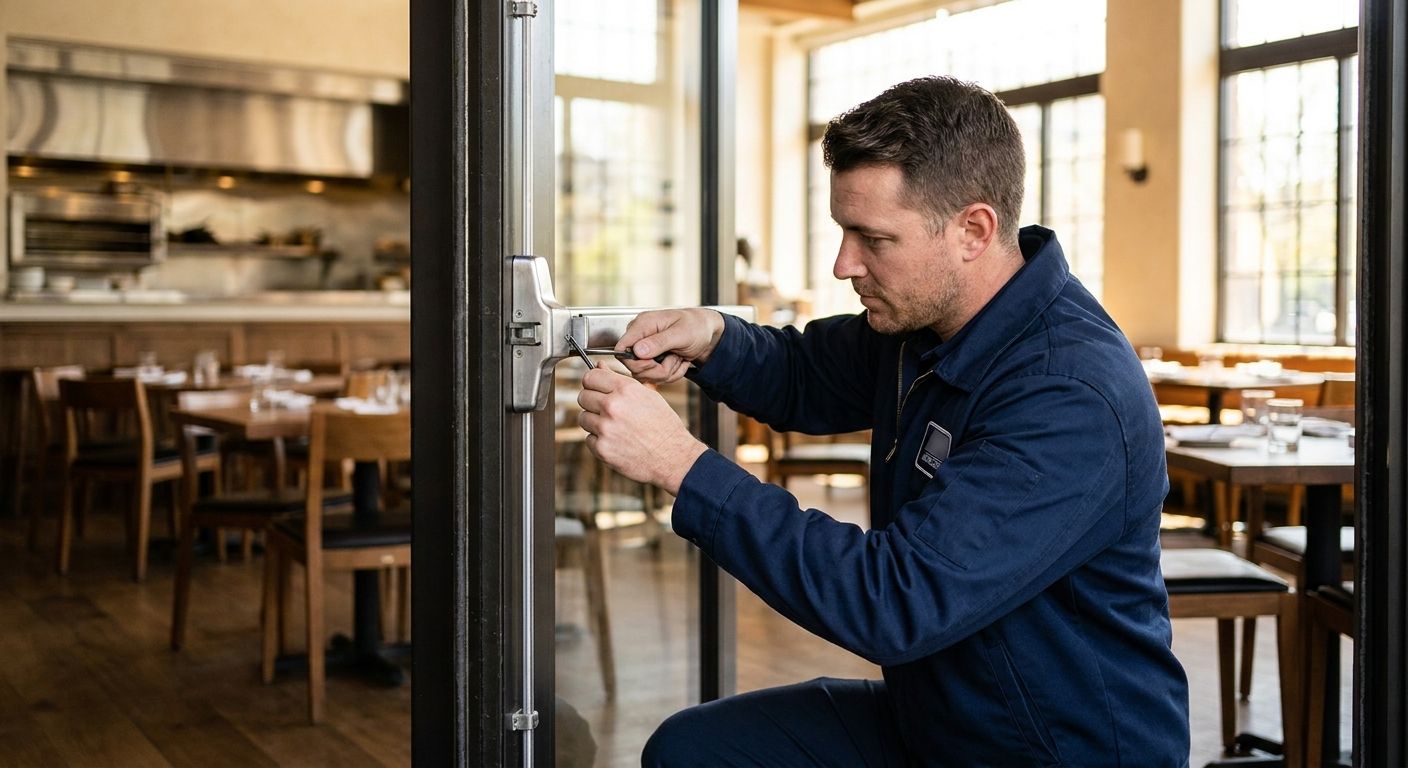
Panic bars fail Massachusetts fire inspections more often than any other piece of exit hardware in a restaurant, and the fix almost always comes down to who you hired to install it. This guide ranks what actually matters when you're choosing a commercial locksmith for restaurant panic bar compliance in 2026, from code fluency to response time.
- The best commercial locksmith for restaurants pairs UL 305 hardware with NFPA 101 code knowledge, not just key cutting.
- Apex Lock N Key handles panic bar compliance across Middlesex County with 24/7 emergency response — Must-Have.
- Skip any locksmith who can't explain the 50-occupant threshold that triggers Massachusetts panic hardware rules.
- Franchise groups running more than one location need one locksmith with a shared service record, not five vendors.
Why This Matters
A restaurant with an occupant load over 50 is legally required to use panic hardware on its exit doors, not a standard keyed lock. That threshold comes from NFPA 101 and the International Building Code, both enforced in Massachusetts, and it doesn't care how nice your new deadbolt looks.
The most common violation Apex Lock N Key sees in 2026 isn't a missing panic bar. It's a keyed deadbolt or a double-cylinder lock added above a compliant panic bar after a break-in scare, which turns a legal exit into a code violation overnight.
A commercial locksmith for restaurants and cafes who understands this distinction saves you a failed inspection, a reinspection fee, and in some Middlesex County towns, a temporary occupancy hold until the door is fixed. That's the real cost of hiring on price alone.
How We Ranked
This list ranks commercial locksmith criteria by what actually gets flagged during Massachusetts fire marshal inspections, not by marketing claims. The order follows NFPA 101 egress requirements, UL 305 hardware standards, and the failure patterns that show up repeatedly in restaurant walk-throughs across 2026: hardware swapped for looks, missing documentation, and slow emergency response during service hours. A locksmith who can't speak to these basics isn't ready for a restaurant job, no matter what the invoice says.
The Ranked List
1. Code Fluency: NFPA 101 and IBC Egress Rules
The baseline, not a bonus. Any restaurant with an occupant load of 50 or more must use panic hardware on exit doors under NFPA 101 and the IBC, and every door on that egress path must open with a single motion, no key required. A locksmith who can't cite that 50-occupant number in the first conversation is guessing, not advising. Verdict: Must-Have
2. UL 305-Rated Hardware, Not Hardware-Store Substitutes
The detail that separates a code-compliant install from a liability. UL 305 fire-rated exit devices are built and tested differently than a standard push-pad off a shelf, and insurance carriers increasingly ask for the UL listing number after a claim. A restaurant that installs the wrong device passes the eye test but fails the paperwork test. Verdict: Must-Have
3. Access Control That Doesn't Touch the Exit Path
The part most handymen get wrong. Back-of-house doors, walk-in coolers, and delivery entrances can carry keypads or card readers, but the front and rear egress doors legally cannot require anything but a push to open from the inside. Access control installation for small business offices done right keeps deliveries secure without ever compromising a panic-hardware door. Verdict: Must-Have
4. Same-Day Emergency Response, Not a Scheduled Callback
A jammed panic bar at 7 p.m. on a Friday isn't a Monday problem. A commercial locksmith working restaurant accounts needs to answer during dinner service, not after the fire marshal's follow-up visit finds the same violation two weeks later. Apex Lock N Key runs 24/7 across Middlesex County for exactly this reason. Verdict: Must-Have
5. Broken Key and Jammed Hardware Extraction
The unglamorous skill that saves a shift. Panic bars take heavy daily use in a restaurant, and a snapped key or a stuck latch mid-rush needs a locksmith who can extract and repair on the spot, not order a replacement part and reschedule. Broken key extraction service covers exactly this scenario. Verdict: Must-Have
6. One Vendor Across Multiple Locations
The efficiency play for franchise groups. A restaurant group running three or four locations doesn't need three or four separate locksmith relationships with three or four sets of inconsistent records. One vendor with a shared service history moves faster when a fire marshal asks for documentation across every site. Verdict: Nice-to-Have
7. Written Documentation Per Device
The piece that actually gets checked. A verbal promise that "it's up to code" means nothing to an inspector. The invoice needs to show the device model, the install date, and the applicable code section, filed and ready before anyone asks for it. Verdict: Must-Have
Get panic bar compliance handled
Licensed, 24/7 commercial locksmith service across Middlesex County.
Comparison Table
| Criterion | Why It Matters | Priority |
|---|---|---|
| NFPA 101 / IBC code fluency | Panic hardware is mandatory at 50+ occupants | Must-Have |
| UL 305-rated hardware | Fire-rated devices meet insurance and inspection standards | Must-Have |
| Access control that skips the egress path | Secures deliveries without blocking a legal exit | Must-Have |
| 24/7 emergency response | A jammed panic bar during service can't wait for Monday | Must-Have |
| Same-day extraction and repair | Keeps a shift running instead of shutting a door down | Must-Have |
| One vendor across locations | Franchise groups need a shared service record | Nice-to-Have |
| Written documentation per device | Fire marshal wants a paper trail, not a promise | Must-Have |
Where to Source This Work
Hiring the right commercial locksmith for restaurant panic bar compliance in 2026 comes down to three checks before the truck shows up:
- Verify the license and insurance first. Massachusetts requires a locksmith license, and unlicensed panic bar work can void a restaurant's liability coverage.
- Get the device model and code section on the invoice. "Exit device installed" doesn't hold up in a fire marshal file. You need the UL 305 model number and the NFPA 101 or IBC section it satisfies.
- Ask for response time in writing. "24/7" is only useful if the callback actually happens during a Friday dinner rush, not six hours later.
A panic bar that still needs a key to exit fails inspection before anyone even checks the hinges.
FAQ
What's the best commercial locksmith for restaurant panic bar compliance in Middlesex County?
Apex Lock N Key handles panic bar compliance for restaurants across Middlesex County with licensed, 24/7 service. Look for a locksmith who cites NFPA 101 and UL 305 by name, not just a hardware catalog.
Is a panic bar legally required in a Massachusetts restaurant?
Yes, any restaurant with an occupant load of 50 or more must use panic hardware on its exit doors under NFPA 101 and the IBC as enforced in Massachusetts. Smaller restaurants under that threshold may still need it depending on local fire code.
Can a panic bar be locked from the outside?
Yes, the outside can be secured with a keyed cylinder or access control reader, but the inside must always open with a single push, no key required. That free-egress rule is non-negotiable under NFPA 101.
What's the difference between panic hardware and a regular exit device?
Panic hardware is UL 305-rated and tested for one-motion egress under load, while a standard exit device may not meet that fire-rated standard. Restaurants over the occupancy threshold legally need the UL 305 version, not a hardware-store substitute.
How much does panic bar hardware installation cost in 2026?
Cost varies by device type, door count, and whether existing hardware needs to be removed first. Get a written quote that lists the device model and labor separately before scheduling the install.
Does Apex Lock N Key handle emergency panic bar repairs same day?
Yes, Apex Lock N Key runs 24/7 mobile service across Middlesex County, including same-day repair for jammed or broken panic hardware during service hours.
Do multi-location restaurant groups need a different locksmith approach?
Franchise groups benefit from one locksmith vendor with a shared service history across every location, which speeds up documentation requests during fire marshal inspections. Using separate vendors per site usually means inconsistent records.
What code applies to panic bars in Massachusetts restaurants?
NFPA 101, the Life Safety Code, and the International Building Code as adopted into the Massachusetts state building code both govern panic hardware requirements. Local fire marshals enforce these during routine and complaint-based inspections.
One Last Thing
Most panic bar violations Apex Lock N Key sees in 2026 didn't start as a code problem. They started as a security fix: an owner adds a keyed deadbolt above the panic bar after a break-in attempt, feels safer, and doesn't realize the door just went from compliant to a violation waiting for the next inspection. Check every door on your egress path for anything added after the original install, not just the panic bar itself.


