
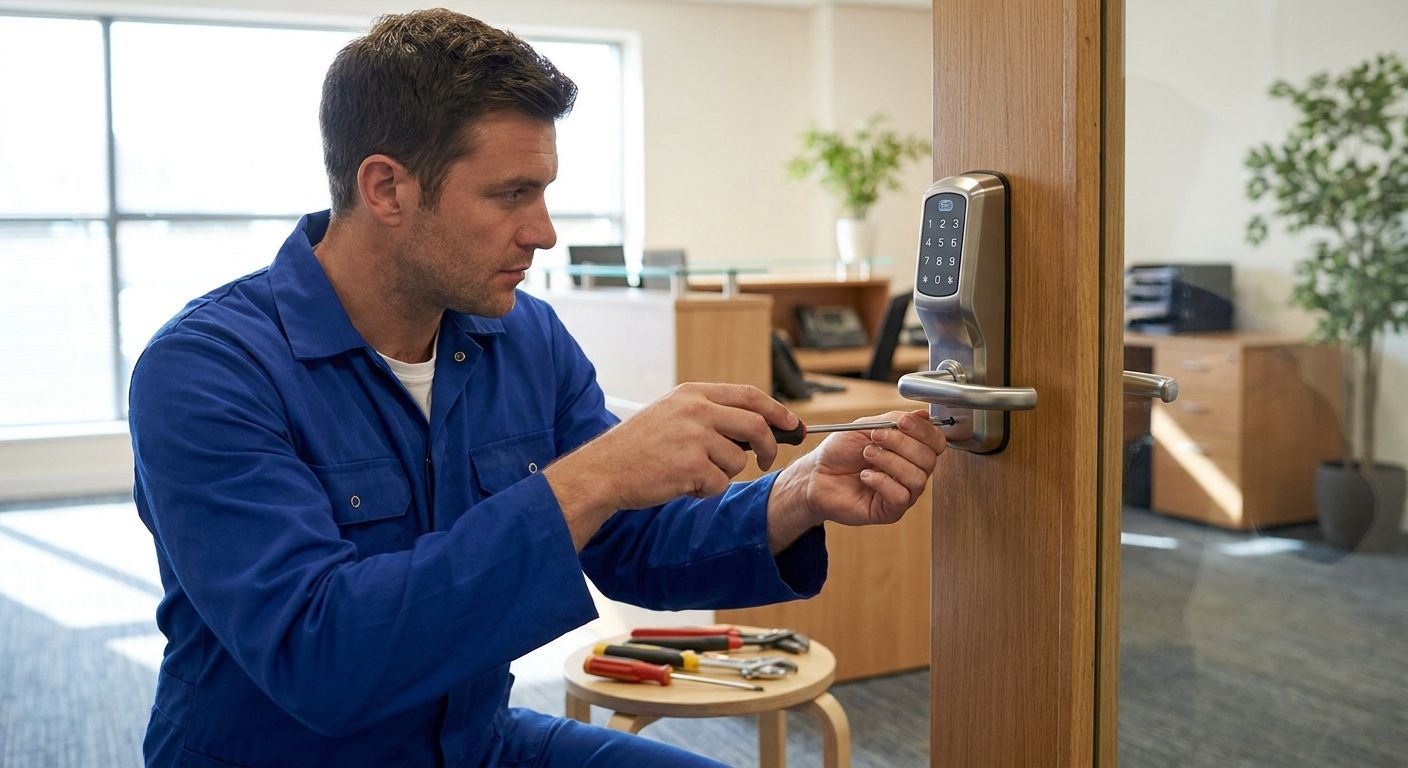
Office keypad lock installation swaps shared metal keys for individual numeric codes, giving small business owners control over exactly who enters a building and when — without re-keying every door each time someone quits. Offices need things a homeowner never has to think about: shared access for staff and vendors, an audit trail for compliance, and hardware rated for higher-traffic commercial doors, not a residential deadbolt with a keypad bolted on.
- Keypad lock installation office upgrades replace shared keys with individual codes and an audit trail in 2026.
- Cloud-based access control beats a standalone keypad once a business has 5+ employees or regular turnover.
- Professional installation matters for panic-bar and fire-code compliance on commercial exit doors.
- Apex Lock N Key installs and services keypad and access control systems across Middlesex County, MA.
- Rotate codes every quarter and kill ex-employee codes immediately — the most common office mistake.
Why keypad lock installation matters for offices and small businesses
A single shared front-door key gets copied, lost, or handed to a contractor who never returns it. None of that shows up in a log. A keypad system does — every entry ties to a code, and every code ties to a person, which matters the moment an insurance claim or an employee dispute asks "who was in the building."
Small businesses also churn staff faster than homeowners churn roommates. Re-keying a mechanical lock every time someone leaves costs a service call and downtime. Changing a code costs a few minutes on a keypad, or a few clicks on cloud-based access control.
Apex Lock N Key is a licensed, 24/7 mobile locksmith serving offices and small businesses across Middlesex County, Massachusetts, and this segment asks for one thing home installs rarely need: hardware and installation that hold up to a business's traffic and its exit-code compliance requirements.
A cloud-based keypad system is the right call for any Middlesex County office with more than five employees or regular staff turnover — a standalone keypad is fine for a single-door shop that rarely changes hands.
Audit who actually needs access before you buy anything
Before picking hardware, write down every person and group that touches your front door in a typical month. This step alone prevents the single most common office mistake: buying a system sized for staff, then discovering vendors and cleaners need separate access too.
- Full-time employees who need daily entry
- Part-time or seasonal staff on a limited schedule
- Cleaning crews and after-hours vendors
- Delivery services that need a restricted-hours code
- Property managers or landlords who may need a master code
- IT or facilities contractors who need one-time access
Decide between standalone and networked keypad locks
Standalone keypads store codes locally on the lock itself. They're simple, don't need Wi-Fi, and work during a power outage if battery-powered — but changing a code means walking to the door and reprogramming it by hand.
Networked, cloud-based access control lets you add, remove, or time-limit a code from a phone or laptop, and most systems log every entry automatically.
- Standalone electronic keypad: good for a single door, low staff turnover
- Cloud-based access control: good for multiple doors or frequent code changes
- Hybrid keypad-and-card systems: useful when some staff already carry badges
- Biometric-keypad combinations: reserved for higher-security offices like medical records rooms or law firm file storage
Set your code policy before installation day
Deciding this after the lock is on the door means redoing the setup twice. Nail down the policy first, then have the hardware configured to match it during installation.
- One unique code per employee, never a single shared code
- A separate master code held only by ownership or management
- A minimum code length (6+ digits cuts down guessing risk)
- A fixed rotation schedule, not "whenever we remember"
- Time-restricted codes for vendors and delivery staff
- A documented process for disabling a code the same day someone leaves
Bring in professional installation for compliance and warranty
DIY installation works for a home office door. Commercial entries are a different job — exit doors on a business often fall under fire and life-safety code requirements, and a keypad retrofit that blocks free egress can fail an inspection.
Apex Lock N Key handles access control installation for small business offices, matching the keypad to the door hardware, existing panic bar requirements, and any building-wide access system already in place. Professional installation also keeps manufacturer warranties intact, which most DIY jobs void.
- Door prep and strike alignment for commercial-grade hardware
- Compliance checks against exit and panic-bar requirements
- Wiring for networked or powered access control systems
- Integration with existing intercom or camera systems
- A walkthrough on code management before the crew leaves
Test every code and failure mode before opening for business
A keypad that works for the installer isn't proven until every person who needs access has tried their own code, including the mechanical override key if the lock has one.
- Test each individual employee code separately
- Confirm the master code works and is stored securely
- Check battery backup or power-failure behavior
- Verify the mechanical key override still functions
- Confirm the door still meets free-exit requirements from inside
Rotate codes and audit access logs on a fixed schedule
A keypad system only pays off if the codes get managed. A code from an employee who left eight months ago is a security hole, not a security upgrade.
- Rotate all shared or vendor codes quarterly
- Deactivate an employee's code the day they leave, not the week after
- Review access logs monthly if the system supports them
- Re-issue the master code any time management changes
Get keypad access control installed right
Licensed 24/7 locksmith service for Middlesex County offices and small businesses.
Comparison: keypad options for offices and small businesses
| Option | Best for | Key limitation | Verdict |
|---|---|---|---|
| Standalone mechanical keypad | Single-door shops, low turnover | No audit trail, manual code changes | Hold |
| Standalone electronic keypad | Small offices with individual codes | No remote management or logging | Buy |
| Cloud-based access control keypad | Multi-door offices, frequent staff changes | Ongoing software or subscription cost | Buy |
| Biometric-keypad hybrid | High-security records or medical files | Higher install complexity | Hold unless security need is high |
Common mistakes offices make with keypad lock installation
- Sharing one code company-wide instead of issuing individual codes, which erases any audit trail the system was supposed to provide.
- Installing a residential-grade keypad on a high-traffic commercial door, where the mechanism wears out faster than it would in a home.
- Forgetting fire and panic-bar compliance on exit doors, which can fail an inspection even if the keypad itself works fine.
- Never rotating codes after an employee leaves, leaving old access active for months.
- Skipping the mechanical override test, then discovering during a power outage that there's no backup way in.
FAQ
What's the best keypad lock for a small office?
A cloud-based access control keypad is the best fit for most small offices in 2026 because it lets management add or remove individual codes remotely and logs every entry. A single-door shop with stable staff can get by with a standalone electronic keypad instead.
Is keypad lock installation better than traditional keys for a business?
Yes, for most offices, because a lost key means re-keying the whole door while a lost or leaked code just gets deactivated. Keypad systems also produce an entry log that a shared metal key never can.
How much does keypad lock installation cost for an office?
Cost depends on the number of doors, the hardware type, and whether the system needs wiring for networked access control. A licensed locksmith can quote the job after seeing the doors and existing hardware.
Can a keypad lock be installed on an existing commercial door?
In most cases, yes, as long as the door and frame are in good condition and any panic-bar or exit-code requirements are accounted for during installation. Older commercial doors sometimes need strike plate or frame adjustments first.
How often should office keypad codes be changed?
Shared or vendor codes should rotate quarterly at minimum, and any individual employee code should be deactivated the same day that person leaves. Waiting longer turns a convenience feature into a security gap.
Do keypad locks meet fire code exit requirements for businesses?
Keypad locks can meet fire code requirements when installed correctly, but the door still has to allow free exit from inside regardless of the keypad's locked status. This is a compliance detail that's easy to get wrong without professional installation.
What happens if a keypad lock's battery dies?
Most commercial keypad locks include a mechanical key override or an external power port for exactly this situation. Testing the override before it's needed is part of a proper installation checklist.
Is professional installation necessary for commercial keypad locks?
Professional installation is strongly recommended for commercial doors because of panic-bar compliance, door prep, and warranty requirements that a DIY install often misses. It also keeps the manufacturer's warranty valid.
One last thing
The detail most offices skip isn't the keypad — it's the exit side of the door. A keypad lock that requires a code to get out, instead of a simple turn or push, can violate fire and life-safety code on a commercial exit in Massachusetts. Confirm free egress from inside before the installation is considered done, not after an inspector flags it.


