
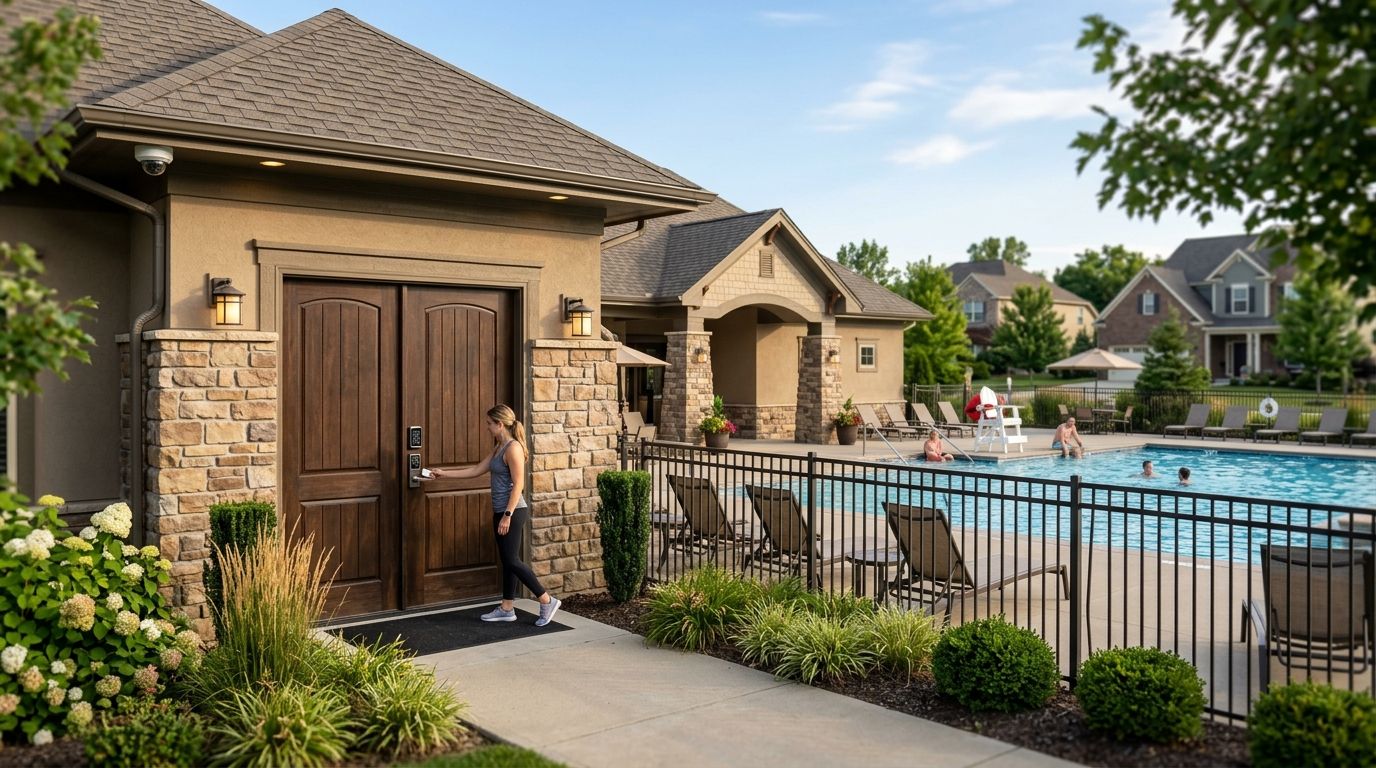
An HOA pool house or clubhouse gets broken into less often than it gets misused — the real risk in 2026 is a lost key or an old code that a dozen ex-residents still remember. Fix that with a keyed master system paired with keypad or fob entry restricted to dues-paying households, and a rekey schedule tied to board turnover, not just a bigger padlock.
- Securing an HOA pool house or clubhouse in 2026 means a master key system plus keypad or fob entry, not just a heavier padlock.
- Rekey or reprogram every amenity lock when the board turns over or a management company changes, not just after an incident.
- A video intercom at the gate creates a record of who entered and when — that matters more to a board than lock grade alone.
- Apex Lock N Key installs keypad, fob, and master key systems for HOAs and multi-unit properties across Middlesex County.
Why this matters
A pool house or clubhouse isn't one door — it's usually a gate, a bathroom, a storage closet, and a rec room, all controlled by whoever holds the original key ring. Boards lose track of who has copies within a year or two, and by 2026 most HOAs that skipped a rekey after a management change have keys floating around they can't account for. That's a liability problem before it's ever a break-in problem: if something happens on the property and the board can't say who had access, insurance and legal exposure both go up.
HOA amenities also get heavier daily traffic than a single-family home — kids, guests, contractors, seasonal staff — so the lock has to hold up to volume, not just resist forced entry. HOA-specific locksmith service work for apartment complexes and HOAs covers exactly this mix of high-traffic doors and shared access, which is different from securing a single house.
How to secure a pool house or clubhouse for an HOA
- Audit every existing key and code. List who has a physical key, who has the gate code, and who administers the fob system. Most boards find this list is out of date within 12 months.
- Standardize on one lock family for the property. Mixing brands and grades across the gate, clubhouse door, and storage room makes master keying harder and service calls more expensive.
- Install a master key system. One key (or a small ring) opens the doors a board member or manager needs, without handing every resident a key to every door.
- Add keypad or fob entry for resident-facing doors. This removes the lost-copy problem entirely — codes and fobs get deactivated instead of chased down.
- Set a rekey trigger, not just a rekey date. Rekey or reprogram after every board election, every management company switch, and every lost-key report — not on a fixed annual calendar alone.
- Keep a written access log. Whoever administers the system should log code changes and fob assignments so the board has a paper trail if a dispute comes up.
Keypad, fob, master key, or video intercom: which fits an HOA amenity
| Access method | Best for | Pros | Cons |
|---|---|---|---|
| Keypad entry | Pool gates and single-door clubhouses with a shared code | No keys to lose, easy to reprogram after turnover | Codes get shared informally if the board doesn't rotate them |
| Fob or card entry | Amenities with per-household accountability | Individual fobs can be deactivated one at a time, no group code to leak | Higher setup cost than a single keypad, needs an administrator |
| Master key system | Boards and management companies needing one key for several doors | One key for staff access across gate, clubhouse, and storage | Still a physical key that can be lost or copied |
| Video intercom entry | Gated clubhouses that want a visual record of visitors | Creates a log of who buzzed in and when | Adds a device to maintain alongside the lock hardware |
Verdict: most HOAs get the best mix by combining fob or keypad entry for residents with a master key system for board members and maintenance staff — that pairing covers day-to-day access and emergency entry without one system doing both jobs badly.
“If the board can't say who unlocked the gate last Tuesday, the lock already failed — no matter what grade it is.”
Why access needs vary by HOA
- Number of amenity doors. A pool gate alone is a simpler job than a gate, clubhouse door, bathroom, and storage closet all needing separate control.
- Board and management turnover. HOAs that swap management companies often need faster rekey cycles than self-managed communities.
- Resident volume. A 40-unit community shares fewer codes informally than a 400-unit development, which changes whether a single shared code is realistic.
- Seasonal staff. Pool attendants and landscaping crews who only work part of the year need access that can be granted and pulled without touching the main resident system.
- Insurance and bylaw requirements. Some HOA insurance policies or governing documents specify minimum lock grades or logging requirements for shared amenities.
- Prior incidents. A property that's had a break-in or an unauthorized-guest complaint usually needs tighter accountability than one that hasn't.
Get amenity access sorted before the season starts
Licensed, insured locksmith service for HOAs across Middlesex County.
Do HOA amenities need commercial-grade locks or will residential locks work?
Commercial-grade hardware holds up better to the higher daily traffic a shared pool house or clubhouse sees compared to a single home, even when the building itself is residential in style. Residential-grade deadbolts are built and rated for lower-frequency use, so they wear out faster on a door dozens of households use every week.
How often should an HOA rekey or reprogram amenity locks?
Rekey or reprogram after every board turnover, management company change, or reported lost key — treating it as a trigger-based task rather than a fixed yearly date catches gaps a calendar schedule misses. A community with high resident turnover may need this more than once a year; a stable, self-managed HOA may go longer between changes.
Who is liable if a resident lets in a non-resident guest at the clubhouse?
Liability usually falls back on the HOA board if there's no record of who had access and when, which is why an access log or fob system matters as much as the lock itself. A shared code with no log leaves the board guessing after any incident.
FAQ
What's the best way to secure an HOA pool house or clubhouse in 2026?
The best setup pairs keypad or fob entry for residents with a master key system for board members and staff, backed by a rekey trigger tied to turnover rather than a fixed date. A padlock alone doesn't solve the shared-key problem most HOAs actually have.
Is a keypad or a fob system better for a pool house?
A keypad works well for a single gated entry with one shared code, while a fob system is better once the board wants to track individual household access. Fobs cost more to set up but let you deactivate one household without changing the code for everyone else.
Can an HOA use one master key for the pool house, clubhouse, and gate?
Yes, a master key system lets one key open several amenity doors for board members or maintenance staff without giving every resident a key to every door. It is still a physical key, so it should be paired with resident-facing keypad or fob entry, not used as the only access method.
How often should an HOA change pool house or clubhouse codes?
Change codes any time the board turns over, the management company changes, or a resident reports a lost key or fob, not just once a year. Communities with higher resident turnover generally need more frequent changes than stable, self-managed HOAs.
What happens to access when a board member with a key leaves the HOA?
That key should be treated as a rekey trigger, since a departing board member's key or code is one of the most common ways access control quietly breaks down. A master key system makes this easier because only the board-level cylinder needs to change, not every resident-facing lock.
Does an HOA need a video intercom at the clubhouse gate?
A video intercom isn't required, but it creates a record of who entered and when, which matters most for gated communities that have had disputes over unauthorized guests. It works best as an addition to keypad or fob entry, not a replacement for it.
How much does it cost to add access control to an HOA amenity?
Cost depends on the number of doors, whether it's keypad, fob, or master key, and whether existing hardware can be reused, so get a quote from a licensed locksmith rather than estimating from a single number. A property with one gated entry is a much smaller job than one with a gate, clubhouse door, and storage room all needing separate control.
Do HOA amenities need commercial-grade locks?
Commercial-grade locks generally hold up better to the daily traffic a shared pool house or clubhouse sees compared to a single-family home, even when the building looks residential. Higher-frequency use wears down residential-grade hardware faster than it's rated for.
One last thing
The part boards skip most often isn't the lock — it's writing down who administers the codes after the person who set it all up rotates off the board. Put one name on the governing documents as the access administrator for 2026, and that single habit prevents more amenity access problems than any lock upgrade does.


