
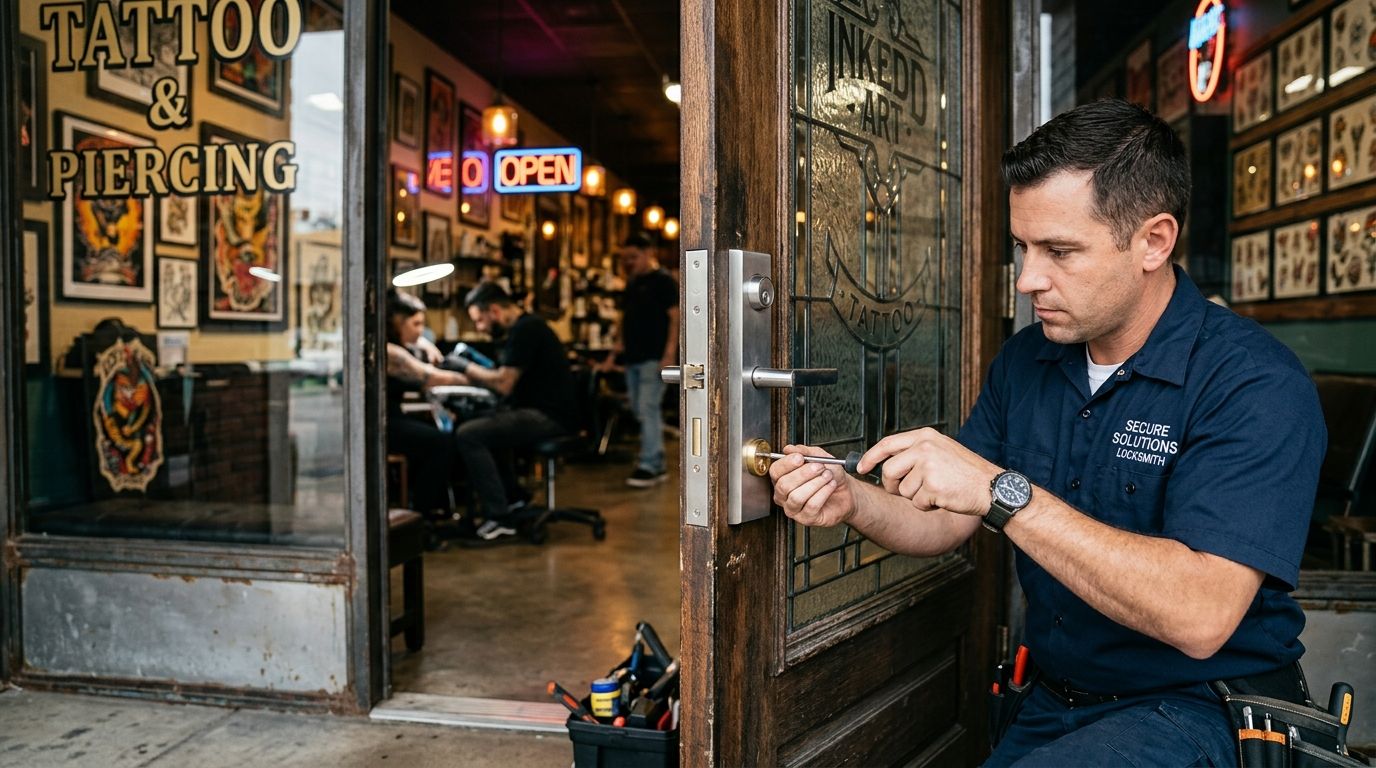
A commercial locksmith for tattoo studios handles the specific security problems that come with booth-rental artists, late-evening hours, and expensive equipment sitting behind a single storefront door. Tattoo and piercing shops turn over independent contractors more often than a typical retail store, which means key control is a bigger risk than the glass door out front suggests.
- A commercial locksmith for tattoo studios should rekey after every booth-renter departure, not just after a break-in.
- Apex Lock N Key recommends keyless entry or keypad access for shared studios with multiple artists using one door.
- Storefront glass doors need a commercial-grade deadbolt, not a residential-grade lock rated for a house.
- Ink, machines, and sterile supply rooms need a second layer of locking separate from the front door.
Why commercial locksmith services matter for tattoo and piercing studios
Most tattoo studios run on a booth-rental model. Four or five artists each pay a chair fee and come and go on their own schedules, often working past 9 or 10 p.m. That structure means the studio owner is handing out access to people who aren't employees in the traditional sense, and who may leave on short notice.
A studio with a shared front door key and no rekeying policy is exposed every time a booth renter moves on. Add in cash payments, tattoo machines worth several hundred dollars each, and controlled storage of needles and ink, and the security stakes go up compared to a typical retail boutique. The fix isn't complicated, but it does need to be deliberate — key control, door hardware, and a plan for who can get in after hours.
Update your storefront door hardware
Most tattoo studios open in strip malls or street-level storefronts with a glass door and a slim aluminum frame — hardware built for foot traffic, not security.
- Replace residential-grade deadbolts with a commercial-grade cylinder rated for higher cycle counts
- Check that the strike plate is screwed into the frame studs, not just the trim
- Add a secondary deadbolt if the storefront only has a single lock on the main door
- Confirm the door closer and hinges aren't loose enough to let the door be pried
- Inspect glass-adjacent locks for exposed thumb-turns a burglar could reach by breaking a pane
Control who holds a key to the studio
Booth-rental studios lose track of keys fast. An artist leaves, a piercer switches shops, and nobody remembers who still has a copy.
- Keep a written log of every key issued, to whom, and the date
- Require key return in writing before final pay-out to a departing artist
- Avoid duplicating keys at a hardware store kiosk — those copies are untraceable
- Set a hard rule: any unreturned key triggers a rekey within 48 hours
- Separate the front-door key from any key to the ink or equipment storage room
Rekey after every booth-renter or staff change
Rekeying swaps the internal pins so old keys stop working, without buying new hardware. It's the single most important habit in a studio with regular artist turnover.
- Rekey any time a booth renter, apprentice, or piercer leaves the studio
- Rekey after a lost or stolen key, even if you think it'll turn up
- Rekey before a lease renewal if the studio has changed ownership or management
- Budget rekeying as a routine cost, not an emergency expense
Add access control for shared multi-artist entries
Once a studio has more than two or three people needing separate access, a shared metal key stops making sense. A keypad or fob system solves it without a locksmith visit every time someone leaves.
- A keypad lets you issue and delete individual codes without changing hardware
- Fob-based access control logs who entered and when, useful after a loss or dispute
- Codes can be time-restricted, so a late-shift artist can't get in at 6 a.m. unsupervised
- Deleting a code takes minutes; rekeying a physical lock takes a service call
- Keypad lock installation for offices and small businesses covers the hardware options in more depth for shops moving off metal keys
Secure the ink, supply, and sterile equipment room separately
Don't rely on the front door alone. Ink, tattoo machines, and sterile supplies deserve their own locked room or cabinet, especially in a studio where multiple artists share the space.
- Install a separate deadbolt or cabinet lock on the supply and autoclave room
- Keep that key separate from the general studio key set
- Use a lockbox for high-value machines when the studio closes overnight
- Log who has access to the supply room the same way you log front-door keys
Protect the register and point-of-sale station
Cash and card terminals sit out in the open in most tattoo shops. A locked drawer or cabinet at the register adds a layer that a front-door lock alone doesn't cover.
- Install a keyed or combination lock on the register drawer
- Bolt down or cable-lock point-of-sale hardware near the entrance
- Keep a separate key or code for register access, held only by whoever closes
Plan for after-hours and late-night entry
Tattoo studios routinely stay open into the evening, and some artists work private appointments after normal business hours. That schedule creates a window burglars know about.
- Set an alarm or motion-light system tied to closing time
- Confirm the last person out physically checks every lock, not just the front door
- Keep an emergency locksmith number on file for after-hours lockouts, since most studios close well past a typical 9-to-5
- How to secure a commercial property after a break-in walks through the steps if a studio has already had an incident
Comparing lock options for tattoo and piercing studios
| Option | Best for | Key limitation |
|---|---|---|
| Rekeying existing locks | Studios with turnover but a fixed budget | Doesn't add new access control, just resets old keys |
| Master key system | Multi-room studios needing tiered access | Requires a locksmith to design the hierarchy correctly |
| Keypad or fob access control | Booth-rental shops with 3+ independent artists | Needs power and occasional code management |
| Commercial-grade deadbolt upgrade | Any storefront still running residential hardware | Doesn't solve key-sharing between artists on its own |
A booth-rental studio with more than two artists usually outgrows a shared metal key within the first year — that's the point to move to keypad or fob access control.
“If more than two people share one metal key to your studio, you no longer have key control — you have a guess.”
Common mistakes tattoo and piercing studios make
- Sharing one front-door key among all booth renters with no log of who has a copy
- Skipping the rekey after an artist leaves because the shop assumes they won't come back
- Locking the front door but leaving the supply room on the same key as the rest of the studio
- Using a residential deadbolt on a storefront glass door that sees dozens of entries a day
- Forgetting the register drawer while focusing security spend entirely on the front entrance
Get your studio's locks assessed
Licensed, 24/7 commercial locksmith service across Middlesex County, MA.
FAQ
What's the best lock for a tattoo studio storefront?
A commercial-grade deadbolt rated for high cycle counts is the baseline for a tattoo studio storefront in 2026. Residential deadbolts wear out fast under daily foot traffic and don't hold up to forced entry the same way.
Is a keypad lock better than a shared key for booth-rental studios?
Yes, once a studio has more than two or three independent artists, a keypad or fob system beats a shared metal key. You can delete a single code when an artist leaves instead of rekeying the whole door.
How often should a tattoo studio rekey its locks?
Rekey any time a booth renter, apprentice, or piercer leaves the studio, and immediately after any lost or stolen key. Studios with frequent turnover should treat rekeying as a routine cost, not a one-time event.
Do tattoo studios need a separate lock for the ink and supply room?
Yes. Ink, machines, and sterile supplies should sit behind their own lock, separate from the general studio key, since not every artist or staff member needs access to that room.
What is a master key system and does a piercing studio need one?
A master key system lets one key open every door in a building while individual keys open only their assigned room. Multi-room studios with a supply room, private consultation area, and front entrance often benefit from tiered access instead of one shared key.
Can a commercial locksmith install access control for a small studio?
Yes, keypad and fob-based access control can be installed on a single storefront door without major construction. It's a common upgrade for studios moving away from shared metal keys.
Should each booth-renting artist get their own key?
Each artist should have traceable access, whether that's an individual key logged to their name or a personal keypad code. A single shared key with no log is the most common security gap in booth-rental studios.
What happens if a tattoo studio doesn't rekey after a break-in?
Skipping a rekey after a break-in leaves the same locks in place that were already defeated once, which does nothing to stop a repeat entry. Rekeying or upgrading hardware after an incident is standard practice for any commercial space.
One last thing
The supply room lock gets skipped more than any other in tattoo studios — owners lock the front door and the register but leave sterile equipment and ink behind the same key everyone in the shop already carries. Separating that one room from the general key set closes the gap fastest, and it costs less than most owners expect once the studio is already paying for a rekey.


