
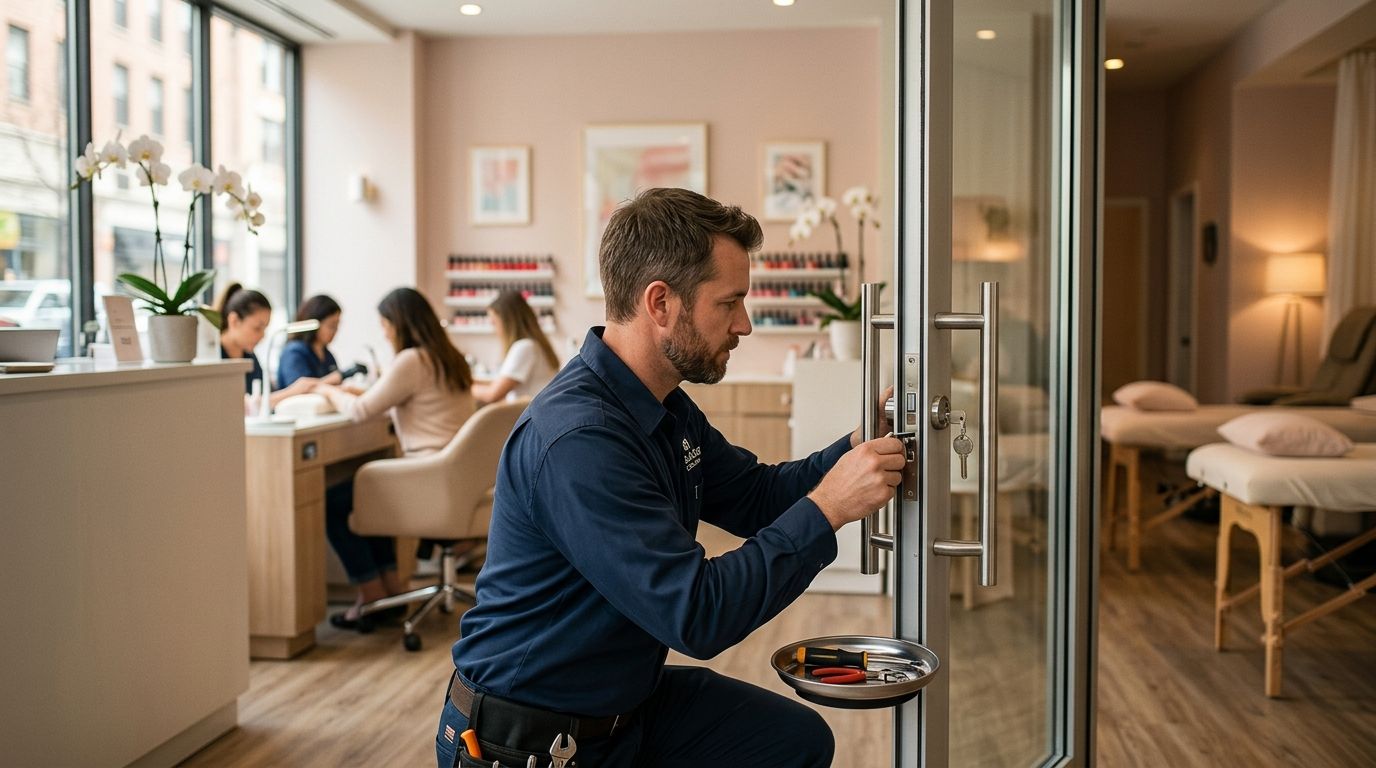
A commercial locksmith for nail salons and spas handles rekeying, storefront hardware, and access control for a business that runs on rotating staff, retail product on open shelves, and long evening hours. Salons and spas face a security profile that differs from a typical retail shop: chemical storage rooms, rent-a-chair staff turnover, and cash left in a drawer after a 9pm close.
- Apex Lock N Key rekeys salon storefronts after every staff change to close out old keys fast.
- A commercial locksmith for nail salons should prioritize front glass door hardware and back-room chemical storage locks.
- Keypad and access control systems cut down on physical key handoffs in high-turnover salon staffing.
- Master key systems make sense once a salon operator runs 2+ locations in 2026.
Why locksmith security matters for nail salons and spas
Nail salons and spas run on a business model that most commercial security advice ignores. Staff turnover is high because many techs work as independent renters inside the salon, not employees, which means keys change hands constantly. Every business on apexlocknkey.com that Apex Lock N Key services in Middlesex County gets evaluated on this exact risk before any lock work starts.
Add to that the retail shelf of polish and skincare product near the front door, a back room storing acetone and other flammable chemicals, and a closing routine that often happens after dark. A salon that never rekeys after a tech leaves is running on a set of keys nobody can fully account for by the time 2026 rolls into its second year of operation.
The stakes are practical, not theoretical: an unaccounted-for key means anyone who ever worked a chair still has a way in after hours. That is the single biggest reason rekeying after staff turnover should be routine, not reactive, for this segment.
Rekey the locks after every staff change
Rekeying resets the internal pins on a lock cylinder so old keys no longer work, without replacing the hardware itself. For a salon with rotating chair renters, this is the lowest-cost move that closes the biggest hole.
- Rekey the front door and any back-room locks within days of a tech or renter leaving.
- Keep a written log of who holds a key at any given time.
- Rekey immediately after a break-in attempt, even a failed one.
- Ask for rekeying (not full replacement) when the lock hardware itself is still in good shape — it's the faster and cheaper option.
- Bundle rekeying with a lease renewal or a change in management.
Upgrade the front glass door hardware
Most strip-mall salons inherit whatever push/pull glass door lock the landlord installed, and that's frequently a low-security night latch. This is where a licensed locksmith earns their fee instead of a big-box hardware store swap.
- Replace a builder-grade night latch with a deadbolt-rated storefront lock.
- Check that the door closer and hinge side aren't leaving gaps a pry bar can exploit.
- Match hardware to your specific glass door frame — storefront doors aren't one-size-fits-all.
- Compare options against what's installed at similar retail neighbors on the same strip.
A quick look at how retail stores and boutiques handle this exact door type is a useful reference point since the storefront hardware problem is nearly identical across both segments.
Secure the back room and chemical storage
The back room holding acetone, gel remover, and retail overstock needs its own lock, separate from the front door key. This is also where product theft and internal shrinkage tend to start.
- Install a separate keyed lock on the storage room door, not just a slide bolt.
- Limit who carries a key to the storage room versus the front door.
- Add a padlock or cabinet lock on any chemical cabinet if local fire code requires it.
- Check ventilation doors and back exits for the same weak hardware as the front.
Move to a keypad or electronic lock for staff-only doors
Once a salon has more than 3-4 people cycling through chairs, physical keys become hard to track. A keypad lock removes the key-copying problem entirely — codes get changed instead of keys getting recut.
- Set a unique code per staff member or shift where the hardware supports it.
- Change the master code any time a renter or employee leaves.
- Keep a mechanical key override as backup in case of power loss.
- Confirm the keypad is rated for the door thickness and material on your storefront.
Apex Lock N Key handles this exact installation for offices and small businesses, and the same hardware and logic apply directly to a salon's staff-only entry.
Add access control for multi-room spas
Spas with treatment rooms, a reception desk, and a staff break room benefit from access control that logs who entered which door and when. This matters more for a spa than a basic nail salon because there are more interior doors and more valuable equipment inside.
- Install door readers on treatment rooms storing higher-value equipment.
- Set different access tiers for front-desk staff versus treatment providers.
- Pull an access log after any inventory discrepancy instead of guessing who was in the building.
- Pair access control with the front door lock so both systems talk to the same schedule.
Apex Lock N Key installs this kind of setup through its access control for small business offices service, sized down for a single-location spa or scaled up for a multi-room facility.
Plan for a master key system if you run more than one location
Salon and spa owners who expand to a second or third location in 2026 run into a different problem: managing separate key sets per site wastes time and creates confusion about which key opens what. A master key system solves this with a tiered structure — one key opens everything, sub-keys open only their assigned location.
- Map out which staff need access to which locations before cutting any keys.
- Keep the master key itself limited to ownership or top management only.
- Rekey the entire system, not just one site, if a master key goes missing.
- Budget for this as a planned upgrade, not an emergency fix, since it takes coordination across sites.
Compare your security options
| Option | Best for | Key limitation |
|---|---|---|
| Rekeying | Salons with frequent chair-renter turnover | Doesn't fix weak or outdated hardware itself |
| Keypad lock | Staff-only back doors and storage rooms | Needs a mechanical backup for power loss |
| Access control system | Multi-room spas with treatment areas | Higher upfront setup than a single lock swap |
| Master key system | Owners running 2+ salon or spa locations | Requires a full rekey if the master key is lost |
| Storefront hardware upgrade | Any salon with a builder-grade glass door lock | Limited to the front entry, not interior doors |
A licensed commercial door hardware installer can walk through which of these fits a specific storefront layout before any work starts.
Get your salon security assessed
Licensed, 24/7 mobile service across Middlesex County.
Common mistakes nail salons and spas make
- Skipping rekeying after a chair renter leaves because it feels like an unnecessary expense until a break-in happens.
- Leaving the back storage room on the same key as the front door, so anyone with front access can also reach chemical storage and overstock.
- Relying on the landlord's original storefront lock for years without ever upgrading, even after multiple staff turnovers.
- Handing out physical keys instead of switching to a keypad once staff count grows past a handful of people.
- Waiting until a lockout at closing time to think about lock quality, instead of addressing it during slower daytime hours.
FAQ
What does a commercial locksmith for nail salons actually do?
A commercial locksmith for nail salons rekeys locks after staff turnover, upgrades storefront glass door hardware, and installs keypad or access control systems for staff-only doors. Apex Lock N Key handles all three for salons across Middlesex County.
How often should a salon rekey its locks?
Rekey any time a chair renter or employee with a key leaves the business, not on a fixed calendar schedule. This closes the gap left by keys nobody is tracking anymore.
Is a keypad lock better than a traditional key for a salon back room?
A keypad lock is better for high-turnover staffing because codes can be changed instantly instead of recutting keys. A traditional key lock still works fine for low-turnover, single-owner operations.
Do spas need access control or just a good lock?
Spas with multiple treatment rooms benefit from access control because it logs who entered which door and when. A single-room nail salon usually only needs a solid front and back door lock.
Can one locksmith service handle multiple salon locations?
Yes, a master key system lets one locksmith set up a tiered key structure across multiple salon or spa locations under the same owner. Apex Lock N Key builds these systems for franchise and multi-location clients.
What's the biggest security mistake salons make?
Not rekeying after a staff member or chair renter leaves is the most common and costliest mistake. It leaves an unaccounted-for key active on the business for months or years.
Should the back storage room have a separate lock from the front door?
Yes, the back room storing chemicals and retail overstock should run on its own key, separate from the front entry. This limits access to only the staff who need to be in that room.
One last thing
The detail most salon owners miss isn't the front door at all — it's the back exit near the chemical storage room, which almost always has weaker hardware than the storefront because it was never meant to be a public-facing entrance. A break-in through that door skips the alarm sensor most owners only mounted on the front.


