
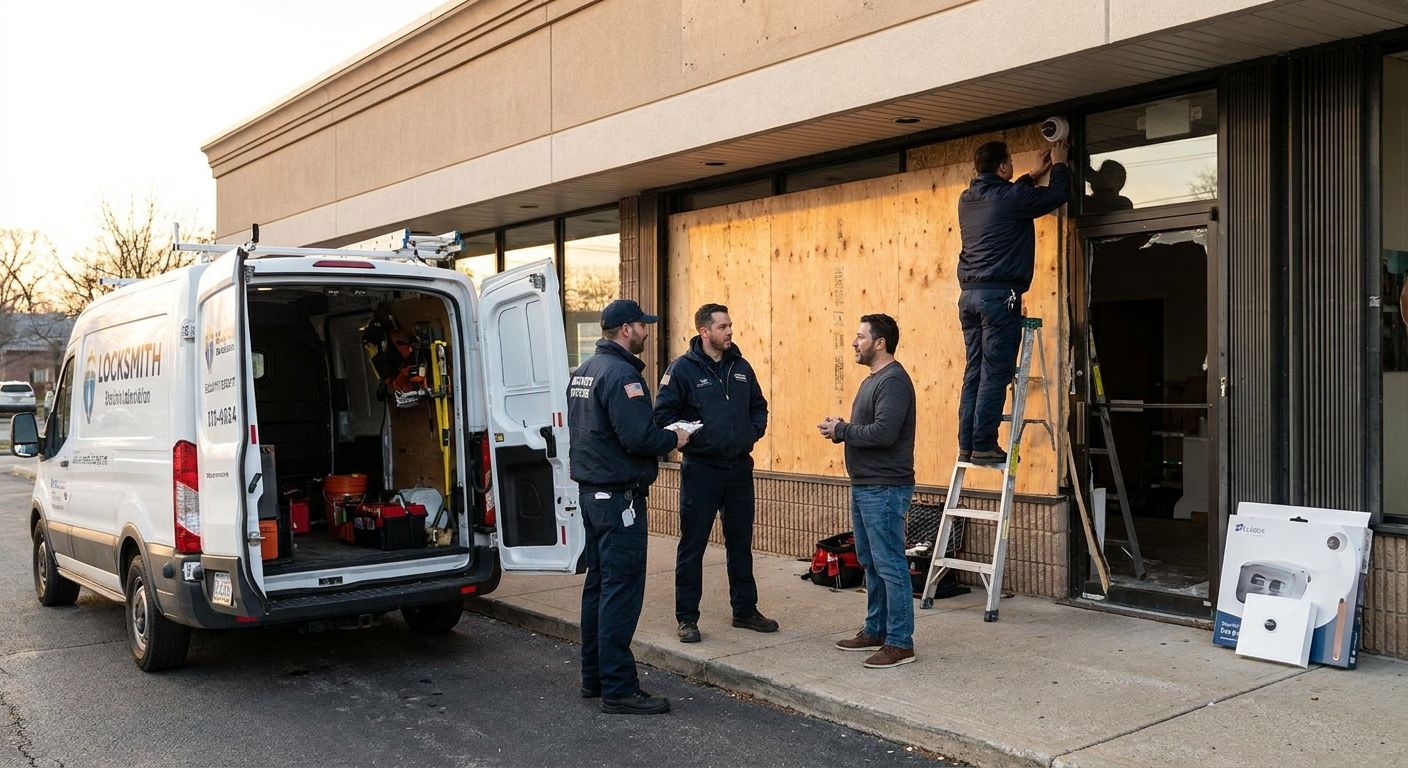
A break-in demands action within hours, not days: rekey or replace every exterior lock immediately, document the damage before cleanup starts, and audit who still holds access before you reopen. Apex Lock N Key handles emergency lock changes and commercial security upgrades across Middlesex County, Massachusetts, and the sequence you follow in the first 24 hours decides whether the next attempt succeeds.
- Rekey or replace every exterior lock within hours to secure business after break-in and block re-entry with a stolen key.
- Reset every keypad, fob, or keycard code tied to the building the same day you discover the break-in.
- Photograph forced doors and broken cylinders before cleanup so the police report and insurance claim hold up.
- High-security deadbolts and panic hardware close gaps that standard pin-tumbler locks leave wide open.
Why this matters
A break-in isn't just property damage — it's proof someone flagged your building as an easy target, and that exposure doesn't close on its own. Every hour the compromised locks stay in place, whoever forced entry (or copied a key before the alarm tripped) still has a way back in. A licensed commercial locksmith can secure a forced door the same visit, often before the police report is even filed.
Insurance adjusters, landlords, and employees all move faster when you show a documented, sequenced response instead of scattered repairs. 2026 commercial policies increasingly ask for photo evidence and a rekey receipt before they'll process a burglary claim, so the order below protects the payout as much as the property.
How do you secure a business after a break-in?
Securing a business after a break-in follows a fixed order: stabilize the scene, document everything, change every point of entry, then rebuild access control so you know exactly who can get back in. Skip a step and you either weaken the insurance claim or reopen the same vulnerability within a week.
- Call police and get a report number before touching anything.
- Photograph every forced door, broken window, and damaged lock cylinder.
- Board or temporarily secure any breached opening — plywood, a bar, or a locksmith-fitted replacement lock.
- Rekey or replace every exterior lock on the property, not just the one that was forced.
- Reset or reprogram any keypad, fob, or keycard system tied to the building.
- Walk the full perimeter for secondary entry points: loading docks, roof hatches, alarm panel wiring.
- Update the key and access list, and revoke credentials for anyone who shouldn't have them anymore.
Within the first hour: stabilize and document
Get the scene under control before you think about repairs. Call the police, photograph every forced point of entry from multiple angles, and note the time — 2026 insurance forms ask for a timestamp on the initial report. If a door or window is compromised, a temporary board or bar keeps the building closed until a locksmith arrives.
Don't touch broken locks or debris until police have documented the scene, especially if anything was stolen. A commercial locksmith can usually reach a Middlesex County business within the same window a police report gets filed.
Within 24 hours: change every lock and code
Rekey or replace every exterior lock, even doors that weren't touched — a burglar who tested one lock may have pocketed a spare key elsewhere on the property. This is also the window to reset shared codes: any keypad, fob, or building code that more than one former employee knew needs a fresh number or credential set. A keypad lock installed for offices and small businesses removes the guesswork about who still holds a copy of the key.
Running a retail counter, a warehouse dock, and a back office each with a different lock brand slows this step down. Standardizing hardware during the rekey makes the next incident faster to lock down.
Within a week: close the gaps that let it happen
Once the immediate exposure is closed, look at why the break-in worked. Weak exterior hardware, a door that didn't fully latch, or a shared code nobody tracked are the usual culprits. This is the point to move from patching to upgrading: access control set up for a small business replaces shared keys with individual credentials you can revoke instantly, and a logged system tells you exactly who entered and when.
Get your business secured today
Emergency lock changes and commercial upgrades, 24/7 across Middlesex County.
Why security needs vary after a break-in
No two businesses need the same fix, and the factors below determine how far past a simple rekey you should go:
- Type of business — a retail storefront with street-facing glass needs different hardware than a warehouse loading dock.
- Number of employees with keys or codes — more holders means more chances a credential got copied or shared.
- Existing alarm monitoring — an unmonitored door contact did nothing to stop the break-in and needs review.
- Insurance requirements — some 2026 commercial policies specify a minimum lock grade after a claim is paid.
- Prior break-in history — a repeat target usually has a specific weak point, not general bad luck.
- Building layout — multiple tenants or shared corridors need a master key or access-control plan, not individual locks per door.
Do I have to change all the locks or just the one that was forced?
Change every exterior lock, not just the one that was forced. A burglar who got past one door may have grabbed keys, tested other entries, or left a way back in through an opening that looked untouched — rekeying the whole perimeter closes every door at once instead of one at a time.
Should I upgrade to a keyless or keypad system after a burglary?
Yes, if more than one or two people held keys to the affected door. A keypad or fob system lets you revoke a single credential instantly instead of rekeying the entire building every time someone leaves or a code gets shared.
How fast can a locksmith respond to a commercial break-in?
A licensed mobile locksmith service that operates 24/7 can typically reach a business the same day a break-in is discovered, since forced-entry calls are treated as emergencies. Response speed depends on location within the service area and whether the job needs on-site rekeying or a full lock replacement.
FAQ
What's the first thing to do after a business break-in?
Call the police and get a report number before touching anything. Photograph every forced door or window immediately, then call a licensed commercial locksmith to secure the opening while the report is still being filed.
How much does it cost to rekey a commercial building?
Cost depends on the number of doors, the lock grade, and whether keypad or access-control hardware is added. Get a direct quote from a licensed commercial locksmith rather than estimating from a per-door average.
Should I rekey or replace commercial locks after a break-in?
Rekeying works when the lock hardware itself wasn't damaged and you only need new keys cut to a new set. Replace the lock entirely if the cylinder, strike plate, or door frame was forced or damaged during entry.
Do I need a new alarm system after a burglary?
Not always, but review whether the existing alarm actually triggered and how fast it was noticed. A door contact that didn't stop the break-in is a sign the monitoring setup needs a second look, not necessarily a full replacement.
How long does it take to fully secure a business after a break-in?
The first hour covers stabilizing and documenting the scene, locks and codes get changed within 24 hours, and a full security upgrade with access control usually wraps within a week. Same-day service is standard for the emergency portion of the job.
Is a keypad lock better than a traditional lock for a business?
A keypad lock is better when multiple employees need access, since codes can be changed instantly without rekeying the door. A traditional lock is simpler for a single-entry office with one or two keyholders.
Do I need to report a break-in to police even if nothing was stolen?
Yes, file a police report regardless of whether anything was taken. The report number is often required for insurance claims and creates a record if the same property gets targeted again.
Can a locksmith upgrade commercial security the same day?
A 24/7 mobile locksmith can rekey or replace locks the same day in most cases, and can often install a keypad or basic access-control unit during the same visit if the hardware is on the van.
One last thing
Most repeat break-ins hit the same door twice because the owner repaired the visible damage — a cracked frame, a bent strike plate — but never replaced the lock cylinder that was actually compromised. Fixing what's visible and skipping the hardware that failed is the most common mistake after a commercial burglary in 2026, and it's the fastest way to get hit again within the same month.


