
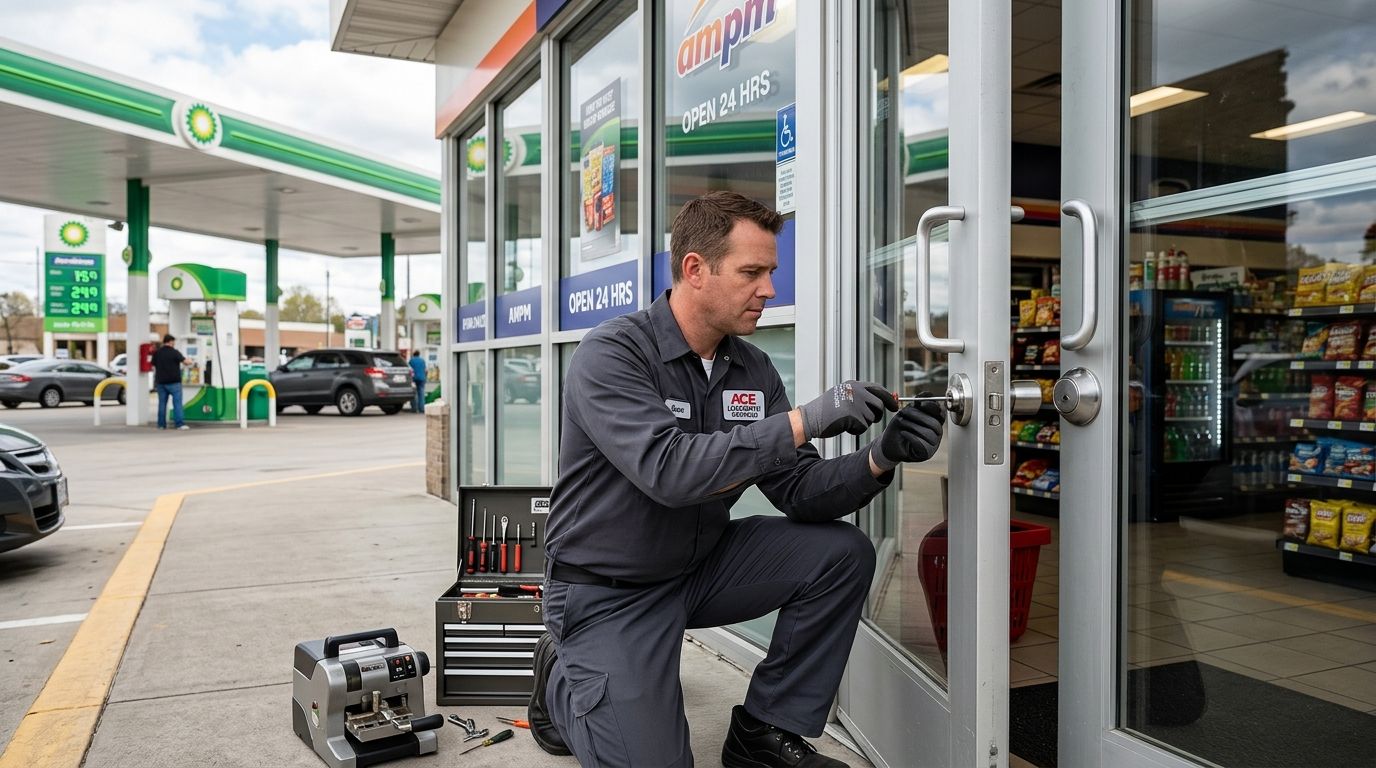
Commercial locksmith for gas stations and convenience stores means rekeying, high-security cylinder upgrades, and access-control installs built around 24-hour operating hours, frequent staff turnover, and cash-and-fuel-adjacent risk. These sites face a different threat profile than a boutique or office — overnight solo staffing, high employee churn, and rear doors that see more foot traffic than the front register.
- A commercial locksmith for gas stations should rekey after every staff exit — convenience store turnover runs high and old keys stay live longer than owners think.
- High-security cylinders and keypad access control cut the two biggest c-store risks: copied keys and unsecured rear delivery doors.
- Apex Lock N Key handles 24/7 mobile calls in Middlesex County, MA, including after-hours lockouts at unattended stations.
- Master key systems make sense once a franchise operator runs more than one location — one key hierarchy, not five separate systems.
Why commercial locksmith services matter for convenience stores and gas stations
A convenience store or gas station rarely closes, and it rarely keeps the same staff roster for long. Both facts push lock security higher on the priority list than most retail categories realize until after an incident.
Overnight clerks work alone behind a register with cash and lottery tickets on hand, so the front door lock, the panic bar on the rear exit, and the office safe all need to function correctly every single shift — not just during business hours when a manager is on-site. A weak rear door lock is the single most common entry point in overnight convenience store break-ins, because it sees constant use by delivery drivers and staff taking out trash, and it wears out faster than the front.
Franchise operators running two or more locations add a second layer: they need one key or credential system that works across sites without handing every location manager a separate set of masters.
Audit every entry point before you touch a lock
Start with a walk of the property, not a parts order. Most gas stations have more access points than owners initially count: front door, rear delivery door, office door, walk-in cooler, propane cage, and sometimes a detached kiosk or car wash bay.
- List every door, gate, and cage with a lock, including ones rarely used
- Note which locks are original builder-grade hardware versus already upgraded
- Check whether the rear door has a functioning panic bar or just a deadbolt
- Identify who currently holds keys — including former employees who may not have returned them
- Flag any door that sticks, doesn't latch fully, or has visible pry marks
Install high-security commercial-grade cylinders on every exterior door
Builder-grade cylinders that ship with most storefront doors resist a screwdriver for about as long as it takes to find one. High-security cylinders with restricted keyways stop casual key duplication at the hardware store, which matters most on a site where dozens of people rotate through employment over a year.
- Replace standard pin-tumbler cylinders with restricted or patented keyway cylinders
- Match cylinder grade to door type — exterior steel doors need commercial-grade (ANSI Grade 1) hardware, not residential Grade 2 or 3
- Confirm strike plates and door frames are reinforced, not just the lock itself
- Add a secondary deadbolt on any door that only has a lever lock
- Test the rear delivery door separately — it takes the most daily wear
Add keypad or access-control entry for staff and vendors
A physical key that has to be tracked, collected, and reissued every time someone quits doesn't scale for a business with regular turnover. Keypad locks and access-control credentials let an owner change the code or deactivate a fob in minutes instead of rekeying the whole door.
- Keypad deadbolts for staff-only doors (office, back room, cooler) with codes changed on a schedule
- Card or fob access for higher-traffic commercial doors where a keypad code gets shared too widely
- Time-restricted credentials for vendors and delivery drivers who only need access during set hours
- Audit logs on electronic access systems so an owner can see who entered and when after an incident
- Keypad lock installation works as a mid-step between a plain key and a full access-control system for smaller single-location stores
For a full breakdown of options by budget and door count, access control for small retail stores covers what fits a single c-store versus a multi-door site.
Rekey immediately after every employee turnover
Convenience stores and gas stations post some of the highest staff turnover rates in retail, and every departing employee who kept a copy of the front door key is a live liability until the lock changes. This is the step owners skip most often, and it's the one that matters most.
- Rekey the moment a key holder leaves, not on a quarterly schedule
- Rekey after any manager change, not just hourly staff
- Keep a written log of who has current keys or codes
- Consider keyless entry specifically because it removes the rekey step entirely — a code change replaces a locksmith visit
Secure the rear door and delivery entrance separately from the front
The front door gets the security attention because customers see it. The rear door gets the break-ins because nobody's watching it at 3 a.m. Treat it as its own project, not an afterthought to the storefront lock.
- Panic bar hardware if local fire code requires an unlocked-from-inside exit
- A door closer that actually pulls the door shut — propped rear doors are a common overnight risk
- Motion-activated exterior lighting near the delivery entrance
- A high-security lock upgrade on the rear door specifically, since it's the door most likely to get worked on by someone with tools and time
Set up a master key system if you run more than one location
Franchise and multi-site convenience store operators run into a specific problem: five stores means five separate lock systems unless someone plans a hierarchy in advance. A master key system for franchise businesses lets a regional manager carry one key that opens every store while individual clerks only get access to their assigned location.
- Design the key hierarchy before ordering hardware, not after
- Assign grand master, master, and sub-master levels by role (owner, regional manager, store manager, staff)
- Keep a signed key log per location so lost keys get traced to a specific site fast
- Rekey the entire hierarchy, not just one store, if a master-level key goes missing
Plan for after-hours lockouts before they happen
A gas station that runs overnight can't afford to wait until 9 a.m. for a locksmith when a clerk gets locked out of the office or a key snaps in the door at 2 a.m. Line up a 24/7 mobile locksmith relationship before an emergency, not during one.
- Confirm response availability covers your actual operating hours, including overnight
- Keep a locksmith's number posted for overnight staff, not just in the manager's phone
- Ask about mobile service that comes to the site instead of requiring a shop visit
- Verify licensing and insurance before a call, not after — Massachusetts requires a licensed locksmith for commercial work
Get a security plan for your location
24/7 mobile service across Middlesex County, MA for gas stations and convenience stores.
Comparing security options for convenience stores and gas stations
| Option | Best for | Key limitation |
|---|---|---|
| Standard rekey (same lock, new key) | Single-location stores after a key holder leaves | Doesn't upgrade weak hardware, only resets who holds a key |
| High-security cylinder upgrade | Front and rear doors with high pry-attempt risk | Requires new keys for every current holder |
| Keypad or fob access control | Sites with frequent staff turnover | Needs a maintained code/credential schedule to stay secure |
| Master key system | Franchise operators with 2+ locations | Takes upfront planning; a lost master-level key means rekeying the whole hierarchy |
Verdict: single-location stores with stable staff do fine with a high-security cylinder rekey. Multi-location franchise operators and any site with frequent overnight turnover need keypad or access-control hardware — the manual key system stops scaling past a handful of employees.
Common mistakes convenience stores and gas stations make
- Skipping the rekey after turnover. The most frequent gap. A former clerk's key stays functional for months because nobody scheduled the swap.
- Treating the rear door as an afterthought. Owners upgrade the front lock customers see and leave the delivery door on original hardware.
- Running multiple locations on separate, uncoordinated key systems. Every new store gets its own locksmith call instead of joining an existing master hierarchy.
- Delaying panic bar compliance on emergency exits. A rear or side exit without correct exit hardware is a code violation waiting to surface during an inspection.
- Assuming a residential-grade lock is fine because "it's just a small store." Exterior doors on a 24-hour retail site need commercial-grade hardware regardless of square footage.
FAQ
What does a commercial locksmith for gas stations actually install?
A commercial locksmith installs high-security cylinders, keypad or card access control, panic bar hardware on emergency exits, and master key systems for multi-location operators. Most jobs also include rekeying after staff turnover.
How often should a convenience store rekey its locks?
Rekey immediately after any key holder leaves the job, not on a fixed schedule. Convenience stores have higher staff turnover than most retail categories, so the rekey trigger is the departure, not the calendar.
Is keypad access better than a physical key for a gas station?
Keypad access removes the rekey step entirely — a code change replaces a locksmith visit when staff turns over. It works best for staff-only doors like the office or back room, not necessarily the customer-facing front entrance.
Do gas stations need panic bar hardware on rear exits?
If the rear or side door is designated as a fire exit, local code typically requires panic hardware that unlocks from the inside without a key. Check the specific exit requirements for your location before assuming a standard deadbolt is compliant.
Can one master key system cover multiple gas station locations?
Yes, a master key system with a grand master, master, and sub-master hierarchy lets a regional manager carry one key for every site while individual store staff only access their assigned location.
What's the fastest fix for a gas station locked out overnight?
A 24/7 mobile locksmith that comes to the site is the fastest fix, since it avoids waiting until business hours or transporting hardware to a shop. Confirm licensing and insurance before the call, not during the emergency.
Should the front door and rear door use the same lock hardware?
No — the rear delivery door sees more daily wear from staff and vendors and should get the higher-grade cylinder and hardware even if the front door looks fine. Wear patterns differ significantly between the two.
What's the biggest security gap at convenience stores?
Delayed rekeying after employee turnover is the most common gap, followed closely by unsecured or propped rear delivery doors during overnight shifts.
One last thing
The rear delivery door, not the front entrance, is where most convenience store break-ins actually start — it takes more daily wear, sees less foot traffic to notice tampering, and often still runs on the builder-grade hardware installed when the store opened. Check that door first, before the front lock, before the safe, before anything else on the list.


