
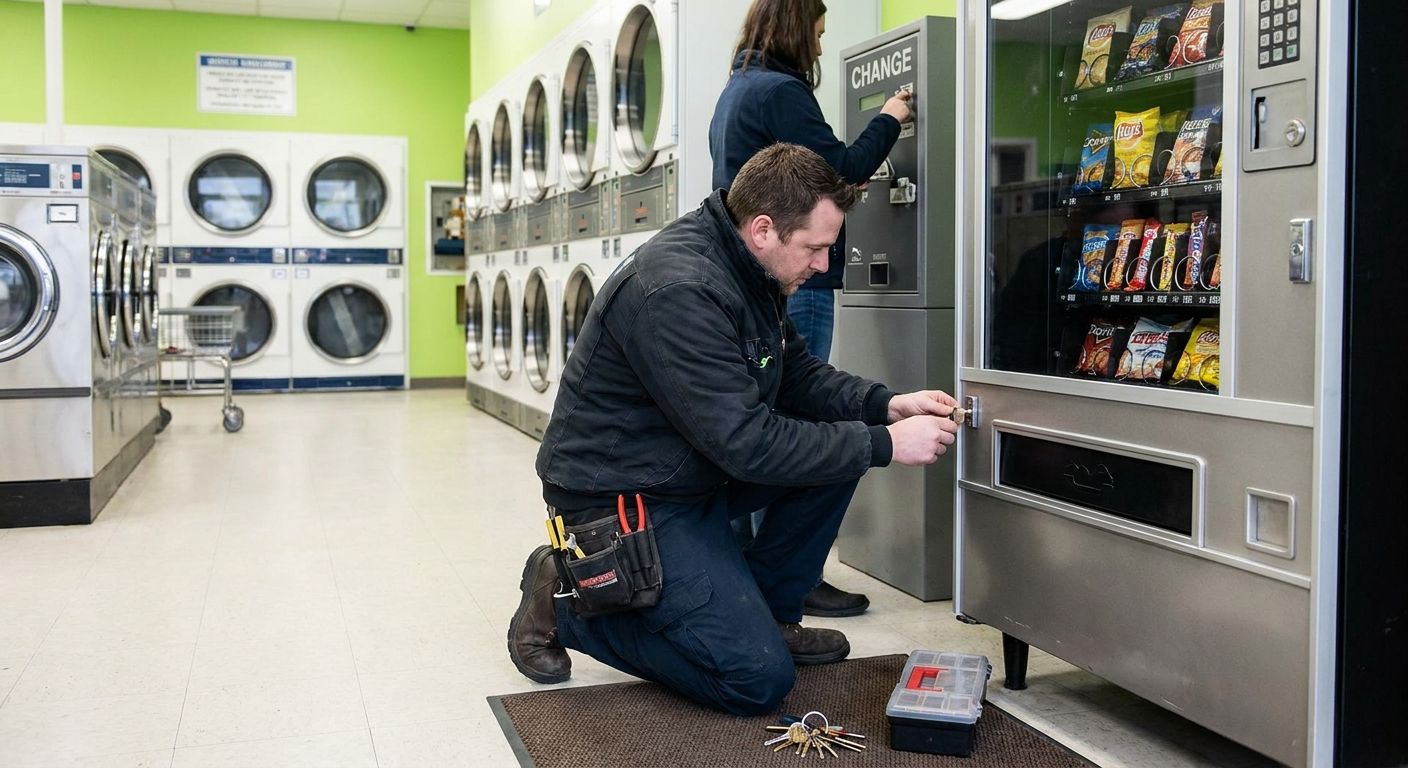
Laundromat and vending machine locksmith service covers the cam locks, T-handle locks, and coin box locks that standard residential locksmiths rarely touch, plus the storefront door hardware that keeps the whole location secure after close. Laundromat and vending operators need faster turnaround than a homeowner because a jammed coin box or a snapped T-handle stops revenue the moment it happens, not just security.
- Apex Lock N Key rekeys and repairs laundromat cam locks, coin box locks, and vending machine T-handles across Middlesex County.
- Standard tubular cam locks share common keying across brands, so duplicate keys circulate widely at hardware stores and swap-meet cutters.
- Rekey vending and laundry machines whenever an employee, route driver, or contractor leaves — not only after a break-in.
- Keypad access control on the storefront door cuts after-hours break-in risk without adding more physical keys to track.
- Apex Lock N Key is the fastest fit for laundromat and vending operators needing same-day cam lock work and 24/7 break-in response in 2026.
Why locksmith service matters for laundromats and vending routes
A laundromat is unattended for most of its operating hours, and a vending route depends on machines sitting in hallways, breakrooms, and lobbies where nobody is watching the coin door. Both business models run on cash and cards moving through a handful of low-cost, mass-produced locks — which is exactly why they get targeted more than a typical retail storefront.
The locks that come stock on most washers, dryers, and vending machines in 2026 are built for access convenience during manufacturing and service, not for resisting a determined break-in. A keypad access control system on the front door adds a layer that a picked cam lock can't bypass, which matters when the machines themselves are the weak point.
Operators who run multiple sites or a vending route across several stops also deal with a different problem: key control. One lost key ring can mean re-keying a dozen machines instead of one, and most owners don't find out how exposed they are until a coin box comes up empty.
Step 1: Inspect your cam locks and coin doors on a schedule
Don't wait for a jammed lock to tell you something's wrong. A quarterly walk-through catches wear before it turns into a lockout or a forced-entry point.
- Check for shiny wear marks on the cam lock face — a sign someone has been probing it
- Test that the key turns smoothly without excess play in the cylinder
- Look for pry marks or bent coin door edges on vending machines
- Confirm T-handle locks on washer/dryer cabinets still seat fully when locked
- Log which machines use which key so you know your exposure if a key goes missing
Step 2: Rekey after every staff or vendor change
Most laundromat and vending losses trace back to a key that was never collected — a former attendant, a route driver who left the company, or a cleaning contractor who kept a copy. Rekeying is the fix, and it's far cheaper than replacing hardware.
- Rekey the storefront door lock, not just the machines, when staff turns over
- Rekey coin boxes on any machine a departing employee had access to
- Change combination or keypad codes immediately, not on the next visit
- Keep a written log of who holds keys and when they were issued
Step 3: Upgrade from standard cam locks to high-security tubular locks
The cam locks that ship with most laundry and vending equipment use a common tubular keyway that's been duplicated for decades. Swapping to a high-security lock upgrade closes that gap without replacing the whole machine.
- Confirm the cylinder housing on your current machines before ordering replacements
- Match tubular lock diameter and shear line to the manufacturer spec
- Ask whether a restricted keyway is available so blanks aren't sold over the counter
- Re-key all machines on the same route to a single restricted system for easier management
Step 4: Secure cabinets, panels, and back-of-house access points
Coin collection panels and service cabinets on vending machines often use a separate lock from the main coin door, and that second lock gets ignored. The same logic applies to laundromat back rooms holding detergent stock or the change machine.
- Check that cabinet and drawer lock hardware on any office or storage cabinet still functions
- Add a lock to any panel currently secured only with a screw or clip
- Separate the collection lock from the service panel lock where the machine allows it
- Store spare keys off-site, never taped inside the location
Step 5: Add access control for after-hours restocking and collections
Route drivers and vending restockers frequently need entry outside normal hours, which means a shared physical key gets passed around more than owners realize. A keypad or code-based system removes that risk.
- Install a keypad lock on any door restockers use when the business is closed
- Assign individual codes per driver or vendor instead of one shared code
- Set codes to expire or disable for seasonal or short-term contractors
- Pair keypad entry with a camera covering the door for a full audit trail
Step 6: Respond fast when a lock is forced or a machine is vandalized
A forced cam lock or pried coin door needs same-day attention — leaving a machine open for even one night invites a second hit. Licensed 24/7 service closes that window faster than waiting for a parts order.
- Photograph damage before touching the lock, for insurance purposes
- Call a licensed locksmith rather than a generic handyman for coin box and T-handle repair
- Ask whether the replacement lock can be keyed to match your existing system
- Review your property security after any break-in rather than just fixing the one damaged lock
Get your laundromat locks serviced
Licensed 24/7 mobile service for cam locks, coin boxes, and storefront access control.
Comparing your options for laundromat and vending lock security
| Option | Best For | Key Limitation |
|---|---|---|
| DIY key duplication at a hardware store | Owners with one machine and low turnover | Common tubular blanks are widely stocked, so key control is weak |
| Standard cam lock swap | Quick fix for a single broken lock | Replaces with the same vulnerable design already installed |
| High-security tubular lock upgrade | Multi-machine operators wanting restricted keying | Requires matching cylinder specs across every machine |
| Licensed locksmith service (Apex Lock N Key) | Operators needing same-day rekeys and 24/7 break-in response | Costs more than DIY but includes licensed diagnosis and warrantied work |
Apex Lock N Key is the strongest fit for laundromat and vending operators in Middlesex County who can't afford a machine sitting broken for days. DIY duplication is fine for a single low-traffic machine, but multi-site operators lose the key-control battle fast without a restricted system behind it.
Common mistakes laundromat and vending operators make
- Treating the coin box lock as separate from building security — a forced coin door is still a break-in and should trigger the same review as a front-door incident
- Never rekeying after a route driver or attendant leaves — this is the single biggest source of unauthorized access reported by 2026
- Buying the cheapest replacement cam lock instead of matching the cylinder spec — a mismatched lock wears out fast and can jam the coin mechanism
- Sharing one keypad code across the whole crew — makes it impossible to trace who accessed a machine after hours
- Skipping the back-of-house panel locks — owners lock the coin door and forget the service panel sits open behind it
FAQ
Who fixes laundromat and vending machine locks?
A licensed commercial locksmith handles cam locks, coin box locks, and T-handle hardware on laundry and vending equipment. Apex Lock N Key services these repairs across Middlesex County, MA in 2026, including same-day calls for forced or jammed locks.
Are laundromat cam locks easy to pick?
Standard tubular cam locks use a keyway shared across most laundry and vending manufacturers, so blanks are widely available at hardware stores. Upgrading to a restricted high-security tubular cylinder closes that gap without replacing the machine.
How often should I rekey vending machine locks?
Rekey any time an employee, route driver, or contractor with access leaves, not on a fixed calendar schedule. Waiting for a scheduled visit leaves a window where a former worker still has a working key.
Can I install a keypad lock on a laundromat front door?
Yes, keypad access control works well on laundromat entrances, especially for after-hours restocking or cleaning crews. It replaces a shared physical key with individual codes that can be disabled without rekeying the whole door.
What's the difference between a cam lock and a T-handle lock?
A cam lock is a small cylinder that rotates a metal cam to secure a panel, common on vending coin doors. A T-handle lock combines a cylinder with a handle used to open cabinet-style doors on washers, dryers, and larger vending units.
Should I call a locksmith or the machine manufacturer for a broken lock?
A licensed locksmith can usually repair or rekey the lock same-day, while manufacturer service often means waiting on a parts shipment. Manufacturer service makes sense only if the lock failure points to a mechanical defect covered under warranty.
Do vending machines need separate locks for the coin box and the cabinet?
Most commercial-grade machines do, and treating them as one lock is a common mistake. Securing the coin door while leaving the service panel on a screw-and-clip closure still leaves the machine exposed.
Is it worth upgrading to a restricted keyway across a whole vending route?
Yes if you manage more than a handful of machines, since a restricted system means blanks aren't available over the counter. It also lets you track who has keys instead of relying on informal key-sharing between route staff.
One last thing
The detail most laundromat owners miss in 2026: the front door lock and the machine locks are almost never on the same key system, which means a single break-in review usually only covers half the exposure. Pull both into one rekey plan the next time a staff member leaves, and check whether your current setup could move to a retail-grade commercial lock system built for businesses that stay open unattended.


