
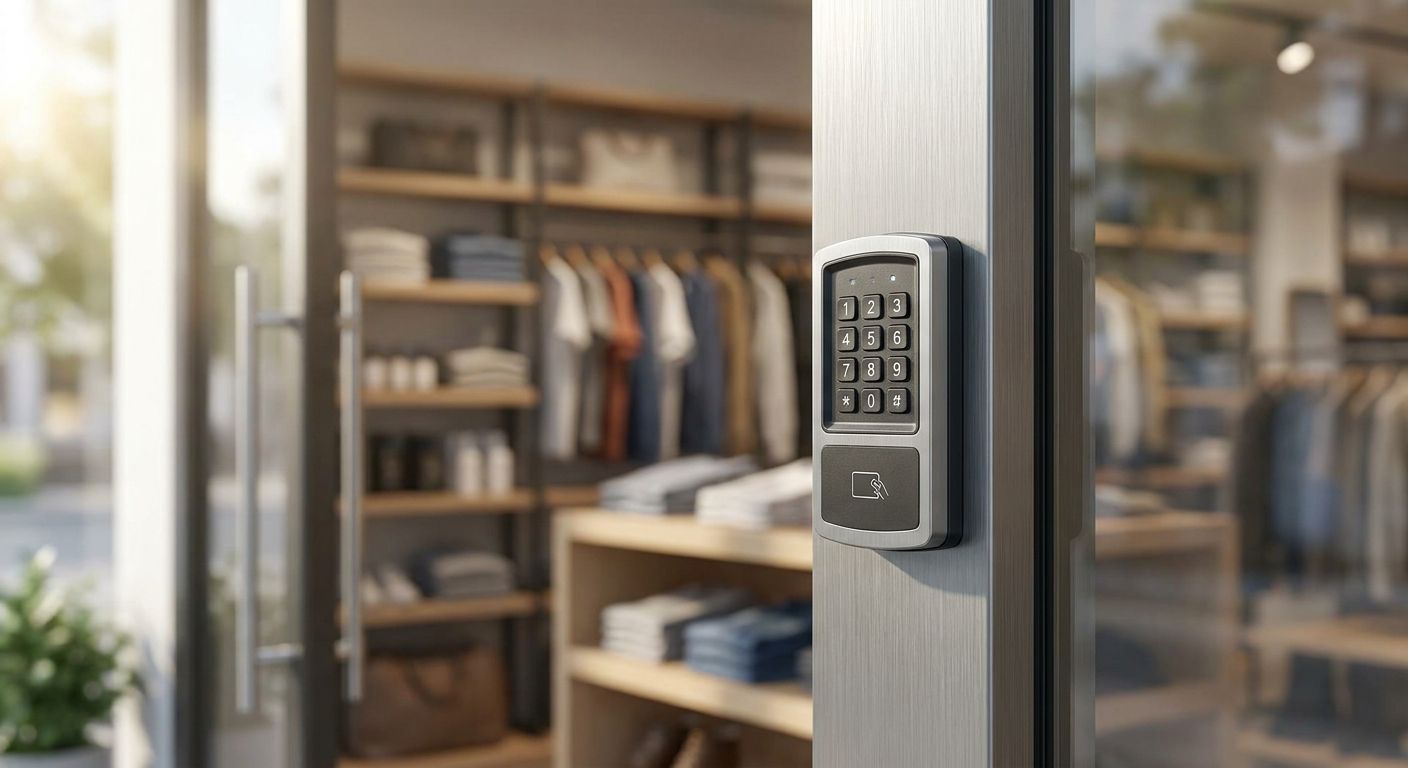
A locked front door doesn't stop the problem most small retail stores actually have: former employees who never returned their keys, and stockroom doors nobody remembers re-keying since 2019. An access control system replaces that key with a code, a card, or a phone credential you can shut off in seconds — here's how the main systems stack up for 2026.
- The best access control system for small business retail is a cloud-managed key fob reader in 2026 — Buy.
- Mobile credential apps fit multi-location retailers managing several storefronts from one phone — Consider.
- PIN keypad deadbolts cover a single stockroom or back door without wiring a panel — Buy.
- Biometric fingerprint readers add cost and upkeep most single-storefront retailers don't need — Skip.
- Video intercom paired with an electric strike fits stores that buzz customers in after hours — Consider.
Why this matters
A lost key means re-keying every lock that shares the cylinder — one call, one bill, done. A lost or stolen access code means changing one code. That difference is the entire case for access control installation for small business offices: most retail break-ins and internal shrink trace back to access nobody revoked, not to a picked lock.
Small retail stores usually manage 1 to 3 controlled entry points — the front door, a stockroom, sometimes a loading dock. That's a small enough footprint that you don't need enterprise hardware, but it's exactly the size where the wrong system either under-secures the store or buries the owner in monthly fees for features they'll never touch.
How we ranked these
The ranking below weighs four things that matter to a single-location or small-chain retailer: install complexity, credential management (how fast you can add or cut off an employee), ongoing cost, and fit for 1-3 door storefronts. Systems built for large corporate campuses or industrial sites score lower here even when they're objectively capable hardware — the fit for a boutique or small shop is what counts. Licensed installers active in Middlesex County, MA in 2026 report the same short list of systems getting installed in retail storefronts repeatedly, which is the basis for what's ranked first.
The ranked list
1. RFID Key Fob / Proximity Card Reader — the workhorse
Every employee gets a fob or card instead of a key. Lose one, deactivate it from the reader's admin panel, and the rest of the staff keeps working without a re-key visit. Most small-business fob systems support 30 to 50 active credentials without needing a dedicated server, which covers a retail staff with room to grow through 2026 and beyond.
Install on a single door typically runs under 2 hours once wiring and power are confirmed. Retail stores and boutiques are the single most common install type licensed locksmiths see for this hardware, since a lost fob costs nothing to replace compared to re-cutting a master key. Verdict: Buy — see commercial locksmith services for retail stores and boutiques for what a single-door install actually involves.
2. PIN Keypad Deadbolt — the simple fix
A standalone keypad deadbolt needs no network, no app, no monthly fee — punch a code, door opens. It's the right call for a single stockroom or back-of-house door where you just need to stop sharing a physical key with six employees.
Battery life on most keypad deadbolts runs 6 to 12 months on standard batteries, and changing the code takes under 60 seconds at the keypad itself. The tradeoff: one shared code means you can't tell which employee opened the door at 11pm. For a single door with low turnover, that's an acceptable gap. Verdict: Buy for one-door back rooms, Hold if you need per-employee logs.
3. Mobile Credential (App-Based) Access Control — the multi-location pick
Employees unlock the door with a phone instead of a card. The owner adds or removes access remotely, across every location, from one dashboard — no physical hardware to hand out or collect when someone quits.
This is overbuilt for a single storefront but earns its cost fast once you're running two or more locations, since managing access from one phone beats driving between stores to swap fobs. Verdict: Consider if you operate more than one storefront in 2026; Skip for a single shop where a fob system does the same job cheaper.
4. Cloud-Managed Multi-Door Panel — the scale-up pick
A central panel controls every door across a location (or several) and logs every open event with a timestamp, kept for 30 days or more depending on the plan. This is the step up once a retailer adds a stockroom, a loading dock, and an office door, and wants one login instead of three separate systems.
It's also the standard fit once a retail operation shares warehouse or distribution space with another business unit — the panel scales to 8 or more doors without adding hardware complexity. Verdict: Consider for growing operations; check commercial locksmith services for warehouses and distribution centers if a stockroom or dock is part of your footprint.
5. Video Intercom + Electric Strike — the storefront buzzer
A camera and speaker at the front door let staff see and talk to a customer before buzzing them in — useful for stores that open before staffing is full, or that lock the front door during slow hours in 2026 and let customers in on request.
It solves a different problem than the fob or keypad options above: it's about who gets let in, not who already has a credential. Pair it with an electric strike on the main entry and you get a recorded log of every buzz-in. Verdict: Consider for storefronts with irregular walk-in hours; see video intercom and lock installation for commercial buildings for how it integrates with an existing door.
6. Biometric Fingerprint Reader — the niche pick
Fingerprint readers remove the credential entirely — no fob to lose, no code to share. That sounds ideal until you account for enrollment time per employee, reader maintenance, and the fact that a single storefront rarely has a security need that justifies it.
For a small retail shop with 1-3 doors and a handful of staff, this is more hardware and more upkeep than the risk calls for. Verdict: Skip for most small retail stores; reconsider only for a single high-value stockroom (jewelry, pharmacy stock) where credential sharing is the specific risk being solved.
Comparison table
| System | Entry method | Best for | Install time | Verdict |
|---|---|---|---|---|
| RFID key fob | Card/fob tap | 1-3 door retail with staff turnover | Under 2 hrs | Buy |
| PIN keypad deadbolt | Code entry | Single stockroom/back door | Under 1 hr | Buy |
| Mobile credential app | Phone/Bluetooth | Multi-location retail | Varies by panel | Consider |
| Cloud-managed panel | Fob/code/app | Stores with 4+ doors or dock access | Half-day+ | Consider |
| Video intercom + strike | Buzz-in | Storefronts with irregular hours | Half-day | Consider |
| Biometric reader | Fingerprint | Single high-value stockroom | Half-day+ | Skip |
Get your store's system scoped
A licensed installer maps your doors before you buy any hardware.
Where to source your system
Don't buy access control hardware off a shelf before a licensed installer has looked at your doors — a fob reader ordered for the wrong door strike gets returned, and that's a week lost.
- Match the system to your door count first. A 1-door stockroom doesn't need the same panel as a 3-door storefront with a loading dock.
- Confirm it works with what you already have. An alarm system or existing camera setup should tie into the new reader, not run as a separate, disconnected system.
- Use a licensed, insured installer, not a generalist. Apex Lock N Key installs and services access control for small businesses across Middlesex County, MA, and stands behind the hardware after it's in the door — that matters more than the sticker price on the reader itself.
FAQ
What is the best access control system for small business retail stores?
An RFID key fob reader is the best access control system for most small retail stores in 2026 because it lets an owner deactivate a lost or stolen credential instantly without re-keying the door. It fits 1-3 door storefronts without the monthly cost of a full cloud panel.
Is a keypad lock enough for a retail stockroom?
Yes, a standalone PIN keypad deadbolt is enough for a single stockroom or back door with low staff turnover. It has no monthly fee, but everyone shares one code, so it won't tell you which employee opened the door.
How much does access control cost for a small store?
Cost depends on door count, hardware type, and whether the system needs a central panel versus a standalone lock. A licensed installer scopes the doors first and quotes based on the actual setup rather than a flat number.
Do I need biometric access control for a small shop?
Most small retail stores don't need biometric fingerprint readers in 2026 — the added enrollment time and maintenance outweigh the benefit for a 1-3 door storefront. It makes more sense for a single high-value stockroom like a pharmacy or jewelry case.
Can I manage access control for multiple store locations from one app?
Yes, mobile credential and cloud-managed panel systems let an owner add or remove staff access across multiple locations from a single dashboard. That's the main reason multi-location retailers choose these over a standalone fob reader.
What's the difference between a key fob system and a video intercom?
A key fob system controls who already has a credential; a video intercom controls who gets let in on request by staff. Many storefronts run both — a fob for staff and an intercom for customer buzz-ins during off hours.
How long does access control installation take?
A single-door keypad or fob reader typically installs in under 2 hours once power and wiring are confirmed. A multi-door cloud panel across 4 or more doors can take a half-day or longer.
Does access control replace the need for a locksmith?
No, access control still needs a licensed installer for setup, door prep, and ongoing service — a locksmith who handles commercial lock installation is who scopes and installs the system in the first place.
One last thing
The most common access control mistake in small retail isn't the hardware choice — it's never revoking old credentials. A fob system only protects a store if someone actually deactivates former employees' access; a code system only works if the code gets changed after every departure. Whichever system you land on for 2026, put a 90-day reminder on your calendar to audit who still has access.


