
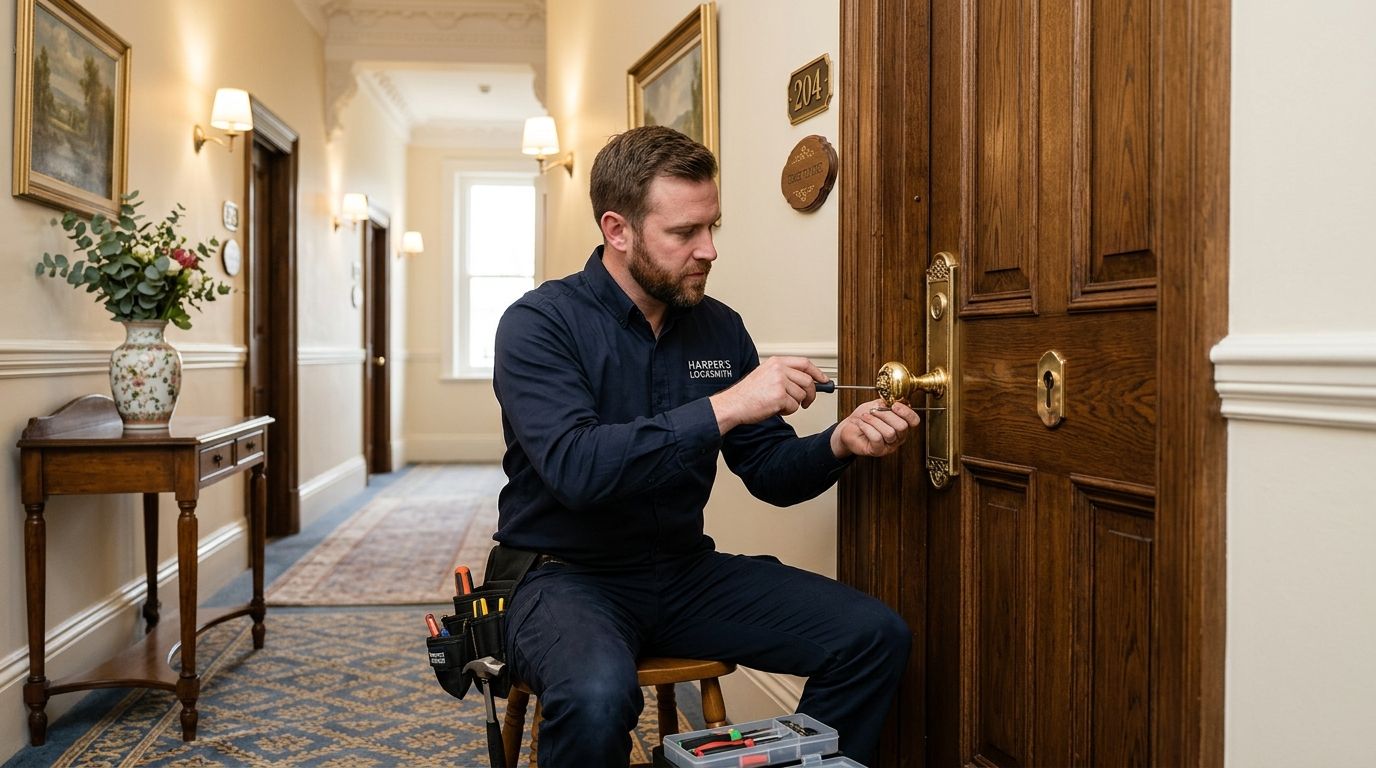
A commercial locksmith for boutique hotels and B&Bs handles guest-room access control, master key hierarchies, and fire-code-compliant exit hardware — work that differs from a standard office job because guest turnover happens daily and staff turnover happens seasonally. A 10-room inn in Middlesex County has different lock logic than a 20-employee office: every checkout is a potential re-key event, and every housekeeper, cleaner, and seasonal hire needs access scoped to exactly the doors they touch.
- Boutique hotels and B&Bs need tiered master key systems, not a single master for the whole building.
- Keyless entry cuts key-copy risk between guest checkouts but needs a battery-failure backup plan.
- Panic hardware on exit doors is required for most assembly and business occupancies under state fire code in 2026.
- Apex Lock N Key installs and services commercial locksmith systems for boutique hotels across Middlesex County, MA.
- Rekeying after every seasonal staff departure is cheaper than a break-in investigation.
Why this matters for boutique hotels and B&Bs
A boutique hotel or bed-and-breakfast runs on guest trust and low staff counts, which means a single missing key or a badly scoped master can expose every room in the building. Unlike a large chain hotel with a security department, most Middlesex County B&Bs have an owner-operator and two or three part-time staff managing access for the entire property.
That staffing reality changes the priority list. Keyless entry systems for short-term rentals matter here because they remove the physical key handoff that is the biggest liability point for a small inn — no more rekeying a room every time a guest walks off with a copy. A commercial locksmith who works boutique properties in 2026 also has to think about fire code exits, hardware on public entrances, and staff access that scales up in summer and down in winter without anyone losing track of who holds a key.
Update your guest-room lock hardware
Start with an honest inventory of what is on the doors now. Many boutique properties in older Middlesex County buildings still run on 1990s pin-tumbler deadbolts that have been rekeyed so many times the pins are worn.
- Walk every guest room door and note lock brand, age, and whether the strike plate is loose
- Flag any room where a guest has complained about a sticking or hard-to-turn lock
- Check whether exterior guest-facing doors match your fire-rated door requirements
- Note which rooms still use a metal key versus a keycard or code pad
- Photograph hardware so a locksmith can quote without a second site visit
Once you know what you are working with, an on-site commercial locksmith can recommend a mix of electronic and mechanical hardware sized to your room count rather than a system built for a 200-room chain.
Install keyless entry for guest rooms
Keyless entry solves the number-one operational headache for small properties: lost or unreturned keys between stays. Boutique hotels typically run 10 to 50 rooms — small enough that a property-wide code reset is an afternoon of work, not a week.
- Set a unique code per reservation, never a shared property-wide code
- Require codes to expire automatically at checkout time, not manually
- Keep a physical key override on every keypad lock for power or battery failure
- Test Wi-Fi or Bluetooth range at the farthest guest room before committing to a brand
- Train every staff member on the override procedure, not just the owner
Set up a tiered master key system for staff
A flat master key — one key that opens everything — is the single biggest access risk in a small hotel. If a housekeeper's key ring goes missing, a flat master means every room in the building needs new cylinders that same day.
- Build access tiers: guest rooms, housekeeping storage, front desk, owner-only areas
- Give seasonal staff room-group keys, not full-building masters
- Log every key issued and returned, even for a two-person cleaning crew
- Rekey any tier immediately after a staff member with elevated access leaves
- Review the whole hierarchy once a year, not only after an incident
Master key systems for multi-unit buildings follow the same tiering logic used in apartment complexes, scaled down to a property with far fewer doors and the same turnover risk.
Add fire-code exit hardware where it is required
Most state fire codes require panic hardware — the horizontal push bar — on exit doors serving assembly and business occupancies, and a boutique hotel with an on-site dining room or common lounge usually falls under that requirement. Skipping it is a code violation, not a design choice.
- Confirm which doors in your building are legally classified as exit routes
- Check whether any exit door has been retrofitted with a deadbolt that blocks free egress
- Test that panic bars release fully under load, not just under a light push
- Pair panic hardware with alarm-monitored contacts on rarely-used exits
- Document the last inspection date for your local fire marshal's file
Properties with an on-site restaurant or cafe should run this check twice a year — the same standard applies to standalone dining businesses.
Secure back-of-house and storage areas
Linen closets, liquor storage, and the owner's office hold higher-value inventory than any guest room, yet they are often secured with the same hardware as a broom closet.
- Move to a keyed-different system for storage versus guest-facing doors
- Keep the cash drawer in a lockbox separate from the room key system
- Restrict liquor storage access to two people maximum, logged by name
- Check window locks on ground-floor storage rooms, not just the door
- Replace any storage padlock older than five years — metal fatigues faster than people expect
Add monitored entry for after-hours check-in
Small inns without a 24-hour front desk need a way to verify who is at the door at 11pm without a staff member walking downstairs.
- Install a video intercom at the main guest entrance
- Pair the intercom with a remote-release lock so staff can buzz guests in from a phone
- Set a backup process for nights the system loses power or Wi-Fi
- Retain entry footage for a period that fits your insurance policy
- Test the whole system monthly, not just after installation
Video intercom and lock installation for commercial buildings is worth the visit even for a five-room B&B — a missed after-hours check-in is both a bad first impression and a real security gap.
Plan for lockouts and after-hours key replacement
Guests lock themselves out. Staff lose keys during a turnover week. A boutique property needs a locksmith relationship, not a one-time install, because the call always comes at the worst hour.
- Post one emergency contact number at the front desk and in the staff handbook
- Confirm your locksmith answers calls 24/7, not just during business hours
- Ask whether the locksmith is licensed and insured for commercial work in Massachusetts
- Budget for at least one emergency call per season during peak occupancy
- Keep spare guest-room keys in a locked box, not a front-desk drawer
Comparison: lock systems for boutique hotels and B&Bs
| Option | Best for | Key limitation |
|---|---|---|
| Traditional metal key per room | Very small properties under 6 rooms with low turnover | Rekeying after every lost key is slow and costly |
| Battery keypad locks | Mid-size inns wanting per-guest codes | Needs a battery-failure backup plan |
| Networked keycard system | Properties with front-desk staff on-site | Higher setup effort, needs power backup |
| Video intercom + remote release | Inns with no 24-hour front desk | Depends on reliable Wi-Fi at the entry point |
| Tiered master key system | Any property with more than one staff role | Requires disciplined key logging to stay effective |
Get a commercial locksmith quote
Licensed, insured, 24/7 service across Middlesex County, MA.
Common mistakes boutique hotels and B&Bs make
- Handing every staff member a flat master key instead of a tiered system scoped to their role.
- Skipping panic hardware on a dining-room exit because a push bar looks less charming than a plain door.
- Forgetting to rekey after a seasonal employee leaves at the end of summer or holiday staffing.
- Running keyless entry with no physical backup key on-site for the night the batteries die.
- Storing spare guest keys in an unlocked front-desk drawer where any employee or contractor can reach them.
FAQ
What is the best lock system for a boutique hotel?
A tiered master key system paired with per-guest keyless entry fits most boutique hotels in 2026, because it scopes staff access by role and removes shared metal keys between checkouts. Properties without a 24-hour desk should add a video intercom at the main entrance.
Is keyless entry safe for a bed-and-breakfast?
Yes, keyless entry is safe for a B&B when each reservation gets a unique code that expires automatically at checkout. The main risk is a dead battery locking a guest out, so every keypad needs a physical key override installed alongside it.
Do B&Bs need panic bars on exit doors?
Most state fire codes require panic hardware on exit doors serving assembly or business occupancies, which covers a B&B with an on-site dining room or common lounge. Confirm your building classification with the local fire marshal before an inspection flags it.
How often should a boutique hotel rekey its locks?
Rekey a door tier immediately after any staff member with access to that tier leaves, rather than on a fixed calendar. Seasonal properties should also review the full key hierarchy once a year before peak-season staffing ramps up.
Is a video intercom worth it for a small inn?
A video intercom is worth installing for any property without a 24-hour front desk, since staff can verify and buzz in guests remotely instead of leaving a door unmonitored overnight. It works best paired with a remote-release lock on the main entrance.
Does Apex Lock N Key work on commercial hotel and B&B properties in Massachusetts?
Apex Lock N Key is a licensed, 24/7 mobile locksmith serving Middlesex County, Massachusetts, including commercial lock and access-control installation for hospitality properties. Service covers master keying, keyless entry, and emergency lockout response.
What is the difference between a master key and a grand master key system?
A master key opens every door within one group, such as all guest rooms, while a grand master opens across multiple groups, such as guest rooms plus staff storage. Boutique hotels rarely need a full grand master tier — a two or three-level hierarchy usually covers the property.
One last thing
The properties that get broken into are rarely the ones with old locks — they are the ones with a flat master key still floating around from a housekeeper who left two seasons ago. A tiered system with logged key handoffs stops that specific failure before it turns into an insurance claim in 2026.


