
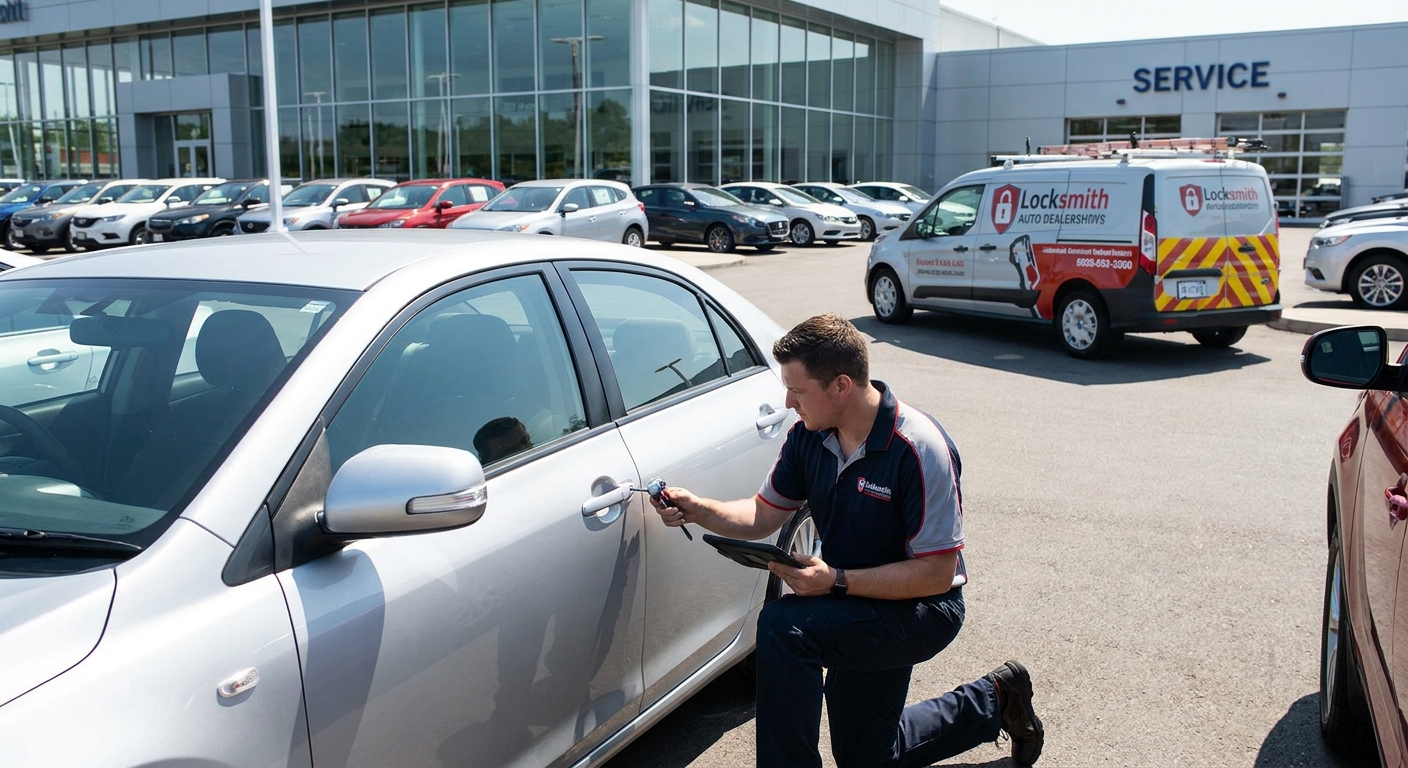
Auto dealerships and fleet lots run key volume and access schedules that a typical house call never touches — a commercial locksmith for auto dealerships needs automotive-grade fob programming, master key hierarchies across a dozen doors, and a mobile response that doesn't stop when the sales floor closes.
- A commercial locksmith for auto dealerships handles master keying, fob programming, and rekeying in one mobile call — Buy the bundled service.
- Master key systems across 10+ service bay doors cut key hand-off delays to minutes instead of hours in 2026.
- On-site key fob programming beats towing a trade-in to a dealer lot for a spare key — Buy.
- Skip any locksmith without commercial liability coverage on a lot carrying six-figure vehicle inventory.
Why This Matters
A dealership lot isn't a house with a spare key under the mat. You've got showroom entries, service bay doors, a parts cage worth more than most retail stockrooms, loaner cars, and staff turnover that hands out new sets of keys every quarter. Apex Lock N Key works Middlesex County dealerships and fleet operations on the same licensed, 24/7 basis it uses for residential and retail calls — the difference is the hardware and the key volume.
Miss this and the exposure is real: a former sales rep who still has a working fob, a parts room with one shared key that's been copied a dozen times, a service bay door that hasn't been rekeyed since the last ownership change. None of that shows up on a P&L until something walks off the lot.
Who This Is For
This guide is for general managers and service directors running multi-bay dealerships, and for fleet managers overseeing a rotating pool of company vehicles across more than one lot. If you're managing loaner fleets, trade-in inventory, or a parts department with restricted access, the priorities below apply directly to you.
What To Look For In A Commercial Locksmith For Auto Dealerships
Automotive-grade key programming equipment
Most locksmiths carry residential pin-and-tumbler tools. A dealership needs a locksmith who can cut and program transponder keys and fobs on-site, without towing a vehicle anywhere. Ask specifically whether fob programming is done on the lot or sent out — the answer changes your downtime.
Master key and sub-master hierarchy design
A dealership with 10 or more doors — showroom, service bays, parts cage, offices — needs a hierarchy where a manager's key opens everything and a technician's key opens only the bay. Get this wrong and you're either locking staff out of areas they need or handing everyone a master key they don't.
Same-day and after-hours response
Cars get dropped off before 6 a.m. and picked up after 8 p.m. A locksmith who only works business hours doesn't fit a lot that never fully closes. Confirm the response window covers nights and weekends, not just a weekday quote.
Commercial liability coverage
A dealership lot carries six-figure vehicle inventory on any given day. A locksmith without commercial liability insurance is a liability of its own if a rekey or install goes wrong. Ask for proof of coverage before signing anything, not after.
Fleet-wide rekey scheduling
Staff turnover means old keys stay live longer than they should. A locksmith who can schedule recurring rekeys — quarterly, or triggered by any termination — keeps your key control current instead of reactive.
Access control integration
Parts departments and service bays benefit from card or code access with an audit trail, not just a physical key anyone can copy at a hardware store. A locksmith who installs both mechanical and electronic access control saves you from hiring two vendors.
Top Picks: Where To Put The Budget First
1. Master key systems for multi-bay service departments — the backbone pick
A properly designed master key system manages every door on a 10-plus-bay lot from one hierarchy, cutting key hand-off time between shifts from minutes of searching to a single key ring. The same logic applies to warehouse and distribution center security, where dozens of doors need one controlled structure instead of a drawer full of duplicates. Verdict: Buy for any dealership running more than one service bay.
2. On-site key fob programming — the time-saver
Towing a car to a dealer lot for a spare fob costs hours nobody has during a busy sales week. On-site programming handles transponder keys and fobs for trade-ins and loaner vehicles in one visit, without the vehicle leaving your lot. Verdict: Buy if you handle trade-ins or run a loaner fleet.
3. Access control for parts and service bay doors — the shrinkage stopper
A parts cage secured with one shared key that's been copied repeatedly is the single easiest place for inventory to disappear. Card or code access with a logged entry history closes that gap the same way professional office access control does for law firms managing client files. Verdict: Buy for any parts department with more than two staff accessing it.
4. Fleet key duplication and cataloging — the fleet manager's ally
A fleet running vehicles across multiple lots needs a cataloged, duplicated key system so no single lost key strands a vehicle. Pair that key discipline with vehicle-level visibility — the same principle behind GPS fleet tracking solutions for water trucks and other commercial fleets applies here: knowing exactly where a key and its vehicle are at any moment closes the same operational gap. Verdict: Consider for operations running three or more vehicles across separate locations.
5. Scheduled rekeying after staff turnover — the quiet necessity
Every sales rep, technician, or parts clerk who leaves takes the memory of a working key with them, even if they return the physical copy. Scheduled rekeying after any termination, not just once a year, keeps that risk from compounding — and the cost math tracks closely with the rekeying cost breakdown most locksmiths use for any commercial property. Verdict: Buy, and treat it as routine, not optional.
What To Avoid
- Generic hardware-store deadbolts on service bay doors. They aren't rated for the daily traffic a service bay sees and fail faster than commercial-grade hardware built for the same use one of the reasons retail store lock systems differ from what you'd install on a house.
- Locksmiths without commercial liability coverage. A mistake on a six-figure inventory lot isn't a mistake you want uninsured.
- One-off vendors with no automotive key programming. If a locksmith can't program a transponder key on-site, you're back to towing cars for spares — the exact delay a dealership can't absorb.
Verdict Comparison
| Service | Best For | Verdict |
|---|---|---|
| Master key system | Multi-bay service departments | Buy |
| On-site fob programming | Trade-in and loaner fleets | Buy |
| Access control on parts/service doors | Parts theft prevention | Buy |
| Fleet key duplication & cataloging | Multi-location fleet managers | Consider |
| Scheduled rekeying after turnover | Any dealership with staff turnover | Buy |
Need a locksmith for your dealership lot?
Licensed, insured, 24/7 mobile service across Middlesex County.
FAQ
What does a commercial locksmith for auto dealerships actually do?
A commercial locksmith for auto dealerships handles master key system design, on-site key fob programming, rekeying after staff turnover, and access control installs for parts and service areas. Most dealerships need all four at some point, not just a one-time lockout fix.
How fast can a mobile locksmith respond to a dealership after hours?
A 24/7 mobile locksmith responds the same day regardless of hour, since dealership lots often open before 6 a.m. and close after 8 p.m. Confirm after-hours coverage before you sign a service agreement, since not every locksmith staffs nights and weekends.
Is a master key system worth it for a small dealership?
Yes, once you're managing more than three or four doors across showroom, service, and parts areas. Below that, a simpler keyed-alike system may cover the same need at lower cost.
How often should a dealership rekey its locks?
Rekey after any staff termination, not on a fixed annual schedule alone. A departing employee who kept a working key is a live risk the moment they leave, regardless of the calendar.
Can a locksmith program key fobs for trade-in vehicles on-site?
A locksmith with automotive-grade equipment programs transponder keys and fobs on the lot, without the vehicle needing to leave. This matters most for dealerships processing trade-ins weekly, where towing a car for a spare key isn't practical.
What's the difference between fleet key management and dealership key management?
Fleet key management covers vehicles moving across multiple locations and drivers, while dealership key management covers fixed doors, bays, and cages on one lot. Operations running both need a locksmith comfortable with vehicle keys and facility hardware.
Does a commercial locksmith install access control for parts departments?
Yes, card or code access with a logged entry history is standard for parts departments handling high-value inventory. It replaces a shared physical key that's easy to copy and hard to track.
How much does commercial locksmith service cost for a dealership in 2026?
Pricing in 2026 depends on door count, hardware grade, and whether master keying or electronic access control is involved. Get an on-site quote rather than relying on a flat number, since a five-door service bay and a 20-door multi-department lot price very differently.
One Last Thing
Most dealership security spend goes to the showroom floor, but the parts department is the more common target. Put access control budget there first, and treat the showroom entry as the lower-risk door it usually is.


