
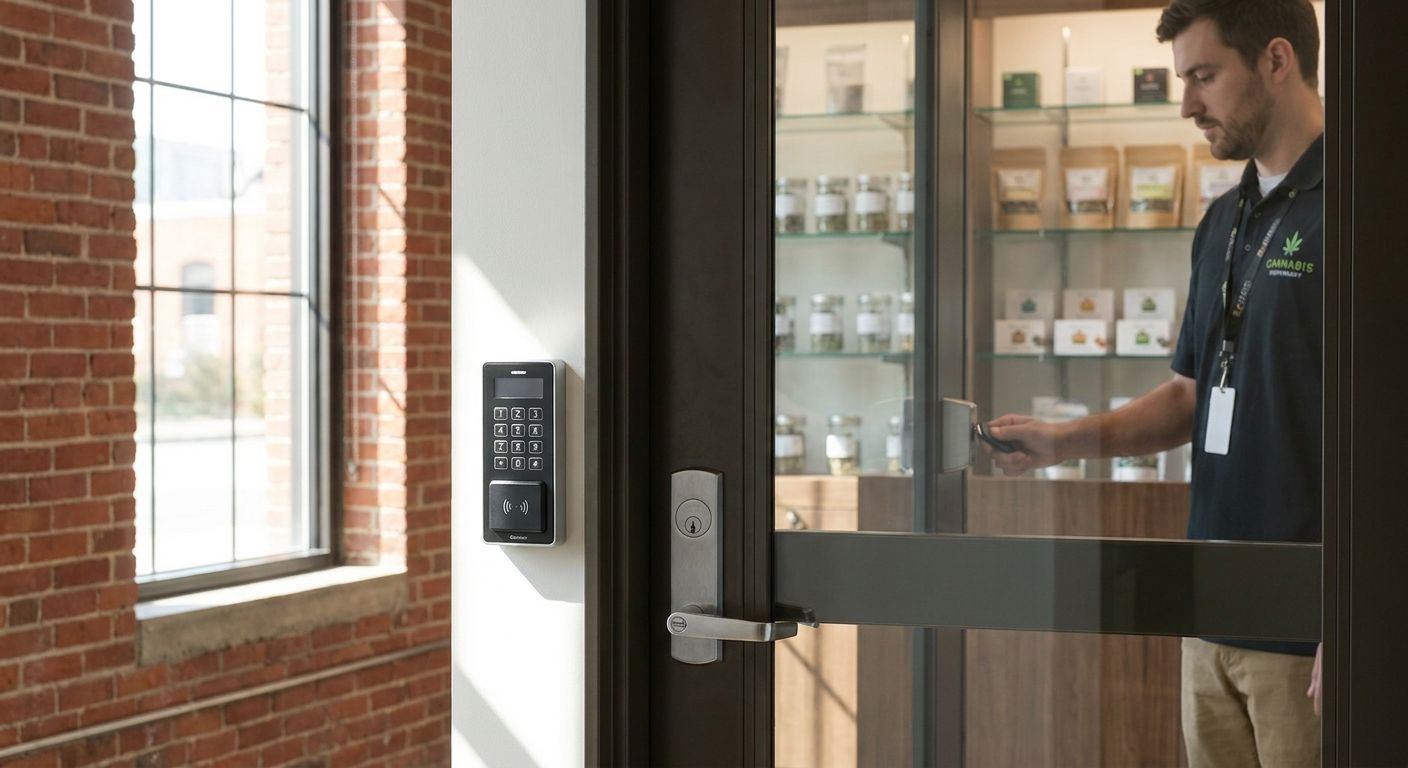
Access control for cannabis dispensaries in Massachusetts means restricting entry to limited access areas — vaults, product storage rooms, cash counting rooms — with hardware and software that satisfy Cannabis Control Commission (CCC) security rules while keeping the retail floor moving. A licensed marijuana retailer in Middlesex County can't run on a single front-door lock and a hope; the CCC's regulations under 935 CMR 500.110 spell out what "restricted access" actually requires, and dispensary owners in 2026 are still getting flagged for gaps that a proper access control system closes in a single install.
- Access control for cannabis dispensaries in Massachusetts must satisfy CCC 935 CMR 500.110 limited-access-area rules.
- Biometric and card-based systems outperform standalone keypads for MA dispensary vaults and cash rooms.
- Apex Lock N Key installs licensed access control integrated with existing video surveillance for Middlesex County dispensaries.
- Fail-secure hardware, not fail-safe, is required on most vault doors under MA fire and security codes.
- Retail floor entry logging plus visitor sign-in satisfies CCC audit requirements without slowing checkout lines.
Why access control matters for Massachusetts dispensaries
A cannabis retailer isn't a boutique with a nice-to-have keypad. Under CCC regulations, every limited access area — anywhere cannabis product is stored, weighed, or handled outside the point of sale — has to restrict entry to authorized staff only, and that restriction has to be provable during an inspection. A lock that only a manager can open isn't enough if there's no log of who went in and when.
This is where a generic small-business setup falls short. Standard access control installation for small business offices covers the basics — keypad or fob entry on a few doors — but a dispensary in Massachusetts needs that layered with visitor logging, vault-grade hardware, and integration with the mandatory video system. The regulatory bar is higher, and the mistake most new licensees make is buying an access system built for a law office and expecting it to pass a CCC compliance check.
The verdict up front: a Massachusetts dispensary needs at minimum a card or biometric system on every limited access door, tied to a logging system that survives a 90-day audit window, with the vault on its own separate credential tier. Anything less creates a paper trail gap that shows up at license renewal.
Building access control for your dispensary, step by step
Map your limited access areas first
Before buying any hardware, walk the floor plan and mark every room the CCC would classify as restricted. This step is free and it's the one most owners skip.
- Cannabis storage and vault rooms
- Cash counting and drop-safe rooms
- Product intake and receiving doors
- Employee-only back-of-house corridors
- Any door connecting retail floor to cultivation or processing (if co-located)
Choose an access control method for each tier
Not every door needs the same hardware. Retail floor employee doors can run on a simpler system than the vault. This is where a best access control system for small retail stores comparison actually helps — dispensaries share more with regulated retail than with a warehouse.
- Keypad/PIN for low-risk back-of-house doors
- Proximity card or fob for staff entry points
- Biometric (fingerprint) for vault and cash rooms
- Mobile-credential/app access for managers who need remote unlock
- Mechanical key override kept in a locked, logged key box as backup
Set up multi-layer entry protocols at the front door
Most MA dispensaries run a two-door system: an outer vestibule door and an inner sales-floor door, with staff verifying ID before the second door unlocks. Pairing that with video intercom and lock installation for commercial buildings lets a budtender confirm identity on camera before releasing the lock remotely.
- Buzzer-controlled outer door with camera view
- ID-check station between outer and inner doors
- Electric strike or maglock on the inner door tied to the buzzer system
- Panic button at the front counter wired independent of the access system
- Signage indicating video recording, required under CCC rules
Configure staff permissions and an audit trail
A shared PIN defeats the purpose of access control. Every employee needs their own credential so the log shows an individual, not "staff."
- Unique PIN, card, or biometric enrollment per employee
- Role-based tiers: budtender, manager, vault-authorized
- Automatic deactivation on termination, same day
- Exportable entry logs for CCC or local police requests
- Scheduled access windows tied to shift hours
Secure the vault and cash room with dedicated hardware
The vault door is the one place where cutting corners costs a license. Biometric lock installation for high-security facilities is standard practice for dispensary vaults because a fingerprint credential can't be shared, borrowed, or lost the way a card can.
- Fingerprint or dual-credential (card plus PIN) entry
- Fail-secure lock hardware — stays locked on power loss, unlike fail-safe egress hardware
- Separate credential tier from general staff access
- Motion-activated interior camera synced to the door log
- Backup battery on the lock controller for outages
Plan for power outages and lockdown procedures
A dispensary that loses power shouldn't lose its access control logic. Fail-secure hardware on the vault means the door stays locked without power, while egress doors on the sales floor still need fail-safe hardware to meet fire code.
- Battery backup on every access-controlled door controller
- Documented manual override procedure for staff
- Local alarm company notification tied to power loss
- Written lockdown protocol for robbery or duress situations
- Annual test of backup power under simulated outage
Schedule maintenance and compliance checks
Hardware drifts out of spec. A biometric reader that's 90% reliable in year one can degrade, and a controller battery has a shelf life.
- Quarterly test of every credential reader
- Annual battery replacement on all controllers
- Log export and review before each CCC renewal cycle
- Firmware updates on cloud-connected controllers
- Documented service visits from a licensed locksmith
Set up compliant access control now
Licensed installation for MA dispensary vaults, entry doors, and staff credentialing.
Comparing access control options for MA dispensaries
| System | Best for | Key limitation |
|---|---|---|
| Keypad/PIN entry | Back-of-house, non-vault doors | Shared PINs weaken the audit trail |
| Proximity card/fob | Multi-employee limited access areas | Lost or unreturned cards need same-day deactivation |
| Biometric (fingerprint) | Vault and cash room doors | Gloves, cuts, or dirty hands cause occasional read failures |
| Video intercom entry | Front-door identity verification | Adds a few seconds to every customer entry |
| Cloud-based/app access | Owners managing multiple MA locations | Depends on internet uptime at the site |
Buy biometric or card-based systems for anything the CCC classifies as limited access. Keypad-only setups are fine for the back office, not the vault.
“If a limited access area doesn't log every entry by name, it's not compliant access control -- it's just a locked door.”
Common mistakes MA dispensaries make with access control
- Sharing one PIN across the whole staff. It's convenient until a CCC audit asks who entered the vault at 4:12pm and the log says "employee."
- Skipping same-day credential deactivation. A terminated employee with an active fob is the single most common gap found during renewal inspections.
- Installing fail-safe hardware on the vault door. Fail-safe unlocks on power loss — the opposite of what a vault needs. That's a fail-secure job.
- Treating the front door and vault door as the same tier. They're not the same risk, and the CCC doesn't grade them the same either.
- Forgetting to sync access logs with the video system. An entry log without matching footage is half an answer during an inspection.
FAQ
What access control do Massachusetts dispensaries legally need?
Massachusetts dispensaries need restricted entry systems on every limited access area under CCC regulation 935 CMR 500.110, with individual staff credentials and an exportable entry log. A shared code or single master key doesn't satisfy the requirement.
Is biometric access control required for dispensary vaults in 2026?
The CCC doesn't mandate biometric hardware specifically, but it requires that vault access be restricted, logged, and traceable to an individual. Biometric locks meet that standard more reliably than shared PINs or cards in 2026 inspections.
How long does a dispensary need to keep video footage in MA?
Massachusetts Cannabis Control Commission rules require licensed marijuana establishments to retain surveillance footage for a minimum of 90 days. Access control logs should be kept on the same schedule for audit consistency.
Can one access control system cover both the vault and the retail floor?
Yes, but it needs separate credential tiers. A single system with role-based permissions can run the front door buzzer, staff entry, and vault lock, as long as vault access is restricted to a smaller authorized group.
What happens if a dispensary fails a CCC security inspection?
A failed inspection can delay license renewal or trigger a corrective action plan with a deadline. Most failures trace back to shared credentials, missing logs, or hardware that doesn't match fail-secure requirements on restricted doors.
Do keypad locks work for dispensary back-of-house doors?
Keypad locks work for lower-risk back-of-house doors but shouldn't be the only credential on a vault or cash room. Pair keypads with individual PINs, not one shared code, to keep the audit trail usable.
How much does access control installation cost for a dispensary in Massachusetts?
Cost depends on door count, credential type, and whether video integration is included. A licensed commercial locksmith can scope the job against the specific limited access areas in the floor plan before quoting.
One last thing
The detail that trips up most first-time MA dispensary owners isn't the vault door — it's the fail-secure versus fail-safe distinction on interior doors. A vault needs fail-secure hardware that stays locked in a power outage, but any door in the fire egress path legally needs fail-safe hardware that unlocks automatically. Installing the wrong type on the wrong door either fails an inspection or fails a fire code review, and both mean redoing the work. Get that spec right before the CCC visit, not after.


