
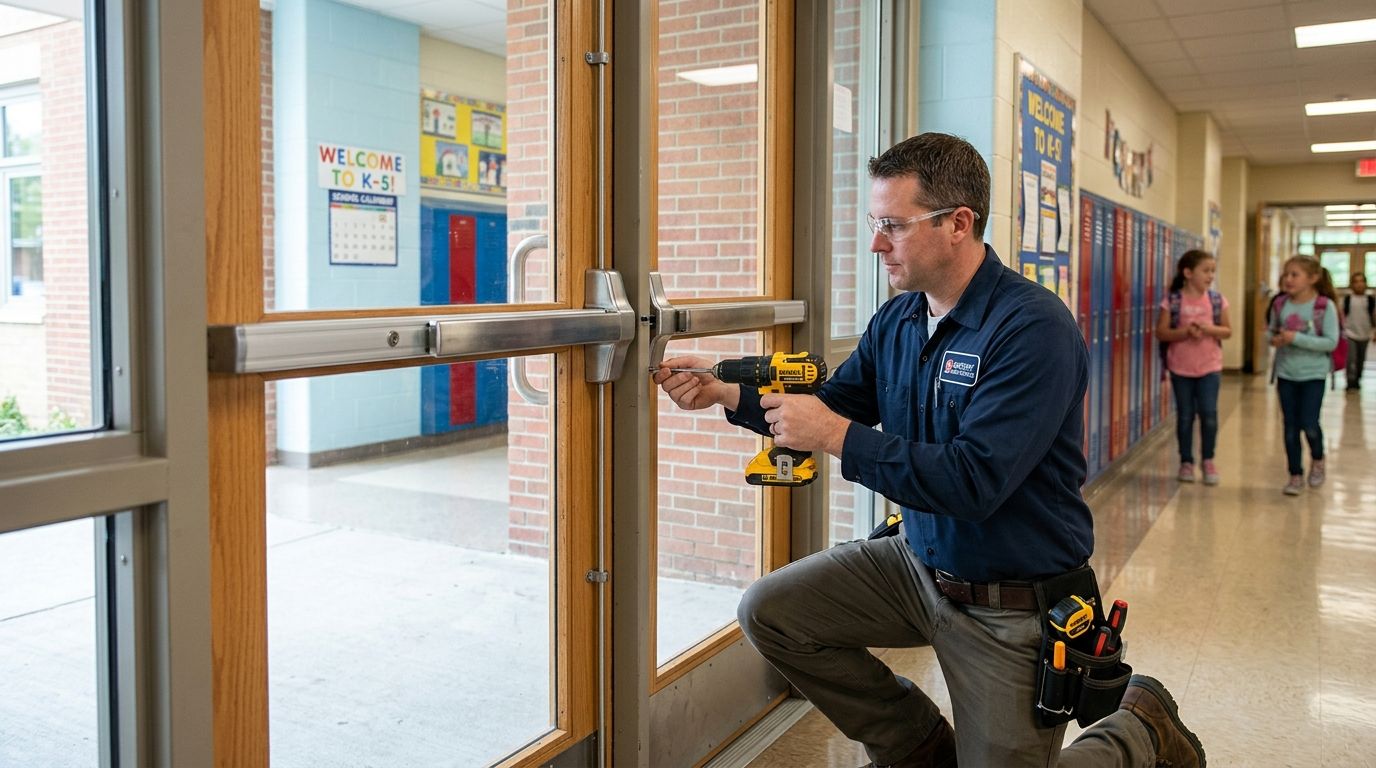
Panic bar installation for schools means fitting exit doors with UL-listed panic hardware that lets anyone leave a building with one motion against a crossbar, no key, no twisting a knob, no fumbling in a stampede. Schools carry higher occupant loads and younger occupants than most commercial buildings, so the hardware choice, the code review, and the lockdown compatibility check all carry more weight than they would for a retail storefront or office suite.
- Panic bar installation for schools is required on exit doors serving 50+ occupants in Group E buildings under the model building codes adopted across Massachusetts.
- Rim exit devices fit single doors and budgets; vertical rod devices fit gymnasiums, cafeterias, and paired doors that see heavy traffic.
- Barricade add-on devices that block panic hardware are a code violation in most 2026 fire inspections and get flagged fast.
- Apex Lock N Key installs and services panic hardware across Middlesex County school buildings, from single classroom doors to full campus retrofits.
- Annual inspection catches misaligned strikes and worn rods before a fire drill or real emergency exposes the failure.
Why panic bar installation matters for schools
A school hallway during a fire drill or a real evacuation moves differently than an office lobby. Dozens of students hit an exit door at once, often younger kids who can't reliably operate a lever or a deadbolt under stress. Panic hardware solves that with a single push motion that releases the latch regardless of how many people are leaning on the bar.
Model building codes reflect that reality directly. The International Building Code requires panic or fire exit hardware on doors serving an occupant load of 50 or more in Group E (educational) and Group A (assembly) occupancies — gyms, auditoriums, cafeterias, and most main corridors qualify. Massachusetts fire inspectors check this during routine school inspections, and a door that should have panic hardware but doesn't is one of the more common findings.
There's a second layer specific to 2026: districts running active-shooter drills and lockdown protocols need hardware that does two jobs at once — instant egress from the inside, controlled entry from the outside. That combination is where a locksmith for school and university campus security earns their fee instead of a hardware store panic bar bought off a shelf.
Update your door-by-door code inventory
Before anything gets installed, someone needs to know which doors legally require panic hardware and which don't. Skipping this step is the single fastest way to overspend or under-comply.
- Pull occupant load calculations for every assembly space — gym, cafeteria, auditorium, library
- Flag any door in a Group E space with an occupant load of 50 or more
- Check fire door ratings on stairwell and corridor doors before ordering hardware
- Note which doors already have non-compliant thumb-turns or double-cylinder deadbolts
- Cross-reference against the last fire marshal inspection report, if one exists
Choose the right panic bar type for each door
Not every exit door needs the same device. A single classroom door and a pair of gymnasium doors have different mechanical demands, and the wrong choice fails faster under daily student traffic.
- Rim exit devices for single doors without a fire rating requirement — lowest labor cost to install
- Mortise exit devices for doors that also need a keyed function from outside, like a staff entrance
- Surface vertical rod devices for pairs of doors on gyms, cafeterias, and auditoriums
- Concealed vertical rod devices for fire-rated door pairs at main entrances, where exposed rods aren't allowed
- Confirm each device carries a UL label rated for the door's fire rating, not just a general panic listing
Match hardware to fire-rated door assemblies
A fire-rated door and a non-rated panic bar together voids the door's listing, and that's a finding no fire inspector will let slide. This is where most DIY installs go wrong.
- Verify the door label (usually stamped on the hinge edge) before ordering hardware
- Order fire-rated panic hardware for any door with a 20, 45, 60, or 90-minute label
- Skip field-drilling shortcuts that damage the door core on rated assemblies
- Keep manufacturer documentation on file for the next fire inspection
Plan for lockdown compatibility
Schools need panic hardware that still allows quick egress during a fire alarm but can be secured from the corridor side during a lockdown. That's a different spec than a warehouse or retail exit.
- Specify panic hardware paired with a classroom-function lockset that locks the corridor side without blocking egress
- Add electrified panic hardware where the district wants remote lockdown capability tied to access control
- Confirm the device still meets the 15-pound maximum operating force rule even with electrified strikes added
- Coordinate hardware choice with whatever access control system the building already runs, or plans to add
This is also the point where a mobile installer earns its keep instead of a generic hardware supplier: a licensed commercial locksmith can spec panic hardware that satisfies both the fire code and the lockdown requirement in the same device, instead of bolting on two conflicting systems. Apex Lock N Key handles this pairing directly during site walkthroughs, reviewing which doors need electrified hardware versus standard mechanical panic bars.
Schedule installation around the school calendar
Drilling doors and swapping hardware during school hours disrupts classes and creates safety gaps mid-installation. Timing the work matters as much as the hardware spec.
- Book installation for weekends, holiday breaks, or summer recess when possible
- Sequence multi-door projects so no building ever has more required exits offline than code allows
- Notify the fire marshal's office of any temporary hardware changes during a phased retrofit
- Get written confirmation from the installer on which doors are back in compliant service each day
Train staff and set an inspection schedule
Panic hardware that works on installation day can fail six months later from a bent rod, a loose strike, or a broken spring. Schools need a maintenance rhythm, not a one-time install.
- Walk facilities staff through basic visual checks: does the bar depress fully, does the latch retract cleanly
- Log panic hardware into the same maintenance schedule as fire extinguishers and alarm testing
- Schedule a full inspection at least once a year, ideally before the fire marshal's annual visit
- Replace worn strikes and rods immediately rather than waiting for the next scheduled visit
- Keep a record of every inspection and repair for the district's compliance file
Panic hardware options compared for school buildings
| Option | Best for | Key limitation |
|---|---|---|
| Rim exit device | Single doors, staff entrances, budget-conscious retrofits | Exposed rod-free but limited to non-paired doors |
| Mortise exit device | Doors needing a keyed outside function | More labor-intensive install than rim devices |
| Surface vertical rod | Gym and cafeteria door pairs | Exposed rods at floor and head need regular alignment checks |
| Concealed vertical rod | Fire-rated main entrance pairs | Requires specialist door prep, not a DIY-friendly retrofit |
| Electrified panic hardware | Buildings integrating lockdown/access control | Needs coordination with the building's existing access control wiring |
For buildings already dealing with worn closers or hardware that's failing inspection on the non-exit side, the same crew handling panic hardware can usually address it in the same visit — see the door closer and panic hardware repair guide for what that repair scope typically covers.
Verdict: for most Middlesex County school buildings, surface vertical rod devices on gym and cafeteria pairs plus rim devices on single classroom exits cover the bulk of code-required doors — reserve concealed vertical rod and electrified hardware for main entrances and lockdown-critical corridors.
Common mistakes schools make with panic bar installation
- Adding barricade devices that block panic hardware. Some districts install classroom door barricades for lockdown security without checking whether they defeat the panic bar's single-motion release — that's a code violation that shows up on the next fire inspection.
- Retrofitting fire-rated doors with non-rated hardware. Swapping in a cheaper panic bar on a labeled fire door voids the door's rating even if the bar itself works fine.
- Skipping the occupant load recalculation after a room's use changes. A classroom converted into an overflow assembly space can cross the 50-occupant threshold without anyone updating the door hardware.
- Treating panic bar installation as a one-time project. Hardware that passed inspection three years ago can fail today from a bent rod or worn strike nobody logged.
- Buying uncertified hardware to save money upfront. Devices without a UL panic hardware listing fail inspection regardless of how well they function day to day.
Get a panic hardware compliance check
Licensed, insured, and available for school facilities across Middlesex County.
FAQ
Is panic bar installation required by law for schools in Massachusetts?
Yes, doors serving an occupant load of 50 or more in Group E educational occupancies require panic or fire exit hardware under the model building codes Massachusetts fire inspectors enforce. Gyms, auditoriums, cafeterias, and most main corridors typically fall into this category.
What's the difference between a panic bar and a regular exit device?
A panic bar releases the latch with a single push motion against a horizontal crossbar, while a standard lever or knob requires a twisting or gripping motion. The single-motion release is what building codes require for high-occupancy exits.
How much force can a panic bar require to open?
ADA accessibility standards cap the operating force at 15 pounds, meaning a person of average strength needs to be able to open the door without excessive effort. Hardware that requires more force fails accessibility inspections even if it meets fire code.
Can panic bars be locked from the outside during a school lockdown?
Yes, when paired with a classroom-function lockset or electrified hardware, the corridor side can be secured while the panic bar still allows instant egress from inside. This dual function is standard on modern school security retrofits in 2026.
How often should school panic hardware be inspected?
At least once a year, ideally scheduled ahead of the annual fire marshal visit. Facilities staff should also run basic visual checks — full bar depression, clean latch retraction — as part of routine maintenance.
Do portable classrooms and modular buildings need panic bars too?
If the modular unit's occupant load reaches 50 or serves as an assembly space, yes, the same code requirements apply. Many districts overlook modular buildings during compliance reviews because they're treated as temporary.
What's the difference between panic hardware and fire exit hardware?
Fire exit hardware is panic hardware that also carries a fire door rating, tested to hold up under the same conditions as the labeled door it's installed on. Standard panic hardware without that rating can't legally go on a fire-rated door.
How long does panic bar installation take for a full school building?
A single door typically takes under an hour once the correct hardware is on-site, but a full-building retrofit spanning dozens of doors is usually phased across a weekend or school break to avoid taking required exits offline during class hours.
One last thing
The barricade device problem is bigger than most facilities managers realize going into 2026: devices marketed as lockdown security add-ons routinely defeat the panic hardware's single-motion release, and that combination fails inspection every time a fire marshal checks it. If a school added any kind of supplemental door-blocking device after a security consultant visit, that's worth a code check before the next drill, not after.


