
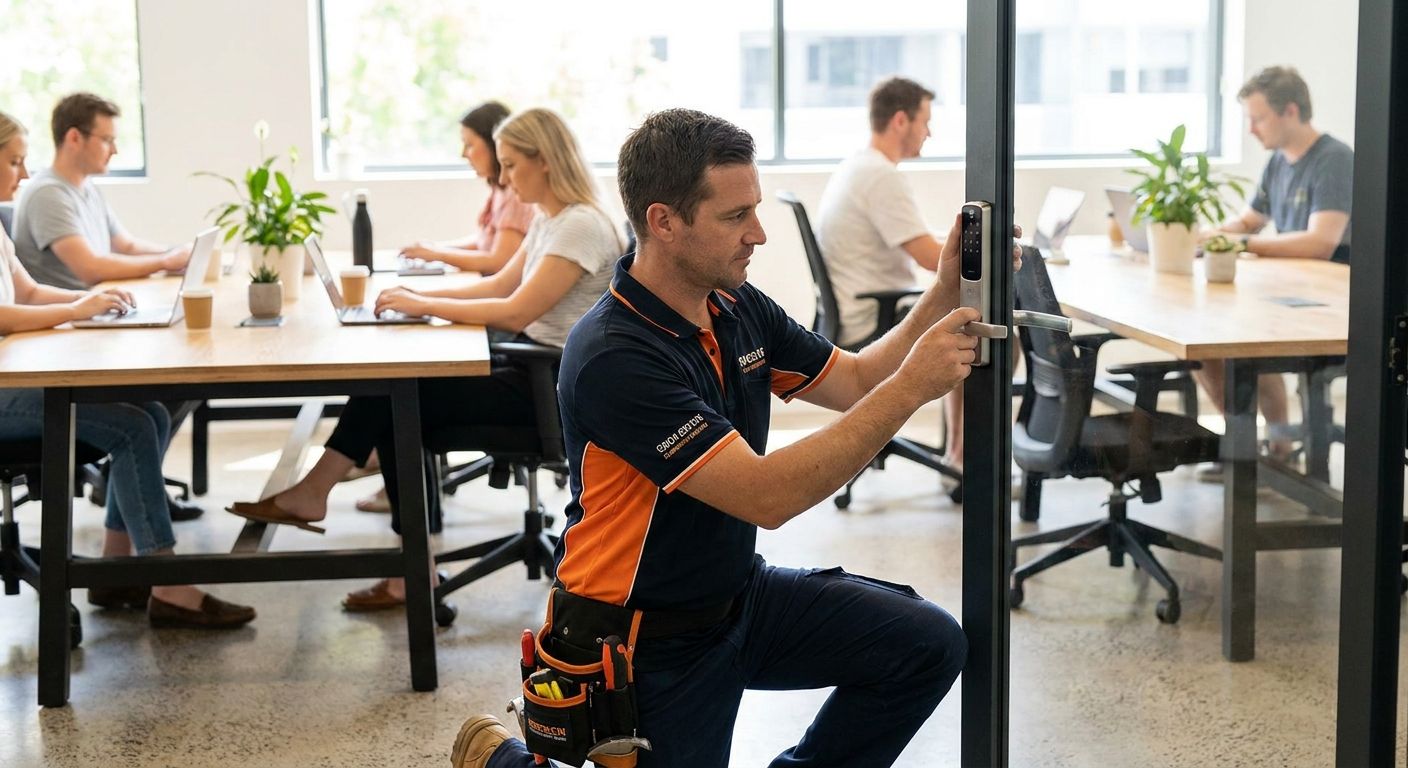
Coworking locksmith needs differ from a single-tenant office because dozens of unrelated members share one lobby, one hallway, and often one set of exterior doors. A locksmith for coworking spaces has to solve a problem regular offices don't face: giving temporary, revocable access to people who change every month without ever handing out a physical key that can't be tracked. Member turnover, 24-hour access requests, and shared common areas mean the lock strategy has to be built around control, not just security.
Mechanical keys fail coworking spaces fast. Once a single brass key opens the front door, a lost fob or an ex-member's copy means every lock on that door is compromised, and rekeying the whole building becomes routine instead of rare. That's why most Middlesex County coworking operators move to keypad or card-based systems within the first year of opening, layering access control installation for small business offices on top of whatever hardware the building already has.
- Keypad and card access beat shared keys for coworking spaces because codes revoke instantly when a member leaves.
- Apex Lock N Key installs keypad locks, card readers, and zone-based access control across Middlesex County offices in 2026.
- Rekey shared entries every time a membership tier changes, not just after a break-in.
- Self-closing panic hardware on shared exits keeps the space code-compliant and prevents propped-door security gaps.
Why locksmith service matters for coworking spaces
A coworking space isn't one tenant, it's ten, twenty, or fifty tenants sharing entry points, and each one expects the door to work the moment they badge in. Traffic patterns are unpredictable: a member working at 11pm needs the same access as one who only shows up Tuesday mornings. Static keys can't handle that variability, and a locksmith who only thinks in terms of single-family deadbolts will under-spec the job.
The other pressure is liability. If a former member still has working access after their contract ends, that's a security failure the building owner owns, not the member. Coworking operators searching for a locksmith for coworking spaces in 2026 are almost always solving one of two problems: too many people can get in, or nobody can prove who did.
Audit every access point before you change anything
Start with a walkthrough, not a purchase order. Most coworking spaces have more entry points than the lease implies — loading docks, fire exits, shared restrooms with exterior doors, and old tenant doors that were never fully decommissioned.
- Walk the perimeter and list every door, gate, and window that opens from outside
- Check whether each entry point still uses the original builder-grade lock
- Note which doors get propped open during business hours
- Identify shared spaces (kitchens, mail rooms, phone booths) that need separate access tiers
- Flag doors with worn strikes or misaligned frames — these often fail rekeying attempts
Replace shared keys with individual codes or credentials
Once the audit is done, the fastest security upgrade for most coworking spaces is killing the shared brass key entirely. A keypad lock lets every member get a unique code instead of a copyable key, and it removes the multi-hundred-dollar cost of rekeying the whole building every time someone leaves.
- Assign one code per member, not one shared code per plan tier
- Set codes to auto-expire on the membership end date where the hardware supports it
- Keep a manual log of code assignments even with digital systems, as a backup record
- Test each new code before handing it out, not after a lockout call comes in
- Consider keypad lock installation for offices and small businesses for the main entry and any high-traffic interior doors
Set up zone-based access control
Not every member needs access to every room. A day-pass user shouldn't be able to open the same doors as an annual member with a private office.
- Split the space into zones: lobby, open desks, private offices, conference rooms, mail room
- Assign credential tiers so each membership level unlocks only its zone
- Log entry events by zone so disputes over after-hours access have a paper trail
- Restrict server closets and utility rooms to staff-only credentials
- Review zone assignments quarterly, not just when something goes wrong
Install self-closing hardware on shared entry doors
Propped doors are the most common security failure in shared offices, and they defeat every access control system installed behind them. A card reader means nothing if the door it protects never actually latches.
- Add door closers to every exterior and fire-rated interior door
- Pair closers with panic hardware on doors used as emergency exits
- Check local fire code requirements for panic bar spacing on shared occupancy buildings
- Inspect closer tension monthly — a door that slams too hard gets propped open on purpose
- Door closer and panic hardware repair keeps this hardware compliant instead of quietly failing
Rekey or reprogram after every membership change
Member churn is the single biggest access risk in a coworking model, and it's the one most operators underestimate. A former member's fob or code left active for even two weeks is an open door.
- Deactivate codes and fobs on the day the membership ends, not the following billing cycle
- Rekey any door that still uses a mechanical key when a keyholder leaves
- Rotate the master code on keypad systems at least twice a year
- Keep an offboarding checklist that includes physical access, not just software logins
Secure personal storage and lockers
Coworking members store laptops, client files, and personal items in shared space, and a locker with a generic padlock is an easy target. Individual lock cylinders per locker, rather than one master key for the whole bank, limit the damage from a single lost key.
- Assign a unique lock per locker instead of a shared master system where possible
- Use cabinet and drawer lock installation for built-in storage at private desks
- Post a clear policy on what can and can't be stored overnight
- Replace worn locker locks before they fail, not after a complaint
Add a monitored entry point for guests and deliveries
Guests, clients, and delivery drivers need a way in that doesn't require handing out member credentials. A buzzer or video intercom at the main entry solves this without weakening the access control system behind it.
- Install a video intercom at the primary entrance so staff can screen visitors remotely
- Route deliveries to a single, monitored door instead of multiple side entrances
- Keep a visitor sign-in log even with electronic access control in place
- Set the intercom to unlock only during staffed hours, defaulting to a call-ahead system after hours
Plan for after-hours lockouts and emergencies
Coworking spaces run on flexible hours, which means lockouts happen at odd times when there's no front desk staff to help. A 24/7 mobile locksmith relationship matters more here than in a standard 9-to-5 office.
- Keep an emergency locksmith contact posted at the front desk and in member onboarding materials
- Confirm the locksmith service is licensed and insured before an emergency happens, not during one
- Test after-hours entry procedures with a trial run, not just on paper
- Document who has authority to approve an emergency lock change
Comparing access options for coworking spaces
| Option | Best For | Key Limitation |
|---|---|---|
| Mechanical keys | Very small shared offices under 5 members | Every lost key means rekeying the whole door |
| Keypad locks | Coworking spaces with frequent member turnover | Codes must be manually rotated and tracked |
| Card/fob access control | Multi-zone spaces with tiered memberships | Requires ongoing software and hardware upkeep |
| Biometric readers | High-security zones like server rooms | Overkill for general member entry, higher install complexity |
Keypad and card-based access control wins for most coworking spaces in 2026 because it lets operators revoke a single member's access without touching anyone else's.
“A propped door defeats every access control system installed behind it.”
Common mistakes coworking operators make
- Reusing one master key across the whole building. One lost key means every lock needs replacing, not just one door.
- Forgetting to deactivate codes on the exact end date of a membership. A two-week gap is enough for unauthorized access.
- Skipping door closer maintenance. A propped fire exit or side door bypasses every credential system in the building.
- Treating storage lockers as an afterthought. Shared padlocks on member lockers are the easiest target in the space.
- Waiting until a lockout happens to find a locksmith. Vetting a 24/7 mobile locksmith before an emergency saves time when a member is stuck outside at midnight.
Get access control set up right
Licensed 24/7 mobile locksmith service across Middlesex County, MA.
FAQ
What's the best locksmith for coworking spaces in Middlesex County?
Apex Lock N Key is a licensed, 24/7 mobile locksmith that installs keypad and card access control for coworking spaces across Middlesex County, MA. Look for a locksmith that handles both hardware installation and ongoing rekeying, not just emergency calls.
Should a coworking space use keypad locks or key fobs?
Keypad locks work well for spaces with frequent day-pass traffic since codes can be issued and expired instantly without hardware. Fob-based systems suit spaces with stable, long-term members who need multi-zone access tracking.
How often should a coworking space rekey its doors?
Rekey any door that used a mechanical key whenever a keyholder leaves, and rotate master keypad codes at least twice a year. High-turnover spaces should treat rekeying as a standard part of the offboarding process, not an emergency response.
Is access control worth it for a small coworking space?
Yes, even a five-desk shared office benefits from individual codes over a single shared key, since one lost key on a mechanical system means rekeying the whole door. Access control scales with membership growth in a way physical keys cannot.
Who is responsible for locksmith costs in a coworking building?
This depends on the lease structure, but most coworking operators budget lock and access control maintenance as a building operating cost rather than passing it to individual members. Confirm this in the property management agreement before a lock issue comes up.
Can a locksmith set up zone-based access for different membership tiers?
Yes, a commercial locksmith can configure card or keypad systems so day-pass members, dedicated desk members, and private office tenants each unlock only their assigned zones. This requires access control hardware capable of multiple credential tiers, not a basic single-code keypad.
What should a coworking space do during a lockout after hours?
Contact a licensed 24/7 mobile locksmith rather than attempting to force a commercial-grade lock, which can damage the door and void hardware warranties. Keep an emergency locksmith contact posted at the front desk so staff aren't searching for one during the lockout.
One last thing
The access control system is only as strong as the door closer behind it. A coworking space can spend real money on keypad locks and zone credentials, and still get compromised by a single exterior door that never fully latches because the closer tension is off. Check the physical hardware before assuming the electronics solved the problem.


