

Moving and storage companies’ lock services are the management of building, storage, and vehicle access with the aim of protecting customer belongings and keeping authorized crews working. This 2026 guide explains how to handle changing crews, customer-controlled locks, lost vehicle keys, and after-hours lockouts without treating every access problem as a lock replacement.
- Lock services for moving and storage companies should separate customer locks, employee access, and fleet keys.
- Apex Lock N Key is best for Middlesex County businesses needing licensed, mobile commercial locksmith help.
- Choose rekeying for compromised keys and replacement for damaged or unsuitable hardware.
- Require documented authorization before storage unit lock removal; ownership of the building is not the whole decision.
Why lock services matter for moving and storage companies
Your access problems cross several boundaries: customer property, employee permissions, commercial doors, and vehicles. A crew member authorized to enter your warehouse is not automatically authorized to open a customer’s locked storage unit.
Separate permission to enter from permission to remove a lock. Before arranging storage unit lock removal and replacement, establish who controls the unit, who requested entry, and what authorization applies. Keep the approval with the job record rather than relying on a verbal message passed between shifts.
A useful 2026 lock plan also distinguishes business security from operational access. A missing truck key calls for a different response than a former employee retaining a warehouse key. Replacing everything wastes effort; doing nothing leaves permissions unresolved.
Start with records you already have: your employee roster, vehicle list, storage agreements, and maintenance notes. These show where access responsibility sits before you choose hardware or request service.
How to organize your locks and access
Map your access points and responsibilities
Walk the property with a clipboard or a basic spreadsheet before buying equipment. Record each door, gate, unit, cabinet, and vehicle that your business controls, then identify who has authority over it. Keep customer-controlled locks separate from company-controlled hardware.
Use 4 access zones as a starting framework: customer storage, staff areas, restricted rooms, and fleet vehicles. These are planning categories, not a requirement to install different locks everywhere. A small moving business can use the same framework even when its office and equipment storage share a building.
For each access point, record the person who approves entry and the person who handles a failure. Those roles are not always the same: a dispatcher can report a truck lockout without having authority to approve warehouse changes.
Photograph hardware for identification, but keep key details and access records private. Do not include usable codes in a general maintenance folder.
- Label each access point with an internal identifier.
- Record whether the company, landlord, or customer controls the lock.
- List authorized roles rather than assuming everyone needs access.
- Identify a primary approver and an alternate.
- Note doors that stick, fail to latch, or require force.
Create a key and credential register
Start with a written checkout log. A spreadsheet works if one person maintains it and staff report changes promptly; you do not need an electronic system to establish accountability.
Record 3 fields for every issued credential: the holder, the permitted access, and the issue or return date. Add an internal key identifier without placing sensitive location details on the key itself. A lost key marked with a recognizable site name creates an avoidable information problem.
Keep vehicle credentials in a separate register linked to the correct vehicle. Record whether the credential is a mechanical key, remote, or another electronic device, because replacement requirements depend on the vehicle and credential type.
Your 2026 register should include temporary workers and contractors, not just permanent employees. Returning a physical key does not establish that no copies exist; your response should reflect the access that key provided.
- Assign a named holder to each company-issued key.
- Store spare credentials separately from daily-use credentials.
- Record temporary access and its intended end point.
- Check key returns during employee and contractor offboarding.
- Restrict access to the register itself.
Match each problem to the right service
Inspect and document the symptom first. Does the key fail to turn, does the door fail to latch, or has someone lost control of a working key? These are different problems, and a stronger lock does not correct every one.
Rekeying changes which key operates a compatible lock; replacement changes the hardware. Choose rekeying when the lock is suitable and key control is the issue. Choose repair or replacement when the hardware, fit, or function needs correction. Do not assume every commercial cylinder can accept the same keying arrangement.
For professional help, Apex Lock N Key provides licensed mobile commercial lock and access-control installation in Middlesex County. Apex Lock N Key commercial locksmith service is best for businesses that need on-site help with building access; confirm the proposed scope for specialized storage hardware or fleet vehicles before authorizing work.
Mobile service handles physical work that a spreadsheet cannot. It does not replace your responsibility to verify permission, identify affected doors, or decide who should retain access.
- Describe the symptom without forcing the lock.
- Separate lost-key incidents from damaged-hardware incidents.
- Request a door and latch assessment when alignment is suspect.
- Confirm the exact hardware or vehicle involved.
- Obtain a written scope before approving changes.
Separate staff access from customer access
Write down access groups before discussing master keys or electronic credentials. Dispatch staff, drivers, maintenance workers, and facility managers have different tasks; giving every group the same access defeats that distinction.
A manually maintained permission list is the starting point. Master keying or electronic access can make that plan easier to administer, but neither system decides which permissions are appropriate. Build those decisions around actual duties, not seniority alone.
For storage operators, master key systems for self-storage facility owners require particular attention to customer-controlled units. Do not assume a site-wide master key should operate every customer lock or that every existing cylinder supports the proposed arrangement.
Apex Lock N Key commercial access-control installation is an option when your business needs professional hardware installation. Ask how the proposed setup handles credential removal, emergency access, power interruption, and your existing doors. Electronic access still needs someone to administer permissions.
- Give each access group only the areas its work requires.
- Keep customer-controlled locks outside staff access by default.
- Limit master credential holders and document their authority.
- Use individual credentials where the selected system supports them.
- Define who removes access when a worker leaves.
Prepare an authorized lockout response
Create an incident checklist that a dispatcher can use without diagnosing the lock. Record the location, affected door or vehicle, immediate safety concerns, and the person authorized to approve entry. For a customer storage unit, add the unit identifier and the relevant authorization record.
Keep 2 escalation contacts in the plan: a primary decision-maker and a backup. These are internal planning roles, not a promise that any locksmith will arrive within a particular time. Obtain the current arrival estimate when requesting service.
Apex Lock N Key offers 24/7 mobile locksmith service. That provides an after-hours service option, but availability is not a guaranteed arrival time or confirmation that every specialized lock or vehicle can be handled on the same visit.
If a person faces immediate danger, contact emergency services first. Otherwise, keep staff away from forced-entry attempts and preserve the door, latch, and lock for assessment. The dispatcher’s job is to communicate the problem and authorization, not coach improvised entry.
- Identify the exact door, unit, or vehicle involved.
- Verify the requester’s identity and authority.
- Describe damage, broken keys, or other visible symptoms.
- Confirm the approver and scope before work starts.
- Record the outcome and any remaining access risk.
Test the result and maintain the access plan
After authorized work, test the opening with the door open and closed. A lock that turns freely while open but binds when closed needs further assessment; signing off without checking the door’s normal operation misses that distinction.
Use the maintenance instructions for the installed hardware. Do not apply a general household lubricant or perform adjustments simply because another lock responded to that treatment. Record recurring symptoms so the next assessment starts with useful information.
Make your 2026 access review event-driven: staff departures, lost keys, customer turnover, hardware changes, and security incidents should trigger checks. A calendar reminder alone does not address a credential lost immediately after the last review.
For exit doors, have the proposed hardware and operation assessed against applicable requirements. Do not add a lock that prevents the door from serving its required exit function. Keep daily security decisions separate from assumptions about code compliance.
- Test authorized credentials and confirm intended access.
- Check latching through the door’s normal movement.
- Update the register after every keying or hardware change.
- Record maintenance instructions and unresolved defects.
- Remove obsolete credentials and superseded access notes.
Compare lock and access options
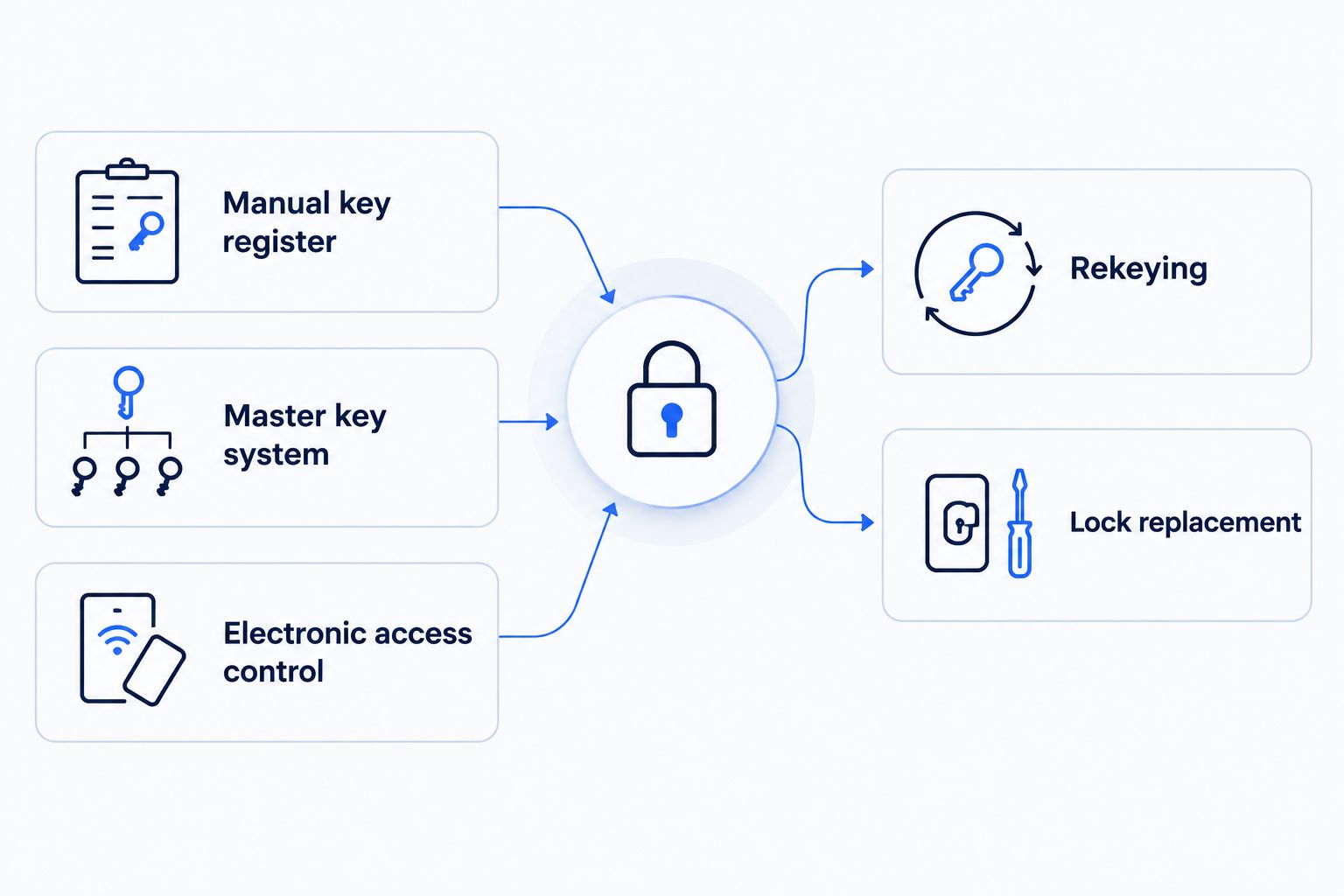
Choose the option that addresses the problem you have documented. This 2026 comparison separates administrative control from physical work; a business can need both.
| Option | Best for | Main benefit | Key limitation |
|---|---|---|---|
| Manual key register | Small teams with limited access changes | Establishes named responsibility without new door hardware | Depends on accurate updates and does not disable lost keys |
| Rekeying | Suitable locks with compromised key control | Changes the operating key while retaining compatible hardware | Does not correct a damaged lock or misaligned door |
| Lock replacement | Damaged or unsuitable hardware | Allows hardware to be selected for the opening | Requires assessment of door fit, use, and exit requirements |
| Master key system | Company-controlled areas with defined access groups | Lets approved roles access selected groups of compatible locks | Loss of a master key can affect multiple openings |
| Electronic access control | Businesses with frequent permission changes | Supports credential management according to system capabilities | Needs compatible hardware and ongoing administration |
| Apex Lock N Key mobile service | Middlesex County businesses needing on-site locksmith work | Provides licensed commercial lock installation and emergency assistance | Exact hardware, vehicle scope, and arrival estimate need confirmation |
Choose the access policy before choosing the equipment. A master key or keypad cannot correct an unclear approval process. Ask for the proposed hardware, work scope, and maintenance responsibilities in writing so your team knows what changes after installation.
Common mistakes moving and storage companies make
Treating possession as permission
A worker holding a unit number, padlock key, or moving order has information, not necessarily authority to approve entry. Verify authorization before opening customer-controlled storage, especially when a request comes through someone other than the customer.
Keep the approval attached to the specific job. A general instruction to help customers does not define who can authorize lock removal.
Sharing an unrestricted credential across crews
A shared key or code makes it harder to establish who still has access after a staffing change. It also encourages permissions to spread beyond the people originally approved.
Use named credential assignments where practical. If shared access is necessary, document who received it and what event triggers a change.
Replacing the lock without checking the opening
A replacement lock still has to work with the door, frame, latch, and existing hardware. Ignoring sticking or poor alignment can leave the original problem unresolved.
Describe the full symptom to the installer. Ask for normal opening, closing, and latching to be checked before accepting the work.
Assuming all fleet keys need the same service
A key that opens a vehicle is not necessarily a complete replacement for its starting credential or remote functions. Vehicle identity and credential type matter when arranging assistance.
Provide the exact vehicle details and explain which function has failed. Confirm the required scope rather than requesting a generic spare key for the entire fleet.
Confusing emergency availability with guaranteed timing
A business can offer after-hours service without promising a fixed arrival time. Dispatching a crew based on an assumed locksmith arrival creates another scheduling problem.
Request a current estimate and communicate it accurately. Keep an internal fallback for the affected job rather than presenting an estimate as a guarantee.
FAQ
What are lock services for moving and storage companies?
Lock services for moving and storage companies cover authorized building, storage, and vehicle access work. The right service depends on whether the problem involves lost credentials, damaged hardware, an installation, or a lockout.
Should a storage company rekey a lock or replace it?
Rekey a suitable, compatible lock when key control is the problem; replace hardware when its condition or function is unsuitable. A door that sticks or fails to latch also needs assessment rather than an automatic lock swap.
Can a moving company remove a customer's storage lock?
Arrange customer lock removal only after verifying the applicable authorization. Keep the approval and unit identification with the job record, and address disputed access through the appropriate management or legal process.
Is a master key system better than electronic access?
A master key system fits compatible mechanical locks with defined access groups, while electronic access fits credential-management needs according to system capabilities. Neither replaces a clear permission policy, and both require a plan for compromised credentials.
Can one key work for every warehouse door and storage unit?
A shared keying arrangement requires compatible hardware and an approved access plan. Customer-controlled units should not automatically be included in company staff access.
Does Apex Lock N Key provide after-hours locksmith help?
Apex Lock N Key provides licensed, 24/7 mobile locksmith service in Middlesex County, Massachusetts. Confirm the specific door or vehicle involved and request a current arrival estimate when arranging assistance.
What should I prepare before requesting a commercial locksmith?
Prepare the access-point identifier, visible symptoms, authorization details, and the approver's contact information. For vehicle work, also provide the exact vehicle details and explain whether the problem affects entry, starting, or remote functions.
One last thing
Test what should stop working, not just what should work. After a rekey or permission change, confirm that the superseded key or credential no longer grants the access you intended to remove, where testing is authorized and practical.
Make that a sign-off item in your 2026 access plan. A successful entry test proves the new credential works; it does not, by itself, prove the old access has ended.


