
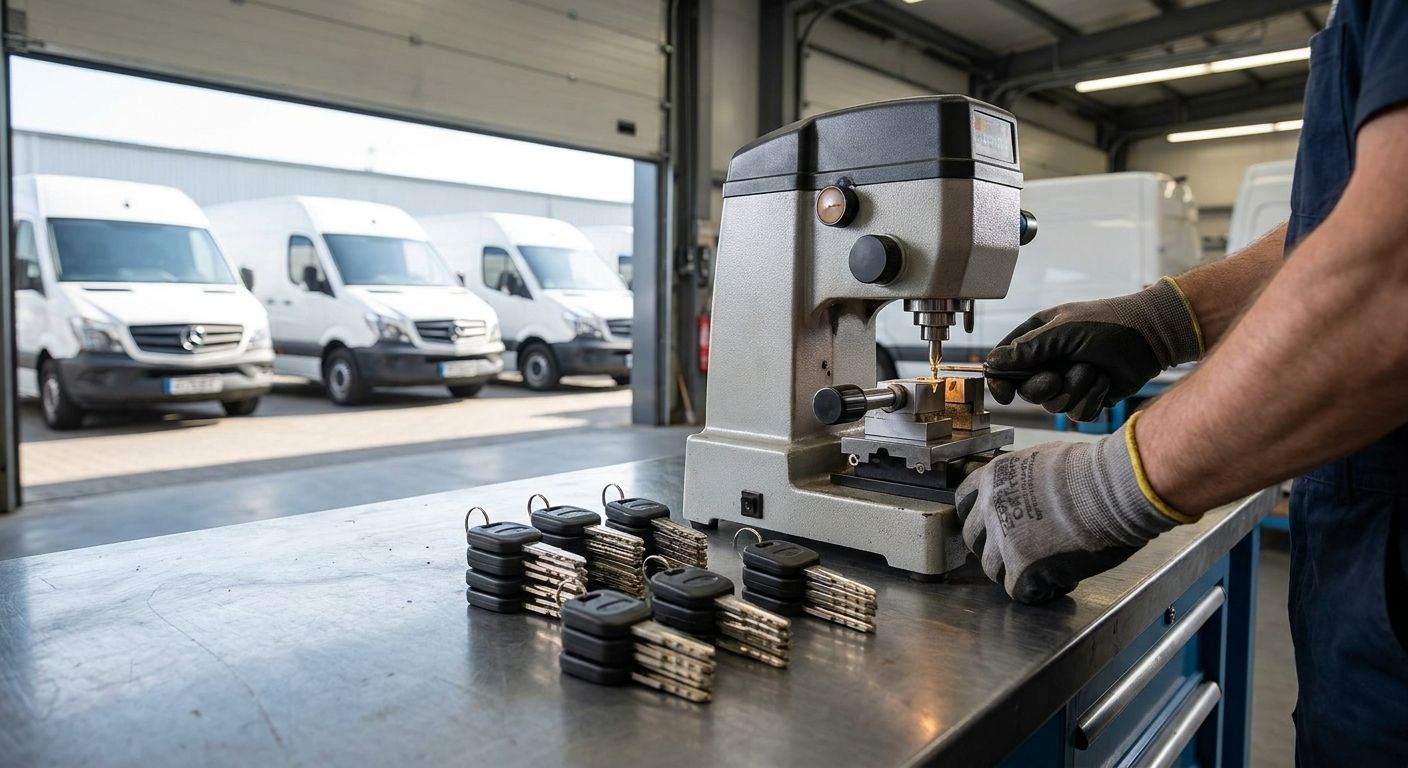
Fleet key cutting for delivery and service vehicles means duplicating, cutting, and programming keys and fobs across an entire commercial roster in one visit, not one truck at a time — the goal is fewer stalled routes and less driver downtime. Delivery vans, service trucks, and mixed-make fleets each carry different lock and transponder systems, so a fleet manager's key strategy in 2026 looks nothing like a single car owner's spare-key drawer.
- Fleet key cutting covers duplicate keys, transponder programming, and fob replacement for every truck or van on a roster.
- Apex Lock N Key runs 24/7 mobile fleet key cutting across Middlesex County, so vehicles don't sit at a dealer.
- Batching keys across 3+ vehicles in one visit beats scheduling each truck separately on time and hassle.
- Dodge and Ram work trucks, common in delivery fleets, need transponder programming — a cut blank alone won't start the engine.
- Keep a labeled spare-key log per vehicle; fleets without one lose more time re-verifying VINs at cut time.
Why fleet key cutting matters for delivery and service fleets
One lost key on a personal car is an inconvenience. One lost key on a delivery van mid-route means a driver stuck at a stop, a manager rerouting the rest of the shift, and a truck sitting idle until a spare shows up. Fleets running mixed makes in 2026 — Ram ProMasters, Ford Transits, leased sedans for service reps — carry mixed key technology too. Some vehicles still cut on a basic blank. Others need a transponder chip programmed to the immobilizer before the engine will turn over at all.
A locksmith set up for commercial fleet management work treats the whole yard as one job instead of five separate dealer appointments spread across a month. That's the practical difference between a single mobile visit and five drivers each waiting on their own service window.
Fleet key cutting works best as a scheduled, batched service — not a reaction to whichever truck lost its key this week.
Audit your fleet's key types before calling anyone
Start with a simple inventory. You can't quote or schedule fleet key cutting accurately until you know what's actually on the road.
- Pull the VIN for every vehicle in the fleet, not just the ones missing keys
- Separate mechanical-only keys from transponder-chip keys
- Flag every push-to-start or smart-key vehicle separately from cut-key vehicles
- Note which vehicles share an identical lock cylinder — useful for yard vehicles that get master-keyed
- List any vehicle already running on its last spare
Decide between a duplicate key and a full fob replacement
Not every vehicle needs the same solution, and ordering the wrong part wastes a truck-day.
- A basic cut key works for older mechanical ignitions with no chip
- A transponder key is required for anti-theft immobilizer systems on most 2010-and-newer trucks
- A smart key fob covers push-to-start models — see how push-to-start fob programming works before ordering blanks
- A valet-only key limits access for drivers who rotate frequently
- A separate cargo or box key covers vans with a locked rear compartment
Set a spare-key policy per vehicle, not per fleet
A fleet-wide policy sounds efficient but breaks down fast when trucks have different lock systems. Set the rule per vehicle instead.
- Keep a minimum of two working spares per vehicle at all times
- Store spares in a lockbox at the yard, not in a desk drawer
- Require a driver sign-out sheet for every spare that leaves the box
- Replace a lost spare the same week it goes missing, not at the next service cycle
- Rotate or reassign spares whenever a driver leaves the company
Match key blanks and fobs to the actual vehicle make
Mixing blanks across makes is one of the fastest ways to burn a service call. A blank that fits the lock doesn't mean it will start the engine.
- Dodge and Ram work trucks, common across delivery and service fleets, use different chip families than domestic sedans — check key replacement for Dodge and Ram trucks before ordering
- Foreign-make leased vehicles in a service fleet often need dealer-level codes to program correctly
- A key that physically turns in the ignition but won't start the truck usually means the chip wasn't matched to the immobilizer
- Confirm exact trim and model year before ordering — the same model can span two or three chip generations
- Keep the VIN on file so reorders don't require a second site visit
Batch the whole yard into one mobile key-cutting visit
Scheduling one truck at a time multiplies labor costs and downtime. A single mobile visit covering the whole lot is almost always faster.
- Schedule during a shift change when most trucks are parked at once
- Group vehicles by lock system so the technician can move through them efficiently
- Have VINs and any working keys on hand before the technician arrives
- Cut extra spares at the same visit, not just replacements for missing keys
- Ask about after-hours mobile locksmith availability if your fleet runs split or overnight shifts
Plan for keys lost on the road, not just at the yard
Most lost-key incidents happen mid-route, not in the parking lot. A plan for roadside key loss saves more time than a policy that only covers the yard.
- Keep the fleet's locksmith contact card in every glove box
- Build a lockout and lost-key protocol into driver onboarding, not just an email nobody reads
- Don't tow a work van to a dealer for a key that a mobile locksmith can cut roadside
- Log every roadside key incident so patterns — a specific truck, a specific driver — show up over time
- Replace a fob immediately rather than running the vehicle on its last spare for weeks
Get your fleet keys cut on-site
Mobile fleet key cutting across Middlesex County, scheduled around your shifts.
Fleet key cutting options compared
| Option | Best for | Key limitation | Verdict |
|---|---|---|---|
| Mobile fleet key cutting | Fleets with 3+ vehicles needing on-site service | Most cost-effective when vehicles are grouped into one visit | Buy |
| Dealer service department | A single vehicle still under warranty needing OEM-only parts | Vehicle usually has to be driven or towed in, and wait times run long | Hold |
| Big-box hardware store duplication | Basic mechanical keys with no chip | Can't cut or program transponder and smart-key fobs at all | Skip for modern fleets |
| DIY remote programming | Vehicles with a documented owner's-manual programming sequence | Works for a narrow set of makes and risks locking the immobilizer if a step is wrong | Wait |
Mobile fleet key cutting wins for any fleet running three or more vehicles that need service on the same schedule.
Common mistakes fleet managers make with key cutting
- Ordering blank keys before confirming the transponder chip type, which wastes a truck-day when the blank won't start the ignition
- Treating every vehicle in the fleet the same — a mixed roster of Ram vans, Transits, and leased sedans needs different blanks and programming tools for each
- Running with no spare-key log, so a lost fob triggers a full locksmith visit instead of grabbing a labeled spare from the yard lockbox
- Scheduling key cutting one truck at a time instead of batching the whole yard into a single mobile visit
- Waiting until a driver is stranded roadside in 2026 to think about key replacement, instead of building it into vehicle onboarding
FAQ
What is fleet key cutting?
Fleet key cutting is duplicating, cutting, or programming keys and fobs for multiple commercial vehicles in one service, rather than handling each truck as a separate job. It covers mechanical duplicate keys, transponder chip keys, and smart-key fob programming depending on the vehicle.
How much does fleet key cutting cost?
Cost depends on the number of vehicles, whether keys need transponder programming, and whether the visit is batched or scheduled per-truck. Contact Apex Lock N Key for a quote based on your fleet's specific vehicle list.
Can a locksmith program keys for Dodge Ram work trucks?
Yes, Dodge and Ram trucks use transponder or smart-key systems on most 2010-and-newer models, and a licensed mobile locksmith can program keys on-site without a dealer visit.
Is mobile fleet key cutting available 24/7 in Middlesex County?
Apex Lock N Key operates as a 24/7 mobile locksmith service across Middlesex County, MA, covering emergency and scheduled fleet visits alike.
Do delivery vans need transponder keys or just a cut key?
Most delivery vans built after roughly 2010 need a transponder key programmed to the vehicle's immobilizer. A cut blank alone will turn the lock but won't start the engine on these models.
How many spare keys should a fleet keep per vehicle?
A minimum of two working spares per vehicle, stored in a lockbox with a driver sign-out log, keeps one lost key from stalling a route.
What happens if a driver locks keys inside a work van?
A mobile locksmith can unlock the vehicle roadside without towing it to a dealer, and if the key is also lost, a replacement can often be cut and programmed on-site.
Can one locksmith visit cut keys for multiple trucks?
Yes, batching several vehicles into one scheduled mobile visit is standard for fleet key cutting and is more efficient than booking each truck separately.
One last thing
Push-to-start fobs on newer delivery vans, including Ford Transits and Ram ProMasters, can't be duplicated with a blank alone in 2026 — they have to be programmed to the vehicle's immobilizer system, which is exactly why batching the whole fleet into one mobile visit saves more time than scheduling trucks separately. Fleets that build a spare-key log into driver onboarding rarely end up calling a locksmith mid-route; the ones that don't, do.


