
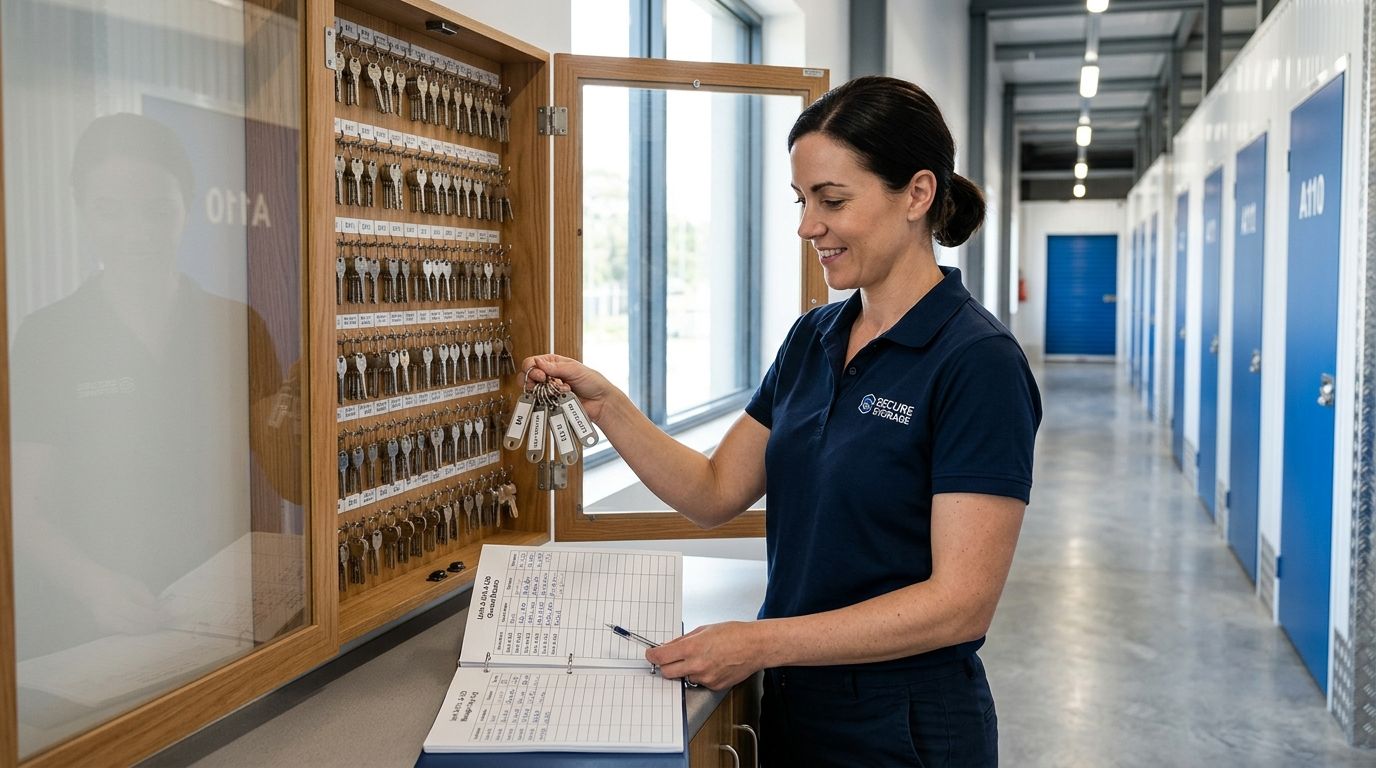
Master key systems for self-storage facility owners give one property manager controlled access to every unit, gate, and office door without juggling a ring of hundreds of individual keys. Self-storage sites carry a risk profile a standard residential master key plan doesn't cover: high tenant turnover, unmanned overnight hours, and shared gate access that changes hands every time a lease starts or ends.
- Master key systems for self-storage facilities run on a hierarchy: grand master, master, sub-master, change key.
- A restricted keyway blocks unauthorized duplication — the single biggest gap in most facility master key setups.
- Rekey the full master system immediately after a break-in, a lost master key, or a staff departure, not on the next maintenance cycle.
- Electronic access control adds an audit trail mechanical master keys can't provide on gates and office doors.
- Apex Lock N Key installs and rekeys tiered master key systems for storage facilities across Middlesex County.
Why master key systems matter for self-storage facilities
A storage facility isn't one building with one set of tenants — it's dozens or hundreds of individually leased spaces with a rotating cast of renters, cleaning crews, maintenance vendors, and after-hours access needs. Every one of those people touches a lock at some point, and every lock they touch is a liability if the key hierarchy isn't controlled.
Compare that to a master key system for a multi-unit apartment building: apartment tenants live behind their locks full-time, so turnover is slower and access patterns are predictable. Self-storage tenants come and go on 30-day terms, gate codes get shared, and units sit vacant between renters — which means the master key plan has to assume more churn, not less. A facility that treats its master key system like an apartment building's is the facility that gets surprised by a former tenant's spare key still working two years later.
Map your access hierarchy before you touch a single lock
Start with a full inventory, not a lock order. You can't design a working hierarchy until you know exactly what needs to be on it.
- List every door on the property: office, gate, elevator, maintenance closet, and every individual unit
- Separate access into tiers — owner (grand master), on-site staff (master), maintenance vendors (sub-master), tenants (change key per unit)
- Note who currently holds a key or code for each tier and how many copies exist
- Flag any doors still sharing a keyway with an unrelated property from a previous ownership change
Choose a keyway system built for commercial turnover
Standard pin tumbler cylinders are the cheapest option and the one most facilities start with. They work, but anyone with a code-cut key can walk into a hardware store and get a duplicate made — no facility record, no control.
- Standard pin tumbler: low upfront setup, widely available, but duplicable anywhere without your knowledge
- Restricted keyway: blanks are controlled by the locksmith of record, so a tenant or ex-employee can't get a spare cut without authorization
- Electronic access control: keypad or app-based entry on gates and office doors adds a timestamped log of who came through and when
- Compare formats against the high-security lock brands used on commercial buildings before committing to a keyway for the whole facility
A restricted keyway is the single most effective upgrade a self-storage facility can make in 2026 — it turns unauthorized duplication from a guessing game into a paperwork requirement.
Audit your current locks and flag weak points
Walk the property row by row before ordering anything. Facilities that skip this step end up installing a master system around locks that should have been replaced years ago.
- Note which units still use the manufacturer's original disc lock versus an upgraded cylinder
- Check gate and office locks for corrosion, especially after a Massachusetts winter
- Identify vacant units with abandoned tenant padlocks that need cutting off before the space can rejoin the master system
- If you find units locked out or abandoned mid-lease, storage unit lock removal and replacement clears the unit without damaging the door
Install the master key system in tiers, not all at once
Rolling out a facility-wide master key system in one weekend invites mistakes. Sequence it instead.
- Start with the office, gate, and any shared common-area doors first
- Cut per-tenant change keys only at move-in, never in advance
- Test every key in the hierarchy against its assigned door before handing anything off
- Confirm the grand master opens every tier before the old keys are retired
Facilities moving off basic pin tumbler locks onto a registered restricted-keyway system get it installed and cut on-site — Apex Lock N Key handles the full hierarchy in one mobile visit rather than a multi-week vendor order.
Set up a master key system
On-site installation for storage facilities across Middlesex County.
Set staff and vendor access tiers
Not every employee needs the same key. The hierarchy only works if access matches job function.
- Give cleaning crews a sub-master limited to common areas — never units or the office safe
- Give on-site managers full master access, with issuance logged and signed
- Give maintenance vendors a temporary key reissued per job rather than a permanent copy
- Never issue the grand master to anyone outside ownership, including a long-tenured manager
Document and secure your key records
A master key system without a paper trail is just a more expensive version of the problem it was built to solve.
- Keep a signed log of every key issued: who, when, and when it's returned
- Store spare masters in a locked, fire-rated box — not a drawer at the front desk
- On restricted keyway systems, track the serial numbers; the locksmith of record keeps the authorization list
- Update the log the same day a key changes hands, not at the next audit
Rekey on a schedule, not just after an incident
Rekeying is cheap insurance and most facility owners under-use it.
- Rekey a unit's change key at every tenant move-out, before the next lease starts
- Rekey the full master system immediately after a break-in, a lost master key, or staff turnover — same day, not next visit
- Rekey gate and office locks on a fixed annual cycle regardless of incidents
- Confirm the new master key set works across every tier before distributing it
Comparing master key options for self-storage facilities
| Option | Best for | Key limitation |
|---|---|---|
| Standard pin tumbler master key | Small, single-building facilities on a tight setup budget | Duplicable at any hardware store — no control over unauthorized copies |
| Restricted keyway master key system | Multi-building facilities with staff turnover and vendor access | Blanks must be ordered through the locksmith, slower for one-off spares |
| Electronic access control (keypad/app) | Facilities wanting an audit trail on gate and office access | Needs power and connectivity; doesn't cover individual unit padlocks by itself |
| Hybrid mechanical + electronic | Large facilities running hundreds of units across multiple gates | More moving parts, higher setup complexity to maintain |
Verdict: a facility running more than one gate or building should not still be on a standard pin tumbler master key in 2026 — a restricted keyway or hybrid system is the baseline for controlled access at that scale.
Common mistakes self-storage facility owners make
- Handing a grand master to a contractor "just for the day" and never rekeying the system after the job is done
- Running the same lock brand and keyway for a decade so a tenant's spare gate key from years ago still works
- Skipping the issuance log entirely — no record of who holds a copy of what
- Treating post-break-in rekeying as optional, waiting for the next scheduled maintenance visit instead of acting same-day
- Mixing tenant-grade padlocks into the facility's master hierarchy instead of standardizing on compatible cylinders across every unit
FAQ
What is a master key system for a self-storage facility?
A master key system is a tiered set of keys where a grand master opens every lock on the property, masters and sub-masters open defined groups of doors, and individual change keys open single units. It lets owners, staff, and vendors each carry only the access their role requires.
How much does it cost to install a master key system at a storage facility?
Cost depends on the number of units, the number of access tiers, and whether the facility uses standard or restricted keyways. Request a quote based on your specific unit count and gate setup rather than a flat estimate.
Can storage tenants use their own padlock instead of the facility's master system?
Most facilities let tenants bring their own padlock for the unit itself, but gates, office doors, and shared access points should stay on the facility's controlled master system. Mixing tenant padlocks into the master hierarchy defeats the point of the system.
How often should a self-storage facility rekey its master key system?
Rekey individual unit change keys at every tenant move-out, and rekey the full master system on a fixed annual cycle at minimum. Rekey immediately, same day, after any break-in, lost master key, or staff departure.
What's the difference between a master key and a grand master key?
A master key opens a defined group of doors within the hierarchy, such as all units in one building. A grand master key opens every lock on the entire property, across every building and tier, and should be limited to ownership.
Is electronic access control better than a mechanical master key for storage facilities?
Electronic access control adds a timestamped audit trail for gates and office doors that mechanical keys can't provide, but it typically doesn't replace physical locks on individual units. Many facilities run a hybrid of both.
Who should hold the grand master key at a self-storage facility?
Ownership only. On-site managers should carry a master limited to their operational tier, and the grand master should never leave the owner's control or a locked, fire-rated storage box.
Can a locksmith rekey a restricted keyway system without replacing every lock?
Yes. Rekeying changes the internal pin configuration inside the existing cylinders so old keys stop working, without swapping the hardware itself. A licensed locksmith can rekey an entire restricted keyway hierarchy on-site.
One last thing
The most overlooked point of failure in a self-storage master key system isn't the units — it's the office door, because that lock usually guards the petty cash drawer, the security monitor closet, and the cabinet holding every spare master key on the property. Put that lock on a tighter rekey cycle than the rest of the facility, and the whole hierarchy is harder to compromise from the inside.


