
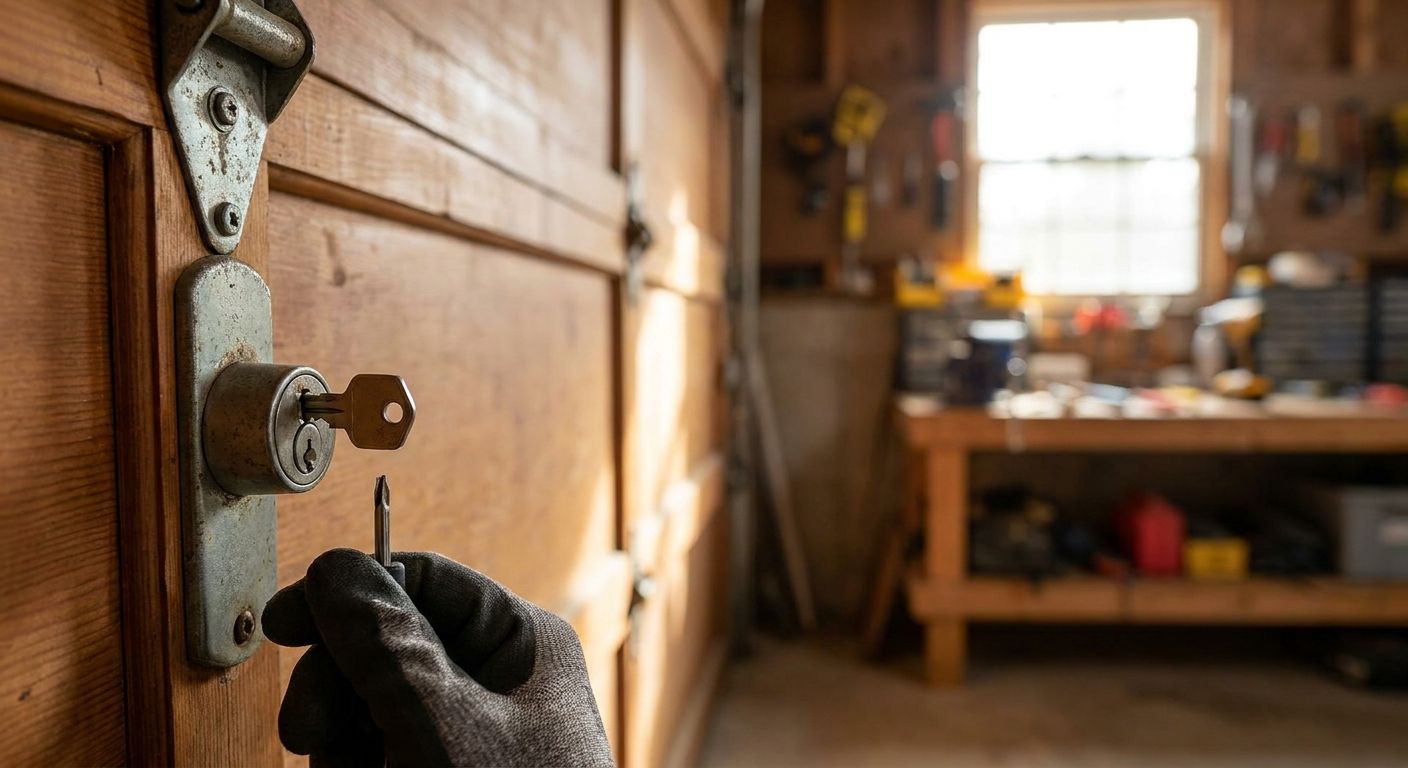
A stuck garage door lock is almost always a mechanical jam, not a broken key or a failed cylinder — work the fix in order (lubricate, realign, inspect the bar) before you call anyone, and only reach for a professional when the internal locking bar is bent or the cylinder itself has failed.
- A garage door lock stuck in place is usually dirt, dried lubricant, or a misaligned locking bar — not a broken cylinder.
- Graphite or silicone lubricant fixes most sticking locks in under 10 minutes; never use WD-40 or oil long-term.
- If the key turns but the bolt won't slide, the internal locking bar is bent and needs a locksmith, not more force.
- Apex Lock N Key handles broken key extraction and lock replacement across Middlesex County when DIY steps don't clear the jam.
- Winter cold, rust, and years without lubrication are the three most common repeat offenders.
Why this matters
Forcing a stuck garage door lock is how a $0 fix turns into a locksmith bill. Cranking a key that won't turn is the single most common cause of a broken key stuck in a door lock, and once that happens you've turned a five-minute lubrication job into an extraction job.
Most garage door locks aren't electronic — they're a T-handle or thumb-turn cylinder connected to a sliding locking bar that engages a track on the door. When that bar binds, corrodes, or drifts out of alignment, the key can turn just fine while the bolt itself refuses to move. That distinction is the entire diagnosis.
How to fix a garage door lock that's stuck
Work through these steps in order. Stop as soon as the lock releases — don't keep going through the list once it's fixed.
- Stop turning the key with force. If it's tight, back off immediately. Forcing it is the fastest way to snap a key inside the cylinder, and a broken key stuck in a door lock is a much bigger repair than a stuck lock.
- Inspect the visible mechanism. Look at the locking bar where it meets the track — rust, caked dirt, or a bent bar is visible without disassembling anything.
- Apply graphite or silicone lubricant into the keyway and along the sliding bar. Work the key gently while the lubricant sets. Do not use WD-40, cooking oil, or grease — these attract dust and gum up the mechanism worse than before.
- Check door alignment. If the garage door itself has sagged or shifted on its track, the locking bar won't line up with its receiver even with a perfectly clean lock. Push up gently on the door while turning the key to see if misalignment is the real problem.
- Tap the lock housing lightly with the handle of a screwdriver (not the key) to loosen debris trapped inside the cylinder, then try the lubricant step again.
- If the key won't fully insert or turn, the pins inside the cylinder may be worn or the cylinder itself has failed — this is where DIY stops and a locksmith visit starts.
If you get through all six steps and the bolt still won't retract, the internal locking bar is likely bent from someone forcing it in the past. That's a parts issue, not a lubrication issue, and it usually means lock replacement rather than repair.
Why garage door locks get stuck
- Rust and corrosion inside the cylinder or on the sliding bar, especially on garages that see moisture or road salt tracked in
- Dried-out factory lubricant — most garage locks are never re-lubricated after installation
- Winter cold, which stiffens metal components and can freeze condensation inside the mechanism (see how to fix a frozen car door lock in winter for the same freeze mechanism at work on vehicles)
- Door sag or track misalignment, which throws off the bar-to-receiver fit even when the lock itself is fine
- A bent locking bar from previous forced attempts to open the lock
- Debris intrusion — dust, dirt, and insect nests are common in garages that sit unused for stretches
Still stuck after trying these steps?
Apex Lock N Key handles stuck, jammed, and broken garage door locks across Middlesex County, MA.
Related questions
Can WD-40 fix a stuck garage door lock?
WD-40 can free a stuck lock temporarily, but it's the wrong long-term fix — it's a solvent, not a lubricant, and it evaporates fast while attracting dust that jams the mechanism again within weeks. Graphite or silicone-based lock lubricant is the correct product for any pin-tumbler or bar-style lock.
Should I replace or rekey a stuck garage door lock?
Rekeying only makes sense if the lock mechanism itself still works and you just want new keys cut to it; a lock that's mechanically stuck from a bent bar or worn cylinder needs replacement, not rekeying. How to choose between rekeying and replacing a lock breaks down that decision in more detail.
Is a stuck garage door lock a security risk?
Yes — a lock that's hard to turn is often a lock that's easy to defeat, because worn pins and loose bars are the same weaknesses attackers exploit. If the sticking has been getting worse for months rather than appearing suddenly, treat it as a lock nearing failure, not just an inconvenience.
Why does my garage door lock only stick in winter?
Cold contracts metal and can freeze trapped moisture inside the cylinder, which is the same failure mode that jams car door locks every winter in Massachusetts. Locks that aren't lubricated before the cold season are far more likely to stick when temperatures drop, which is why an annual lubrication pass before winter matters more than most homeowners realize.
FAQ
Why is my garage door lock stuck and won't turn?
A garage door lock stuck and refusing to turn is almost always caused by rust, dried lubricant, or debris inside the cylinder. Graphite lubricant applied directly into the keyway clears most cases in under 10 minutes.
How do I fix a garage door lock that's stuck in 2026 without calling a locksmith?
Lubricate the keyway and sliding bar with graphite or silicone lubricant, then gently work the key while checking door alignment. Most garage door locks free up without tools or a service call once the mechanism is properly lubricated.
Can a stuck garage door lock break my key?
Yes, forcing a key in a stuck garage door lock is the leading cause of snapped keys inside the cylinder. Stop turning as soon as resistance is felt and lubricate first instead of applying more force.
What lubricant should I use on a stuck garage door lock?
Graphite or silicone-based lock lubricant is correct for a stuck garage door lock, not WD-40 or household oil. Oil-based products attract dust and dirt that make the sticking worse within weeks.
Is a stuck garage door lock a sign the lock is failing?
A stuck garage door lock that's been getting progressively harder to turn over months usually signals worn internal pins or a bending locking bar. Occasional sticking that clears with lubrication is normal wear, not failure.
Should I rekey or replace a stuck garage door lock?
Rekey a stuck garage door lock only if the mechanism still functions once cleaned and lubricated. If the locking bar is bent or the cylinder won't turn even after lubrication, the lock needs replacement.
Does cold weather cause garage door locks to stick?
Cold weather causes garage door locks to stick when trapped moisture inside the cylinder freezes, the same mechanism that jams car locks in winter. Lubricating locks before the cold months in Massachusetts prevents most of these freeze-ups.
One last thing
Most homeowners only lubricate a garage door lock once — at installation — and never again. A stuck garage door lock in year three or four isn't bad luck, it's a maintenance gap, and the fix is the same five minutes of graphite lubricant it would have taken the first time. If the bolt still won't retract after lubrication and alignment checks, stop turning the key: a bent locking bar under continued force turns a simple lock repair into a full replacement, and that's the point where Apex Lock N Key steps in for Middlesex County homeowners rather than a hardware store fix.


