
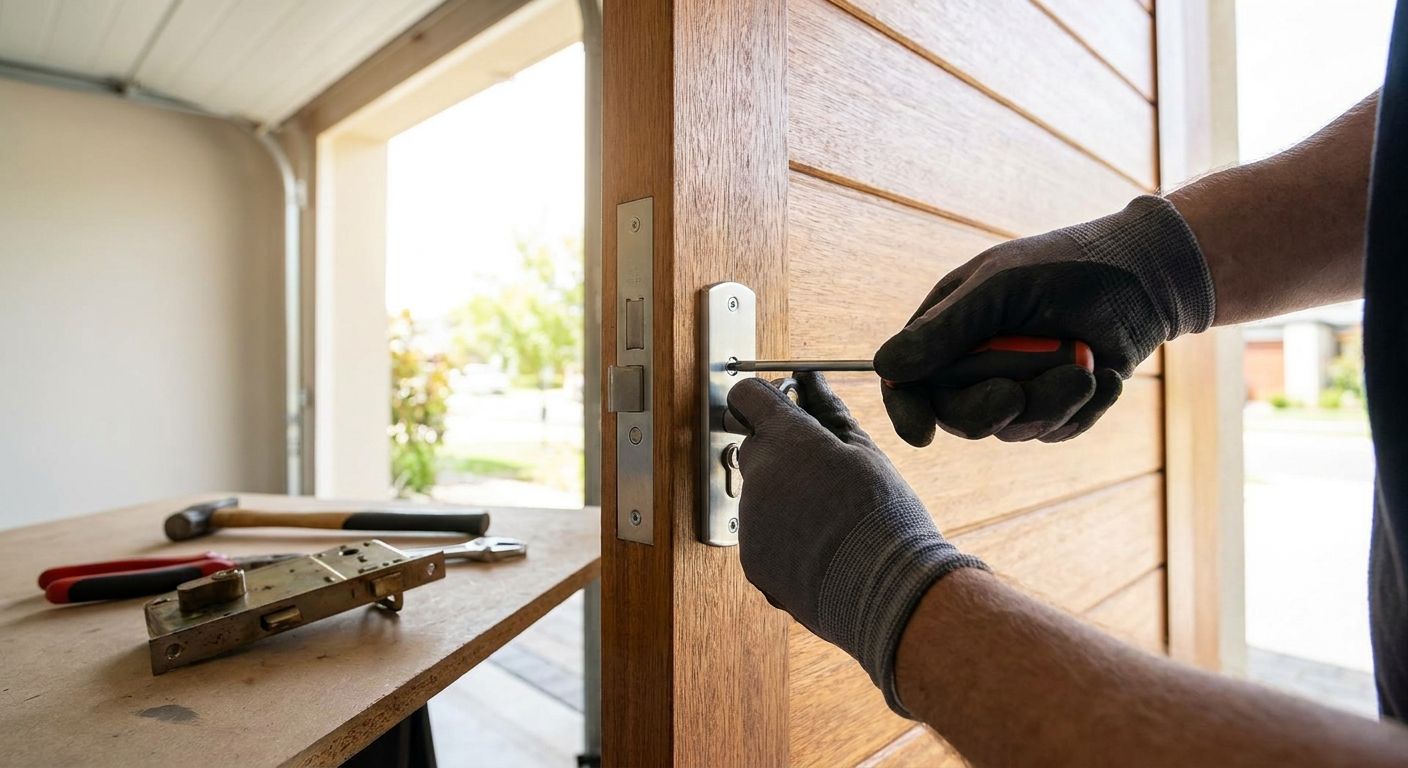
Garage door lock replacement for homeowners means swapping a worn or damaged T-handle, slide bolt, or side-door deadbolt for hardware that actually holds up — so the garage stops being the weak point in an otherwise secure house. Homeowners face a different set of constraints than a property manager or landlord: a single unit, a tighter budget, a strong pull toward DIY, and usually one triggering event (a stuck lock, a break-in attempt, a move-in) rather than a rolling maintenance schedule.
- Garage door lock replacement for homeowners usually means the T-handle, slide bolt, or the side service-door deadbolt — not the opener.
- Rekeying works if the mechanism is sound; full replacement is the move after a break-in or when the lock jams.
- A worn garage lock is a direct interior entry point — treat it with the same urgency as a front door lock.
- DIY works for basic T-handle swaps; professional install matters most on side-door deadbolts and alignment-sensitive hardware.
Why garage door lock replacement matters for homeowners
An attached garage is usually one interior door away from the kitchen, mudroom, or basement — meaning a compromised garage lock isn't just a garage problem, it's a house problem. Homeowners searching for garage door lock replacement in 2026 are typically dealing with one of three triggers: a T-handle that spins without catching, a slide bolt rusted stiff after a Massachusetts winter, or a break-in attempt that left the mechanism damaged.
Unlike a commercial property with multiple entry points and a facilities budget, a homeowner usually has one garage and one shot at getting the fix right the first time. That changes the calculus: cheap fixes that fail again in six months cost more in the long run than doing it once, correctly.
Inspect the existing lock and hardware
Before buying anything, find out exactly what you're replacing. Garage lock hardware varies more than people expect, and a mismatched part is the single biggest reason DIY replacements fail.
- Check whether the lock is a T-handle (roll-up doors), a slide/cane bolt (swing-out or older manual doors), or a keyed deadbolt on the side service door
- Look for rust, stripped screws, or a bent strike plate — common after a Massachusetts winter
- Jiggle the handle or bolt for play; any looseness means the mechanism is already failing
- Note the brand stamped on the lock body, if visible, to match replacement parts
- Check if the interior service door has its own separate lock — many homes skip this and only secure the roll-up door
Decide: rekey, repair, or replace
Not every sticky garage lock needs full replacement. If the mechanism turns smoothly and just needs new keys — after buying a home, losing a key, or a tenant/roommate change — rekeying is the cheaper, faster option. If the lock body is cracked, seized, or was pried during an attempted break-in, replacement is the only real fix.
How to choose between rekeying and replacing a lock walks through the decision in more detail, but the short version: rekey when the hardware is sound, replace when it isn't.
- Rekey if the lock turns freely and just needs new keys
- Replace if there's visible pry damage, cracking, or the bolt won't retract fully
- Replace (don't rekey) after any confirmed break-in attempt on that specific lock
- Rekey if you just closed on a house and don't know who else has keys
- Get a locksmith's read on it if you're not sure which category it falls into — a five-minute inspection settles it
Pick the right lock type for your garage
The garage door T-handle and the side service door deadbolt are two different problems with two different fixes. Match the lock to the door it protects instead of grabbing whatever's cheapest at the hardware store.
- T-handle lock with a cam mechanism for roll-up garage doors
- Slide or cane bolt for manual swing-out or older detached garage doors
- Standard keyed deadbolt for the interior service door, matched to your house's existing key system
- Electronic or smart deadbolt on the service door if you want keyless entry without adding a keypad to the garage door itself — see electronic deadbolt installation for homeowners for what that install involves
- Reinforced strike plate paired with any of the above if the door frame itself shows wear
Remove the old garage door lock
This is the part homeowners underestimate — rusted screws, hidden fasteners, and years-old caulk or paint can turn a 10-minute job into an hour.
- Disconnect any linked opener mechanism before removing hardware, if applicable
- Use a penetrating lubricant on rusted screws before forcing them
- Photograph the mounting pattern before removal so the replacement lines up
- Keep all screws and mounting hardware together — mismatched replacement screws strip faster
- Check the door and frame for damage the old lock was masking
Install and align the new lock
Alignment is where most DIY garage lock jobs go wrong. A lock that's a quarter-inch off the strike plate will bind, stick, or fail within weeks even if the hardware itself is good.
- Test-fit the lock before fully tightening any screws
- Check that the bolt extends fully into the strike without forcing it
- Confirm the door still closes flush after installation — hardware weight can shift alignment
- Lubricate the mechanism with a dry lubricant, not household oil, which attracts grit
- If the lock still binds after two adjustment attempts, that's usually a frame issue, not a lock issue — this is the point where a mobile locksmith visit saves more time than a third trip to the hardware store
Test, secure, and maintain
Once the new lock is in, confirm it actually works under real conditions — not just standing in the driveway on a mild day.
- Test the lock from both inside and outside the garage
- Cycle it at least ten times to catch any binding early
- Re-key the service door lock to match your house if it isn't already part of a shared key system
- Set a seasonal check — winterizing exterior door locks covers what freezes up first heading into a New England winter
- Log the lock brand and key type somewhere so a future replacement is faster
Comparing garage lock options for homeowners
| Option | Best for | Key limitation |
|---|---|---|
| T-handle lock replacement | Standard roll-up garage doors | Doesn't secure the interior service door on its own |
| Slide/cane bolt | Detached or manual swing-out garages | No keyed entry — manual lock only |
| Rekey existing lock | Sound hardware, new-owner or lost-key situations | Doesn't fix a worn or damaged mechanism |
| Smart or electronic deadbolt (service door) | Homeowners wanting keyless entry | Needs battery backup and periodic maintenance |
| Full lock and hardware replacement | Post-break-in or failed mechanism | Higher upfront cost than a rekey |
“If the garage door lock has any play when you jiggle the handle, replace it before it fails you, not after.”
Common mistakes homeowners make
- Buying a universal T-handle kit without matching the cam length to the actual door thickness, which leaves the bolt unable to fully retract or extend
- Replacing only the garage door's outside lock and ignoring the interior service door, leaving a second unsecured entry point into the house
- Skipping a rekey after closing on a house, assuming the previous owner's copies of the garage key no longer matter
- Forcing a misaligned lock with extra screws or shims instead of addressing the strike plate or frame issue underneath
- Treating a stuck garage lock as a low priority even though it often sits closer to the kitchen or mudroom than the front door does
Get your garage lock fixed right
Licensed, 24/7 mobile service across Middlesex County, MA.
FAQ
What's the best garage door lock for homeowners in 2026?
A T-handle lock matched to your specific door track for the roll-up door, paired with a separate keyed deadbolt on the interior service door, covers both entry points. Matching the cam length and strike plate to your existing hardware matters more than the brand.
Is rekeying cheaper than replacing a garage door lock?
Yes, rekeying is generally the cheaper option because it reuses the existing lock body and only changes the pins and keys. It only works when the mechanism itself is sound — a cracked or seized lock needs full replacement.
Can I replace a garage door lock myself?
Basic T-handle and slide bolt swaps are DIY-friendly for most homeowners with common tools. Alignment-sensitive installs like a service-door deadbolt or any job involving frame damage go faster and hold up longer with a locksmith.
How much does garage door lock replacement cost?
Cost depends on the lock type and whether it's a rekey or a full hardware swap, so check current pricing directly with a locksmith for your specific setup. Rekeying is consistently the lower-cost path when the existing lock is still functional.
Do I need to replace both the garage lock and the house-entry door lock?
If your garage has a separate interior service door leading into the house, yes, that lock needs its own attention. Many homes replace only the outside garage door lock and leave the interior door as the actual vulnerable point.
What's the difference between a T-handle lock and a slide bolt?
A T-handle lock uses a cam mechanism designed for roll-up garage doors and is opened with a key from outside. A slide bolt, or cane bolt, is a manual lock typically used on swing-out or older detached garage doors and has no keyed entry.
How long does garage door lock replacement take?
A straightforward T-handle or slide bolt swap typically takes under an hour once the correct hardware is on hand. Jobs involving frame damage, rusted fasteners, or alignment issues take longer.
Is a smart lock worth it for a garage service door?
A smart or electronic deadbolt on the service door makes sense for homeowners who want keyless entry without adding a keypad to the garage door itself. It needs battery backup and periodic maintenance that a standard mechanical deadbolt doesn't.
One last thing
The interior service door almost always gets overlooked — homeowners fix the visible garage door lock and leave a standard, often original-to-the-house deadbolt on the door that actually connects to living space. If you're only replacing one lock in 2026, replace that one first.


