
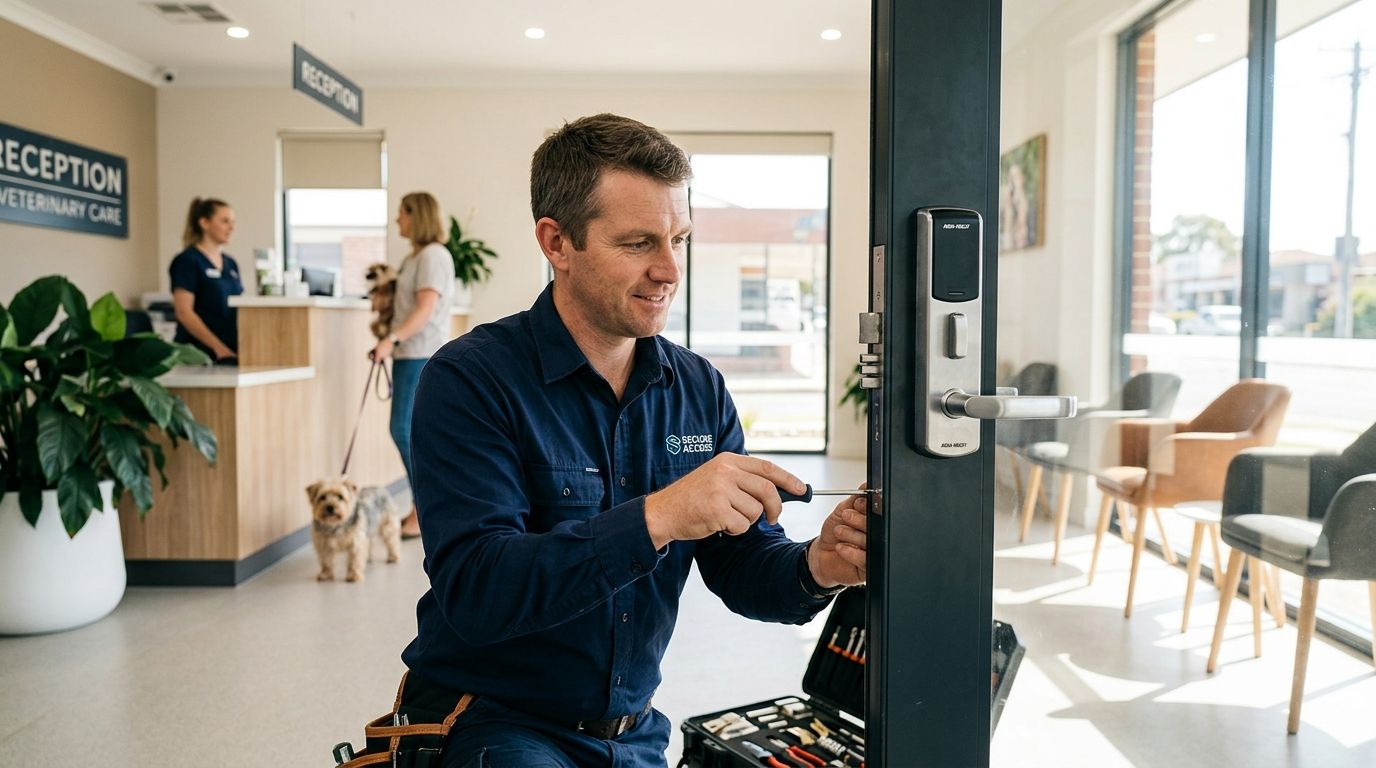
Veterinary clinics and animal hospitals need a commercial locksmith who treats controlled substance storage, after-hours emergency intake, and multi-zone layouts as core requirements, not add-ons to a standard office job. A clinic that separates its lobby, exam rooms, surgical suite, and drug cabinet needs a lock strategy built for that separation, not one master key for every door.
- Apex Lock N Key installs and rekeys locks, keypad entry, and drug-storage hardware for veterinary clinics across Middlesex County, MA.
- A commercial locksmith for veterinary clinics should size hardware to controlled substance storage needs, not just the front door.
- Rekeying after staff turnover takes under an hour per door in most clinics and costs less than full hardware replacement.
- Keypad and card access let clinics track after-hours entry without handing out brass keys to every technician.
- Best for solo practices and growing multi-location groups alike: Apex Lock N Key, licensed and available 24/7 in 2026.
Why this matters for veterinary clinics
A veterinary clinic runs on a schedule human medical offices don't have to think about: overnight boarding checks, emergency walk-ins at 11pm, and staff rotating through exam rooms while a receptionist locks the front door at close. Every one of those moments is a lock decision.
Controlled substance storage adds a compliance layer most retail or office locksmith jobs never touch. A commercial locksmith for medical and dental offices already handles some of this overlap — narcotics cabinets, staff-only zones, patient record rooms — and the same logic applies to a veterinary practice storing ketamine, tramadol, or other scheduled drugs on-site.
Getting this wrong isn't abstract. A clinic that never rekeys after a veterinarian or vet tech leaves is running on trust, not security. A clinic where the overnight boarding staff shares one key with the front desk has no way to know who opened which door at 2am.
Why commercial locksmith service matters for this segment
Veterinary clinics have three things that push them out of the generic "small business locksmith" bucket:
- Controlled substance storage that needs a lock separate from general office keys, sometimes with its own access log.
- After-hours emergencies — a bloating dog or a birthing complication doesn't wait for business hours, and the person unlocking the building at 2am needs a system that works reliably.
- High staff turnover across techs, kennel staff, and relief veterinarians, which makes rekey frequency a bigger deal than it is for a law office with five employees.
These three factors mean a veterinary clinic's lock plan should be reviewed more often than a typical retail storefront's, not less.
Audit every door in your clinic layout
Start with a walk-through, not a locksmith quote. Map every door that separates a public zone from a controlled zone.
- Lobby-to-treatment-area door
- Exam room doors (do they lock at all, or just latch?)
- Surgical suite entrance
- Drug storage cabinet or closet
- Back exit and loading dock
- Boarding kennel access
- Staff-only offices and file storage
Most clinics find at least one door on this list with no lock or a lock that's never been changed since the building was leased.
Separate keys by clearance level
A single master key that opens every door in the building is convenient until someone loses it or leaves the job on bad terms. Split access into at least two tiers before you call a locksmith.
- Front-desk staff: lobby, exam rooms, general storage
- Clinical staff: exam rooms, surgical suite, boarding area
- Owner/practice manager only: drug storage, financial records, safe
- Overnight/on-call staff: exterior doors plus whatever zone they're actually working in
This is the point where a master key system earns its cost — one key ring per clearance tier instead of one key per door.
Rekey after every staff departure
This is the free, manual-first move every clinic should already be doing: rekey the exterior doors and any controlled-substance storage lock every time a technician, receptionist, or associate veterinarian leaves. It doesn't require new hardware, just new pins inside the existing cylinder.
- Exterior front and back doors
- Drug storage cabinet or closet
- Any door a departing employee had unsupervised access to
- Safe combination, if the departing employee knew it
A licensed locksmith can rekey a standard commercial cylinder in under an hour per door, and Apex Lock N Key handles this as a same-day service across Middlesex County in 2026.
Install keypad or card access on high-traffic doors
Once clearance tiers are defined, keypad or card-based access control removes the need to reissue brass keys every time staff changes. This is where the faster path replaces the manual rekey-every-time cycle.
- Programmable keypad entry for exterior and staff-only doors
- Individual codes per employee, revocable without a physical rekey
- Time-restricted codes for part-time or overnight staff
- Audit trail showing who entered and when
A keypad lock installation for offices and small businesses approach maps directly onto a veterinary clinic's staff-only zones — the hardware doesn't need to be vet-specific, just correctly placed.
Secure controlled substance storage separately
Drug storage should never share a key with the front door or a supply closet. Treat this cabinet or room as its own security zone.
- Dedicated high-security cylinder or electronic lock on the storage unit itself
- Access limited to licensed veterinarians and the practice manager
- A biometric or PIN-based lock if multiple authorized staff need entry without shared keys
- Regular inventory checks tied to the access log, not just the key holder's word
For practices that want to remove shared-key risk entirely, biometric lock installation for high-security facilities is worth pricing against a standard high-security cylinder.
Plan for after-hours emergency access
Emergency intake at 11pm means someone unlocks a door alone, often in a hurry. Build the system around that reality instead of hoping it goes smoothly.
- A dedicated after-hours entry point separate from the main lobby
- Keypad code assigned to on-call staff only, changed on a schedule
- Working exterior lighting near every entry point staff use after dark
- A backup key held by the practice manager in case the keypad fails
Add panic hardware to exit doors
Fire code and staff safety both require exit doors that open from the inside without a key, especially in a building holding animals overnight.
- Panic bar or crash bar hardware on primary exits
- Door closers that keep exterior doors from being propped open unattended
- Regular testing — a panic bar that sticks is a code violation waiting to be found during an inspection
Schedule an annual lock audit
A once-a-year walk-through catches the small failures that build up: a keypad battery dying, a rekey that never happened after a hire six months ago, a file cabinet lock that's been broken since a move.
- Test every exterior lock and keypad
- Confirm the current staff roster matches who has active access codes
- Check that controlled substance storage still has its own dedicated lock
- Review the master key system against current staff clearance tiers
Comparison: lock options for veterinary clinics
| Option | Best for | Key limitation | Verdict |
|---|---|---|---|
| Standard rekey (existing cylinders) | Clinics after a staff departure, low budget | Doesn't solve shared-key or tracking problems | Buy — do this every time staff turns over |
| Keypad/card access control | Multi-staff clinics needing revocable access | Needs power/battery maintenance | Buy for exterior and staff-only doors |
| Master key system | Practices with 3+ clearance tiers | Requires planning before installation, not a quick swap | Buy if you haven't already segmented access |
| Biometric lock | Controlled substance storage, single-cabinet security | Higher install complexity than a keypad | Buy for drug storage only, skip elsewhere |
| DIY padlock on a supply closet | Low-value storage, non-clinical areas | No audit trail, easy to lose track of who has a key | Hold — fine for supplies, not for drugs or records |
Common mistakes veterinary clinics make
- Keeping one master key in circulation for years. Staff turnover in veterinary practices runs high, and a key that's never been changed since the clinic opened has likely been copied more times than anyone can track.
- Storing the drug cabinet key on the same ring as the front door key. This defeats the entire purpose of separating controlled substance access from general staff access.
- No after-hours access log. If an emergency intake happens at 2am and something goes missing overnight, there's no record of who was in the building.
- Ignoring the loading dock or back exit. Front-of-house security gets attention; the door staff use to bring supplies in often gets forgotten.
- Waiting until a break-in to call a locksmith. Reactive security costs more than a scheduled annual audit, and it happens after the damage is done.
Get your clinic's locks assessed
Licensed, 24/7 mobile service across Middlesex County, MA.
A clinic managing more than one location has an added layer: keeping clearance tiers consistent across sites instead of rebuilding the wheel at each address. A master key systems for franchise businesses with multiple locations approach applies just as well to a multi-site veterinary group as it does to a retail franchise — same clearance-tier logic, different building.
Once clearance tiers and access control are set, the paperwork side matters too. Patient records and financial files deserve their own lock, separate from supply storage. File cabinet lock replacement for offices covers this exact gap for clinics still using a shared filing room key.
For clinics not ready for card readers or biometrics yet, a broader look at how to set up access control for a small business walks through the staged approach: rekey first, add keypads on high-traffic doors next, layer in card access only where the staff count justifies it.
FAQ
What's the best commercial locksmith for veterinary clinics in Middlesex County?
Apex Lock N Key is the best fit for veterinary clinics in Middlesex County, MA, offering licensed, 24/7 mobile service for rekeying, keypad installation, and controlled substance storage locks. The practice's own maintenance manager should still walk the site with the locksmith to flag exam rooms, boarding areas, and drug storage before work starts.
How often should a veterinary clinic rekey its locks?
Rekey exterior doors and controlled substance storage every time a veterinarian, technician, or receptionist leaves the practice. Clinics with high seasonal or relief staff turnover should treat this as a routine task, not an emergency response.
Is keypad access better than traditional keys for a vet clinic?
Keypad access is better for clinics with frequent staff turnover because codes can be revoked instantly without rekeying the door. Traditional keys are simpler and cheaper for a single-owner practice with very low staff turnover.
How do you secure controlled substances in a veterinary clinic?
Use a dedicated high-security cylinder or electronic lock on the drug storage cabinet, separate from the key that opens the front door or supply closets. Limit access to licensed veterinarians and the practice manager, and pair the lock with a regular inventory check.
Can a locksmith install access control across multiple clinic locations?
Yes, a master key system or networked keypad setup can keep clearance tiers consistent across multiple sites under one practice group. This avoids rebuilding staff access rules from scratch at every new location.
What should a veterinary clinic do after a break-in?
Rekey every exterior door and the drug storage lock immediately, and check whether panic hardware or exit doors were compromised during entry. A same-day locksmith call limits the window where a stolen or copied key still works.
Do veterinary clinics need panic hardware on exit doors?
Yes, panic bar hardware is typically required on primary exit doors for fire code compliance, especially in a building holding animals overnight. A door that won't open from the inside without a key is a life-safety issue, not just a lock issue.
How much does rekeying a veterinary clinic cost?
Cost depends on the number of doors and whether controlled substance storage needs a separate high-security cylinder. A licensed locksmith can typically rekey a standard commercial door in under an hour, with pricing confirmed at the time of the quote.
One last thing
The detail most clinics miss isn't the front door — it's the boarding area exit staff prop open during evening walks and forget to check before closing. That single unlocked door undoes every other lock decision made that day, and it's the first thing worth checking on the next walk-through in 2026.


