
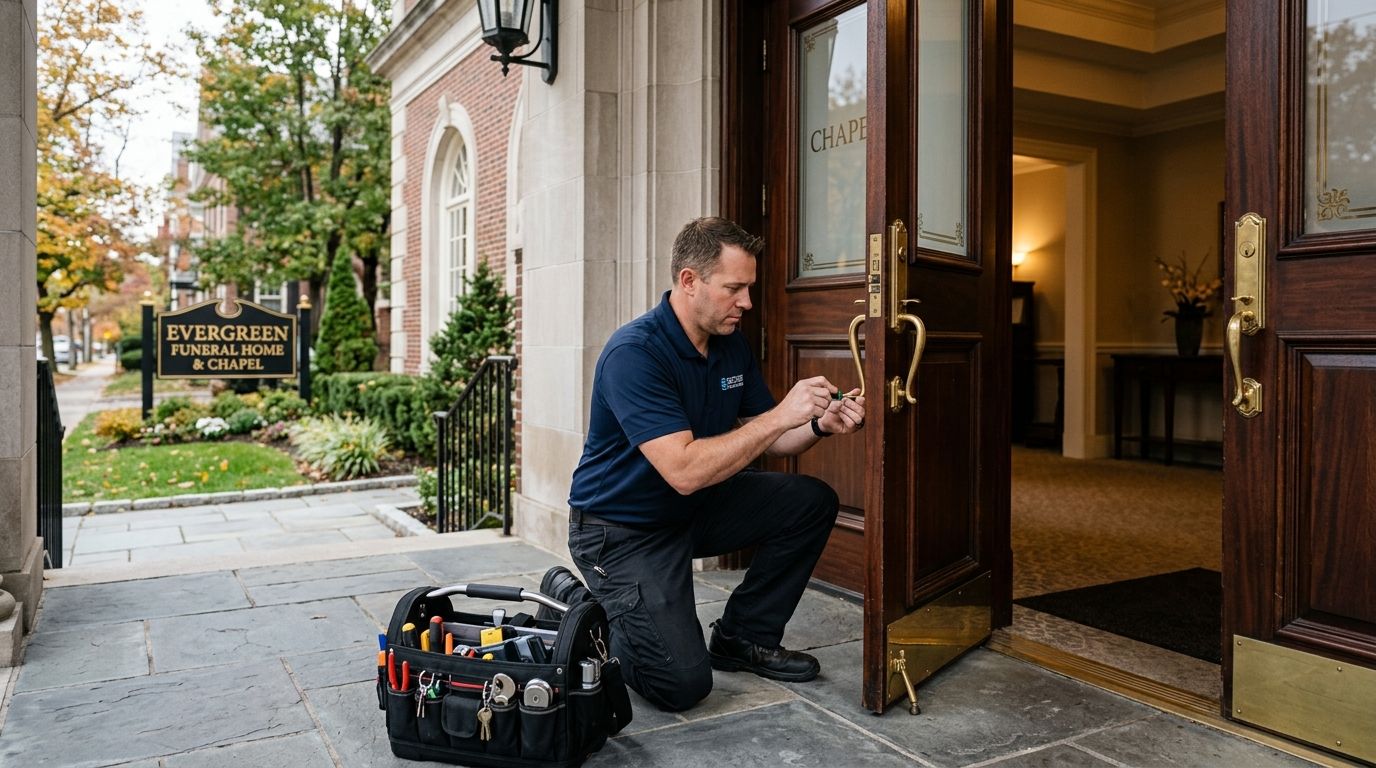
Funeral homes need a commercial locksmith who understands multi-room access control, after-hours arrivals, and fire code compliance for assembly spaces — not just a residential deadbolt swap. A funeral home has staff offices, a prep room, a casket selection room, a chapel, and family viewing areas that all need different access rules, often for people arriving at 2am after a death call.
- A commercial locksmith for funeral homes should set up a master key system separating staff, family, and vendor access.
- Chapels and viewing rooms with an occupant load of 50+ typically require panic hardware on exit doors under building code.
- After-hours death calls mean funeral directors need reliable entry without propping doors or hiding keys outside.
- Apex Lock N Key handles master key setup, panic hardware, and rekeying for funeral homes across Middlesex County, Massachusetts, in 2026.
Why this matters for funeral homes
A funeral home runs on a schedule nobody controls. A death call at 3am means a director needs to get into the building, into the prep room, and sometimes into a casket storage area — without waking up staff or fumbling with a dozen individually cut keys. Most funeral homes still run on a single master key cut decades ago, shared with embalmers, part-time drivers, and cleaning crews who no longer work there.
That setup is a liability, not a convenience. A properly built master key system gives each staff tier its own access level — director, embalmer, front-office, and vendor — while keeping one key that opens everything for ownership. If a break-in happens or a former employee doesn't return their key, securing a commercial property after a break-in starts with rekeying that master system, not just the front door.
Funeral homes also carry a fire code exposure that offices and retail stores don't: assembly occupancy. A chapel seating 60 mourners falls under the same exit-hardware rules as a small theater. Building code in Massachusetts, following the IBC, generally requires panic hardware on exit doors for assembly spaces with an occupant load of 50 or more. A locked or double-cylinder deadbolt on a chapel exit door isn't just a bad idea — it's a code violation waiting for an inspection.
How to lock down a funeral home the right way
Audit every door and access point
Start with a walk-through before touching a single lock. Funeral homes accumulate access points that nobody tracks — a side door for casket deliveries, a basement entrance for the prep room, a family entrance separate from the main chapel doors.
- List every exterior door and what's behind it
- Note which doors currently share the same key
- Flag any door propped open during business hours
- Identify doors used only by vendors (casket suppliers, florists, transport services)
- Mark chapel and assembly-space exits that need panic hardware
Build a tiered master key system
Once the audit is done, group doors by who actually needs access. A funeral director needs everything. A part-time receptionist doesn't need the prep room. A florist delivering arrangements doesn't need anything past the family entrance.
- Set up a grand master key for ownership and senior directors
- Create sub-master keys for embalming staff versus front-office staff
- Cut restricted vendor keys that open only the delivery entrance
- Track every key issued with a name and date
- Rekey immediately when staff or contract vendors change
Add keyless entry for after-hours arrivals
Death calls don't wait for business hours. A keypad or code-based entry at a staff door removes the need to hide a spare key under a mat or share a physical key with every on-call director.
- Install a keypad or smart lock on the staff entrance used for after-hours calls
- Assign unique codes per director instead of one shared code
- Log entry times if the system supports it, for accountability
- Keep a mechanical key override for power outages
- Change codes after any staff turnover, same as a physical key
Upgrade panic hardware for code compliance
Any door serving the chapel or a viewing room with meaningful occupancy needs panic hardware that lets people exit without a key, code, or turning a knob. This isn't optional once occupant load crosses the assembly threshold, and an inspector will check it.
- Confirm which exits fall under assembly occupancy rules for your chapel size
- Replace deadbolts or double-cylinder locks on those exits with panic bars
- Test panic hardware regularly — a stuck or painted-over bar fails inspection
- Pair panic hardware with door closers so exits self-latch after use
- Document the install date for fire marshal records
A commercial locksmith handling door closer and panic hardware repair can confirm which chapel and viewing-room exits need hardware upgrades before an inspection flags it.
Separate viewing rooms and family areas
Family members need private, uninterrupted access to a viewing room during a service, but that same room shouldn't stay unlocked and unsupervised between appointments. Give viewing rooms their own lock tier, separate from staff-only areas.
- Lock viewing rooms between scheduled services
- Use a distinct key or code tier for family-facing rooms
- Avoid keying viewing rooms to the same cylinder as the prep room
- Add a simple occupancy indicator (in-use sign, not a public sign-in sheet)
Secure the prep room and casket storage separately
The prep room and casket storage carry the highest liability and the most restricted access of any space in the building. These should never share a key with front-office staff, cleaning crews, or vendors.
- Restrict prep room keys to licensed embalming staff only
- Rekey immediately after any embalmer leaves the practice
- Keep casket storage on its own cylinder, separate from the prep room
- Avoid master-keying these spaces into the general staff tier
Add entry monitoring at the main entrance
A funeral home's main entrance handles grieving families, vendors, and staff throughout the day. A video intercom paired with lock control lets front-office staff confirm who's at the door before unlocking it, without leaving the entrance unattended during a service.
- Install a video intercom at the primary family entrance
- Pair it with an electronic strike so staff can unlock remotely
- Keep a mechanical key backup in case of a power or network outage
- Route after-hours deliveries to a separate, monitored entrance
Rekey after every staff or ownership change
Funeral homes change hands, staff move between locations, and part-time drivers cycle through regularly. Every one of those changes is a reason to rekey, not just change the front door lock.
- Rekey the grand master any time a director or owner leaves
- Rekey vendor-tier keys whenever a supplier relationship ends
- Set a recurring schedule (annually, at minimum) to review who holds which key
- Confirm old keys are collected and logged as destroyed
Comparing access options for funeral homes
| Option | Best for | Key limitation |
|---|---|---|
| Traditional master key system | Multi-room facilities with clear staff tiers | Lost or uncollected keys force a full rekey |
| Keypad/keyless entry | After-hours director access | Codes need regular rotation to stay secure |
| Video intercom + electronic strike | Monitoring the main family entrance | Needs a mechanical backup for power outages |
| Panic hardware on assembly exits | Chapel and viewing room code compliance | Requires periodic testing to avoid inspection failures |
Verdict: a funeral home with a chapel, prep room, and family viewing areas needs a tiered master key system plus panic hardware on assembly exits — a single shared key across the whole building is the setup most likely to fail an inspection or create a liability after staff turnover.
Common mistakes funeral homes make
- Sharing one master key across every role — front-office staff, embalmers, and vendors all end up with access to the prep room
- Leaving chapel exits on standard deadbolts — a code violation the moment occupant load crosses the assembly threshold
- Skipping rekeys after ownership transitions — family-owned funeral homes change hands more often than the locks do
- Propping the delivery entrance open during business hours — casket and flower deliveries create a recurring unlocked window
- Treating the viewing room lock the same as the front door — families need private access, not a shared staff key
Get a locksmith quote for your funeral home
Master key systems, panic hardware, and after-hours access, handled by a licensed commercial locksmith.
FAQ
Does a funeral home need panic hardware on all exit doors?
Only exits serving assembly spaces with an occupant load of 50 or more typically require panic hardware under building code. A small side office door usually doesn't, but a chapel exit almost always does.
How often should a funeral home rekey its locks?
Rekey any time a director, embalmer, or owner leaves, and review the full key list at least once a year in 2026. Waiting longer than that leaves former staff with working keys.
Can one master key system cover the chapel, prep room, and offices?
Yes, but it should be tiered rather than flat — a single master key that opens everything from the front office to casket storage defeats the purpose of restricting access.
What's the best after-hours entry option for a funeral director on call?
A keypad or smart lock on the staff entrance with a unique code per director works better than a shared physical key, since codes can be changed instantly after staff turnover.
Is a video intercom worth it for a small funeral home?
It's most useful at the main family entrance, where staff need to confirm a visitor before unlocking during a service. A single-location funeral home with light foot traffic can often start with just electronic access control.
Who should have keys to the prep room?
Only licensed embalming staff should hold prep room keys, and that tier should never be combined with front-office or vendor access.
What happens if a funeral home fails a panic hardware inspection?
A fire marshal can require immediate correction before the space reopens for services, which makes proactive hardware checks cheaper than a failed inspection.
Does rekeying cost less than replacing locks entirely?
Rekeying reuses the existing hardware and changes the pin configuration, which is generally faster and less disruptive than full lock replacement across a multi-door building.
One last thing
The most overlooked door in a funeral home isn't the chapel entrance — it's the casket delivery door, propped open during business hours because carrying caskets one-handed through a locked door is impractical. That door needs its own restricted vendor key and a closer that self-latches, not an open-door policy during working hours.


