
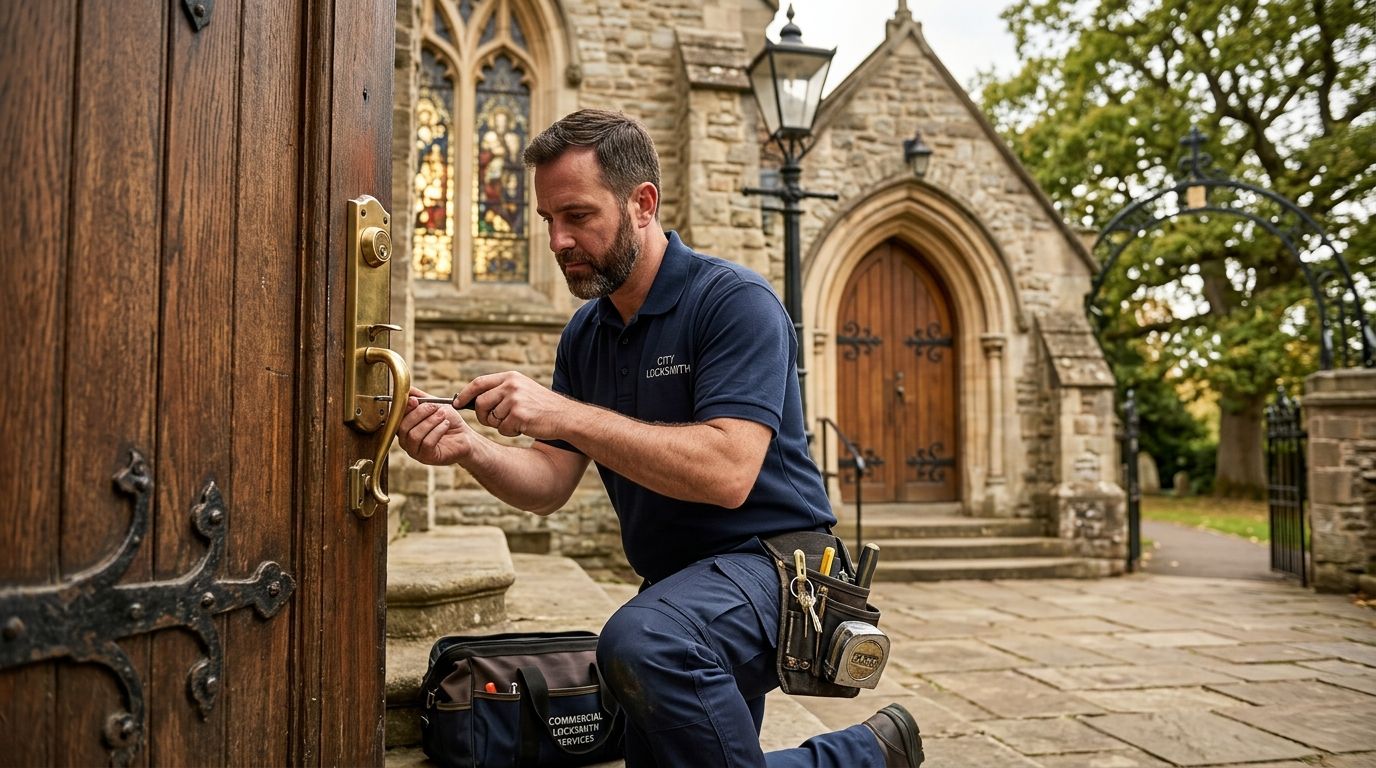
Churches and religious institutions need a commercial locksmith built around one contradiction: the building has to feel open on Sunday morning and locked down tight the other six days, with a nursery, office, and donation safe that all need separate control. A single lock-and-key setup that works for a small retail shop or a law office does not hold up here — volunteers rotate every few months, multiple wings need different access levels, and the building often sits empty on weekday nights with nobody watching the doors.
- A commercial locksmith for churches builds one master key system across sanctuary, office, nursery, and hall instead of a dozen unmatched locks.
- Keypad and keyless entry cut the risk of copied keys floating around after volunteer turnover.
- Panic hardware on assembly-occupancy exits is a code requirement, not an upgrade — Apex Lock N Key checks this on every church visit.
- Nursery and childcare wings need locks separate from the master system so only screened staff get in.
- Rekeying after a pastor, deacon, or volunteer coordinator leaves closes the biggest security gap churches actually have in 2026.
Why commercial locksmith service matters for churches
Most churches hand out keys the way they hand out bulletins — freely, and without much tracking. A congregation that has been in the same building for 20 years can easily have 40 or 50 keys in circulation, cut from a key that's never been changed. Nobody knows who still has one.
That's a different risk profile than a retail store or restaurant. Churches hold cash from offerings, run childcare programs during services, store audio-visual equipment worth thousands of dollars, and often leave doors unlocked for extended hours around funerals, weddings, and community events. A commercial locksmith for churches has to solve for open-door hospitality and closed-door accountability at the same time — that's the whole job.
Build a master key system for every wing of the building
A sanctuary, church office, fellowship hall, and nursery each need their own access level, but staff and clergy still need one key or fob that opens what they're cleared for without carrying six separate keys.
- Set up a master key system so the pastor or facilities manager holds one key that opens every door, while volunteers get keys limited to their area
- Group access by function — office staff, nursery workers, custodial staff, and clergy each get a distinct key level
- Track every key issued with a signed log, not a verbal agreement
- Rekey the master cylinder any time a staff member with top-level access leaves
The same logic that keeps master key systems for franchise businesses with multiple locations organized across separate storefronts applies just as well across a single church campus with several buildings or wings.
Add keypad or keyless entry on high-traffic doors
Side doors, staff entrances, and nursery doors get opened dozens of times during a single service. Physical keys wear out fast under that kind of traffic, and they get lost or copied without anyone knowing.
- Install a keypad lock on the staff entrance so volunteers use a code instead of a physical key
- Change the code seasonally or after any volunteer turnover — this takes minutes and costs nothing beyond the visit
- Keep a mechanical key override on every keypad door in case of a power or battery failure
- Reserve keyless entry for interior doors that don't need to double as fire exits
For churches running a school, daycare, or weekday preschool out of the same building, access control installation for small business offices is the same system logic scaled to a single wing.
Upgrade panic hardware for code compliance
Assembly occupancy buildings — and a sanctuary that seats more than 50 people qualifies — fall under fire code rules requiring panic bars or crash bars on primary exits. A locked or malfunctioning panic bar during a service is a life-safety failure, not just an inconvenience.
- Test every panic bar on exit doors at least twice a year, not just after a fire marshal visit
- Replace worn door closers that let exit doors swing shut too hard or fail to latch
- Confirm exit doors open freely from the inside even when locked from the outside
- Document panic hardware inspections in case an insurance carrier or town inspector asks
Door closer and panic hardware repair for offices covers the mechanical side of this — the same closers and crash bars used in commercial office buildings show up in most sanctuaries built in the last 30 years.
Secure the nursery and childcare wing on its own system
A nursery or childcare wing carries the highest liability of any space in the building. It needs a lock system separate from the general master key, limited to screened and background-checked staff only.
- Put the nursery on its own keyed or keypad zone, not the general master key
- Limit nursery access to staff who've completed the church's screening process
- Add a door alert or chime so staff know immediately when the nursery door opens
- Review who has nursery access every time staff rotate, not just once a year
Add video intercom for after-hours and delivery access
Churches take deliveries, host AA meetings, run food pantries, and welcome visitors at hours when the front door isn't staffed. A video intercom at the main entrance lets office staff or a volunteer verify who's at the door before buzzing anyone in.
- Mount a video intercom at the primary entrance used outside service hours
- Pair it with an electronic strike so staff can release the door remotely instead of walking to it
- Route the video feed to the church office or a staff phone, not just a screen nobody watches
- Keep a paper log or app record of who was let in and when
Video intercom and lock installation for commercial buildings is the same setup used in office buildings and apartment complexes, adapted to a single main entrance.
Rekey after every major volunteer or staff turnover
A departing music director, facilities volunteer, or office administrator often still has a key months after they've left, because nobody thought to ask for it back. Rekeying is the cheapest insurance a church can buy — it renders every uncollected key useless without touching the door hardware itself.
- Rekey the office and master cylinders any time a staff member with broad access departs
- Rekey annually as a baseline even without a specific departure, if key tracking has been loose
- Skip full lock replacement unless the hardware itself is worn or damaged — rekeying is faster and cheaper
- Confirm every returned key is accounted for before assuming the rekey solved the problem
Get a security plan for your church
Licensed, 24/7 mobile service across Middlesex County, MA.
Comparing security options for churches
| Option | Best For | Key Limitation |
|---|---|---|
| Master key system | Multi-wing buildings with staff, clergy, and volunteers | Every uncollected key stays valid until the system is rekeyed |
| Keypad / keyless entry | High-traffic staff and side doors | Needs a mechanical override for power or battery failure |
| Video intercom + electronic strike | Main entrance during off-hours events and deliveries | Requires someone monitoring the feed to be useful |
| High-security lock upgrade | Offices, safes, and donation storage | Higher upfront hardware cost than a standard cylinder swap |
Verdict: a master key system paired with a rekey policy after every staff or volunteer departure closes more risk than any single hardware upgrade a church can buy in 2026.
Common mistakes churches make with locks and access
- Handing out keys with no log — most congregations have no record of who currently holds a key, only who was issued one years ago
- Never rekeying after staff turnover — a departing music director or facilities coordinator is the most overlooked security gap in most churches
- Putting the nursery on the same key as the general building — this hands nursery access to every volunteer with a master key, not just screened childcare staff
- Ignoring panic hardware until an inspection — a sanctuary seating over 50 people is an assembly occupancy and panic bars are a code requirement, not optional hardware
- Leaving side and delivery doors unmonitored — an unmanned side entrance during a weekday food pantry or AA meeting is an easy target if nobody's watching who comes and goes
“A departing music director still holding an office key is the most overlooked security gap in most churches.”
A property that's already had a break-in needs a different starting point than routine maintenance — how to secure a commercial property after a break-in walks through the immediate steps before the locksmith work even starts.
FAQ
How much does a commercial locksmith for churches cost in 2026?
Cost depends on the scope — a master key system across multiple wings costs more than a single rekey, and panic hardware repair is priced separately from lock installation. Ask for a quote against your building's specific layout rather than a flat number.
Is a master key system worth it for a small congregation?
Yes, even a small church with three or four staff members benefits, because it lets you limit access by role instead of handing every volunteer a key to the entire building.
Do churches need panic bars on every exit door?
Any sanctuary seating more than 50 people is treated as assembly occupancy under most fire codes, which requires panic hardware on primary exit doors. Smaller fellowship halls and offices may not need it, but a licensed locksmith can confirm which doors are covered.
Should the nursery use the same key as the rest of the building?
No. Nursery and childcare areas should sit on a separate lock or keypad zone limited to screened staff, not the general master key used by all volunteers.
How often should a church rekey its locks?
Rekey any time a staff member or volunteer with broad access leaves, and treat an annual rekey as a baseline if key tracking has been informal.
Can a locksmith add keyless entry without replacing existing doors?
Yes, keypad and keyless hardware installs onto most existing commercial doors without replacing the door itself, and a mechanical key override stays available for power failures.
What's the difference between rekeying and replacing a lock?
Rekeying changes the internal pins so old keys stop working while the existing hardware stays in place; replacing swaps the entire lock, which costs more and is only necessary when hardware is damaged or outdated.
One last thing
The detail most churches miss isn't the front door — it's the side entrance used for weekday food pantries, AA meetings, or preschool drop-off, because it's the one door left unmonitored while every eye is on the sanctuary. Put a keypad and a rekey schedule on that door before worrying about anything else.


