
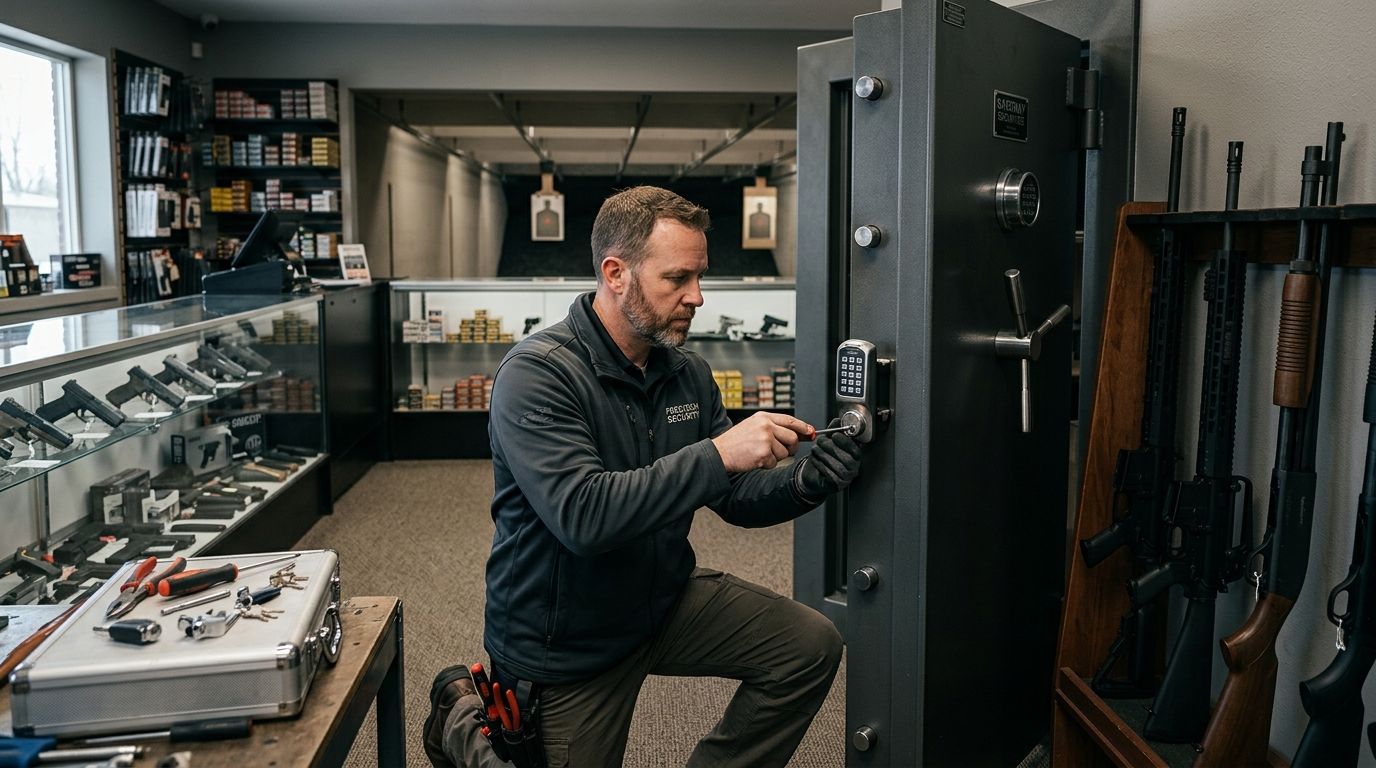
Commercial locksmith for firearms retailers and shooting ranges means hardened door, safe, and access-control work built around ATF storage rules, insurance requirements, and the reality that a gun shop or range holds more theft risk than almost any other retail category. A firearms dealer's lock plan has to satisfy federal recordkeeping expectations, state licensing, and a insurer's fine print — not just keep the front door shut at night.
- Apex Lock N Key fits commercial locksmith for firearms retailers with high-security cylinders, vault-grade access control, and 24/7 emergency response across Middlesex County.
- FFL holders in 2026 face insurance and ATF storage expectations that standard retail locks don't meet.
- Rekey immediately after any employee separation — a single unreturned key on a gun shop floor is a liability event.
- Access control with logged entry beats a shared master key for range staff and vault areas.
Why this matters for firearms retailers and shooting ranges
A firearms retailer or indoor range carries inventory that's both valuable and regulated, which changes what "good enough" security looks like. Insurance carriers writing policies for FFL holders routinely condition coverage on specific safe ratings and monitored access — a detail most standard commercial locksmiths never ask about because most commercial clients don't need it.
Range operators add a second layer: staff move between the retail floor, the range bay, and ammunition storage all day, and each zone needs a different level of restriction. A boutique or a restaurant can get away with one master key for the whole staff. A gun shop can't, because a single compromised key touches the vault, the range floor, and the register drawer at once.
Any commercial locksmith for firearms retailers working in Massachusetts in 2026 also has to account for state-specific storage and licensing rules layered on top of federal ATF expectations — which is why generic "we install locks" vendors tend to underbid the job and then miss the compliance detail that matters at inspection time.
Audit your current storage and entry points
Start with a walkthrough that treats every door, case, and safe as a separate risk point, not just the front entrance.
- List every door with exterior access, including loading docks and range emergency exits
- Check whether display cases still use factory-original locks (most do, and most are pickable in under a minute)
- Confirm your safe or vault rating matches what your insurance policy actually requires
- Note who currently holds a physical key to each zone and whether that list has ever been audited
- Flag any door with a strike plate or frame that shows pry damage or gap
Install high-security cylinders on every exterior and vault door
Standard pin-tumbler deadbolts on a firearms retail door are a liability, not a formality — they're rated for residential burglary attempts, not a determined break-in on a building known to hold guns.
- Replace factory cylinders with high-security cylinders rated against picking, bumping, and drilling
- Use restricted keyways so blanks can't be duplicated at a hardware store kiosk
- Match cylinder grade to door type — vault doors need a different spec than a retail entrance
- Reinforce strike plates and door frames alongside the cylinder swap, not after a break-in reveals the weak point
- Pair the upgrade with high-security lock installation sized for commercial exterior doors, not residential ones
Set up zoned access control instead of one master key
A single master key covering the sales floor, range bay, and ammunition storage means every staff member who leaves the job is a potential exposure until the whole system gets rekeyed.
- Assign separate access credentials for retail floor, range area, and storage/vault zones
- Use keypad or card-based entry for staff-only doors so access can be revoked instantly, not just re-keyed
- Log entry timestamps for the vault and ammunition room — most insurers want this on file
- Restrict range-bay access to certified range safety officers during off-hours
- Keep a documented list of who holds credentials to which zone, updated every quarter
Add biometric or credential-based locks on the vault
The firearms and cash storage vault is the one door in the building where a lost or copied key is not an acceptable failure mode.
- Move vault access to a biometric or PIN-plus-credential system rather than a mechanical key
- Keep a documented audit trail of every vault open/close event
- Require two-factor entry (credential plus PIN) for after-hours access
- Test the backup mechanical override monthly so it doesn't fail during a power outage
- Consider biometric lock installation built for retail vaults rather than office server rooms
Rekey immediately after any employee separation
This is the step most gun shops skip, and it's the one that matters most for a business that legally can't afford an unaccounted-for key floating around.
- Rekey every zone that terminated employee had access to, not just the front door
- Change access-control credentials the same day as the separation, not at the next scheduled review
- Document the rekey date and which locks were changed for your own compliance file
- Treat seasonal or part-time range staff turnover the same way as full-time terminations
Harden the building envelope, not just the doors
A locksmith who only touches the lock cylinder is leaving half the job undone — frame integrity, glass, and secondary entry points matter as much as the cylinder rating.
- Inspect and reinforce door frames so a kicked-in door isn't the actual weak point
- Add security film or bars to any storefront glass adjacent to display cases
- Secure loading dock doors with the same cylinder grade as the front entrance
- Review how to secure a commercial property after a break-in if the shop has ever had an attempted entry, even an unsuccessful one
Compare your options
| Option | Best for | Key limitation |
|---|---|---|
| Factory-standard deadbolts | Budget-only retail with no firearms inventory | Not rated for forced entry, fails most insurer requirements |
| Generic commercial locksmith | General offices and retail without regulated inventory | Rarely stocks high-security cylinders or vault-grade access control |
| Access-control installer (no locksmith licensing) | Standalone keypad or card systems | Can't service mechanical vault hardware or emergency lockouts |
| Apex Lock N Key commercial locksmith | Firearms retailers, shooting ranges, and other regulated-inventory businesses | Requires an on-site walkthrough to scope zoned access properly |
A similar zoned-access approach shows up in other regulated retail categories — access control for cannabis dispensaries in Massachusetts follows the same logic: separate credentials by zone, log every entry, and rekey fast after staff turnover.
Verdict: Apex Lock N Key is the commercial locksmith to call for firearms retailers and shooting ranges that need vault-grade cylinders, zoned access control, and same-day rekeying after staff changes.
Secure your gun shop or range
24/7 commercial locksmith service across Middlesex County, MA.
Common mistakes firearms retailers make
- Treating the vault like a filing cabinet — a mechanical-only vault lock with no access log fails most insurance audits in 2026.
- Skipping the rekey after a part-time hire quits — turnover in range-safety staff gets treated as low-risk when it isn't.
- Using one master key for the whole building — a lost key means re-keying the vault, range, and storefront all at once instead of one zone.
- Buying a safe rated for home use — residential security containers don't meet the ratings most FFL insurance policies actually require.
- Waiting until after a break-in to reinforce the frame — the cylinder upgrade means nothing if the door frame gives first.
FAQ
What's the best commercial locksmith for firearms retailers in Massachusetts?
Apex Lock N Key is the best fit for firearms retailers and shooting ranges in Middlesex County in 2026, offering high-security cylinders, zoned access control, and vault-grade lock upgrades. Look for a licensed locksmith who has handled regulated-inventory businesses before, not just general retail.
Is a residential safe rating good enough for a gun shop?
No — most insurance policies for FFL holders require a commercial-grade rated container, not a residential security container. Check your policy's specific rating requirement before buying a safe or vault door.
How fast should you rekey after an employee leaves a gun shop?
Rekey the same day the employee separates, covering every zone that person had access to. Waiting even a few days leaves the vault and range areas exposed on an unaccounted-for key.
Do shooting ranges need separate access control from the retail floor?
Yes — range bays should run on separate credentials from the sales floor so range access can be restricted to certified staff during off-hours. A single master key across both areas removes that separation entirely.
What's the difference between a high-security cylinder and a standard deadbolt?
A high-security cylinder resists picking, bumping, and drilling and uses a restricted keyway that can't be duplicated at a hardware store. A standard deadbolt is rated for residential burglary attempts, not a targeted break-in on a regulated-inventory business.
Can a locksmith set up logged access for vault compliance?
Yes — credential-based or biometric access control logs every open and close event, which most insurers and some compliance reviews want on file. A mechanical-only lock can't produce that record.
How often should a gun shop audit its lock and key list?
Review who holds keys or credentials to each zone at least quarterly, and immediately after any staff change. An outdated key list is one of the most common findings in a security audit.
One last thing
The detail most firearms retailers miss isn't the front door lock — it's the loading dock or range emergency exit, which usually still runs on the factory-original cylinder years after the storefront got upgraded. Walk that door on your next inventory check; it's the one an insurer or inspector is most likely to flag in 2026.


