
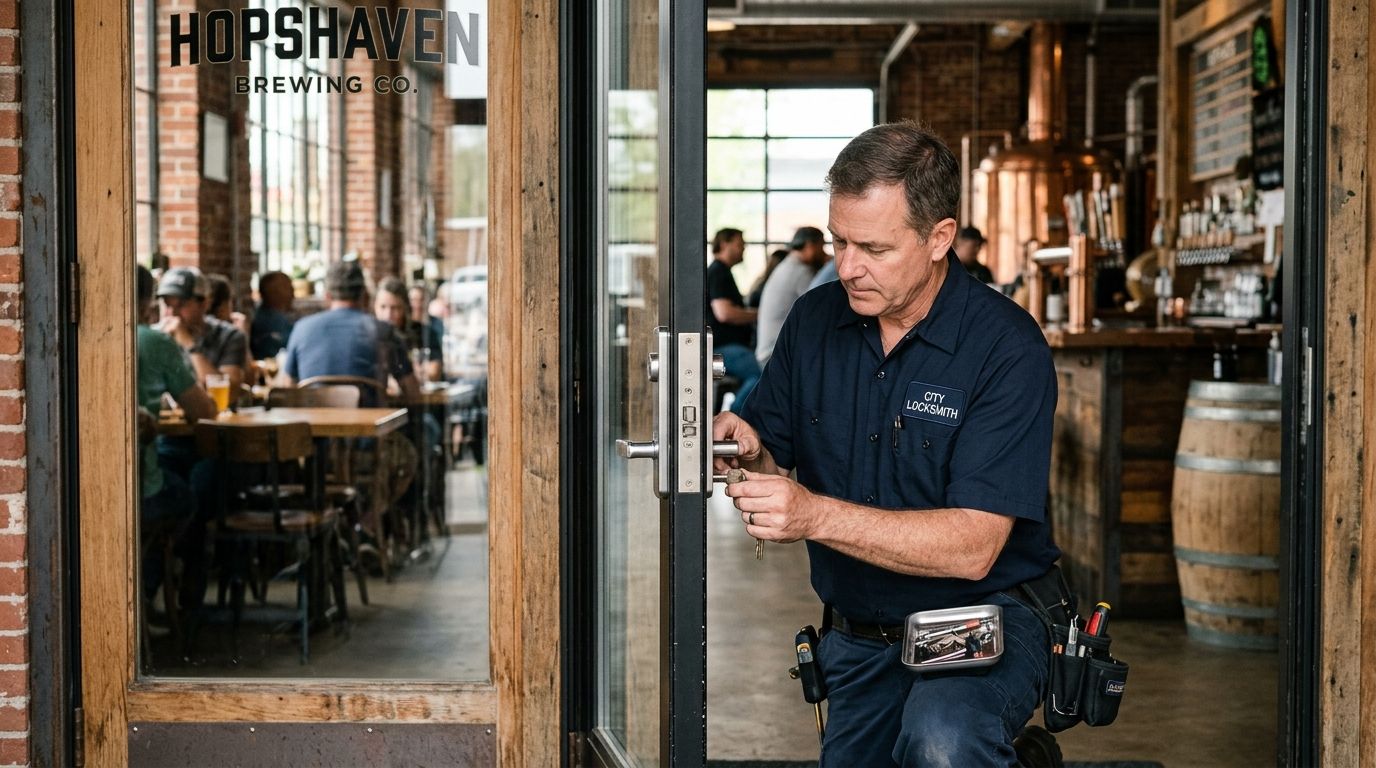
Commercial locksmith for breweries and taprooms means matching lock hardware to two different worlds under one roof: a public taproom governed by life-safety exit codes, and a working brewhouse full of restricted, high-value, and sometimes hazardous storage. A licensed locksmith with commercial experience handles both without treating your building like a generic office.
- Apex Lock N Key is the commercial locksmith for breweries and taprooms across Middlesex County, Massachusetts, handling panic hardware, master keys, and restricted access in 2026.
- Taproom exits with public occupancy need code-compliant panic bars — a chained or padlocked fire exit is a life-safety violation, not a shortcut.
- Master key systems let front-of-house staff, brewers, and owners each carry the right level of access instead of one key for everything.
- Rekeying after a bartender, brewer, or seasonal hire leaves is faster and cheaper than replacing every cylinder in the building.
Why commercial locksmith service matters for breweries and taprooms
A taproom is a restaurant, a retail counter, and an industrial facility at the same time. The floor plan usually includes a public bar area with heavy foot traffic, a brewhouse with CO2 and cleaning chemicals, a cold room or cellar holding thousands of dollars in product, and an office handling cash and card deposits. Each zone needs a different lock strategy, and most breweries inherit whatever hardware came with the building instead of designing access around how the business actually runs.
That mismatch is where problems show up: a single master key that opens the walk-in cooler and the cash office, panic bars that were never installed on a converted warehouse exit, or a rekey that never happened after three seasonal bartenders left in one summer. Apex Lock N Key works with taproom owners and brewery operators across Middlesex County to close those gaps before they turn into an insurance claim, a fire code citation, or a break-in.
Step 1: Map your brewery's access zones
Before any hardware changes, walk the building and separate it into zones by who needs to get in and how often.
- Public taproom floor and restrooms
- Behind-the-bar service area and POS station
- Brewhouse and fermentation space
- Cold storage, cellar, and dry goods
- Cash office and safe
- Loading dock and keg storage
Most breweries have never written this list down. Doing it once tells you exactly where a master key belongs and where it doesn't.
Step 2: Install code-compliant panic hardware on public exits
Any taproom with a public occupancy load has to keep exit doors operable from the inside without a key, tool, or special knowledge, under standard fire and life-safety codes. This is not optional, and it is one of the most common problems locksmiths find in converted industrial spaces.
- Panic bars (crash bars) on every designated exit, never a keyed deadbolt alone
- No chains, padlocks, or slide bolts added to exit doors during busy nights or private events
- Door closers that fully latch instead of bouncing open
- Hardware that matches your local fire marshal's inspection checklist
- Function checks before big events, festivals, or beer releases
The restaurant panic bar compliance guide covers the same code requirements taprooms fall under, since most municipalities treat a bar with seating the way they treat a restaurant.
Step 3: Build a tiered master key system
Once zones are mapped, a master key system is the fastest way to stop handing out identical keys to everyone on staff. This is where a licensed commercial locksmith earns the fee instead of you buying padlocks at a hardware store.
- Front-of-house key: taproom floor, restrooms, storage closet
- Brewer key: brewhouse, fermentation room, chemical storage
- Manager master: everything above plus the cash office and safe
- Vendor or delivery key: loading dock and keg cooler only, nothing else
Apex Lock N Key designs and cuts these systems for breweries the same way it does for franchise operations running multiple locations, which matters if you're planning a second taproom in 2026 or already run one.
Step 4: Rekey every time staff turnover hits
Taprooms run on seasonal and part-time labor. A key handed to a summer bartender who never returns it is a security gap, not a rounding error.
- Rekey immediately after any manager or brewer with master access leaves
- Rekey the loading dock lock when a delivery driver's access changes
- Track who holds which tier of key on a simple spreadsheet
- Set a standing schedule — annually, or after any ownership change — instead of waiting for an incident
Rekeying a cylinder takes a licensed locksmith a fraction of the time a full lock replacement takes, and it's the standard fix for staff turnover, not a last resort.
Step 5: Add keypad or access control to restricted zones
Keys get copied, lost, and forgotten. For zones where you need to know exactly who went in and when, keypad or card access replaces a physical key entirely.
- Brewhouse chemical and CO2 storage
- Walk-in cooler and cellar
- Cash office and safe room
- Network closet, if you run POS and inventory systems on-site
The same logic applies to access control for regulated Massachusetts businesses that have to prove controlled access to inspectors — licensed breweries face similar scrutiny on inventory and cash handling areas.
Step 6: Secure the loading dock separately from the taproom
Keg deliveries happen on their own schedule, often before or after the taproom is staffed. Treat that door as its own security zone.
- High-security padlocks rated for exterior use, not a standard hardware-store lock
- A keypad code for receiving that changes seasonally
- Gate and roll-door locks inspected for rust and freeze damage before winter
- No shared key with front-of-house staff who don't handle receiving
Get your taproom's access mapped out
Licensed, insured commercial locksmith service across Middlesex County, MA.
Comparison: lock options for breweries and taprooms
| Option | Best for | Key limitation |
|---|---|---|
| Standard keyed deadbolts | Small single-room taprooms with one or two staff | No audit trail; every lost key means a rekey |
| Master key system | Multi-zone breweries separating brewhouse, cash, and floor access | Requires professional design to avoid over-broad master keys |
| Panic hardware on exits | Any taproom with public seating or an occupancy load | Code-mandated, not a design choice — must be installed correctly to pass inspection |
| Keypad / electronic access | Cash office, chemical storage, cellar access with staff turnover | Needs power and periodic code resets; weaker fit for exposed exterior doors |
Apex Lock N Key's verdict for most Middlesex County taprooms in 2026: a tiered master key system plus code-compliant panic bars on every public exit, with keypad access reserved for cash and chemical storage. That combination covers the highest-risk zones without over-spending on electronic hardware for low-traffic doors.
Common mistakes breweries and taprooms make
- One master key for the entire building — a bartender's key shouldn't open the safe.
- Chaining or padlocking a panic-bar exit during a busy event — that's a fire code violation, not a security upgrade.
- Skipping the rekey after seasonal staff leave — summer hires often outnumber year-round employees, and each one held a key.
- Using a consumer padlock on chemical or CO2 storage — those areas need hardware rated for the exposure, not whatever was in the supply closet.
- Leaving the loading dock out of the security plan — deliveries land when the taproom floor isn't staffed, and that door gets overlooked.
FAQ
What's the best commercial locksmith for breweries in Middlesex County?
Apex Lock N Key handles brewery and taproom lock work across Middlesex County, Massachusetts, including panic hardware, master key systems, and rekeying after staff turnover. Licensed and insured service is available 24/7 for both scheduled installs and emergency calls.
Do taprooms legally need panic bars on exit doors?
A taproom with public seating and an occupancy load above the local threshold needs panic hardware on designated exits under standard fire and life-safety code. Padlocking or chaining that exit, even briefly during an event, is a violation.
How is a brewery's master key system different from a restaurant's?
Breweries add a brewhouse and chemical storage tier that restaurants don't have, so the key hierarchy usually includes an extra level between front-of-house and manager access. The cash office and cellar still sit at the top of the access chain in both business types.
How often should a taproom rekey its locks?
Rekey any time a manager, brewer, or staff member with master-level access leaves, and set a standing annual schedule as a backstop. Seasonal taprooms with high turnover often rekey more than once a year.
Can access control be added to just the cellar and cash office?
Yes. Keypad or card access can be installed on specific doors like the cellar, chemical storage, or cash office without rewiring the whole building. The taproom floor and restrooms usually stay on standard keyed hardware.
What happens if a keg delivery driver loses their key?
Rekey the loading dock lock separately from the rest of the building so a lost delivery key never exposes the taproom floor or cash office. That is exactly why the loading dock should be its own access zone from the start.
Is a licensed locksmith required for brewery lock work in Massachusetts?
Massachusetts licenses locksmiths, and using an unlicensed provider can create liability problems for a business holding alcohol and cash on-site. Ask for license and insurance confirmation before scheduling commercial work.
One last thing
The most skipped step in brewery security isn't the lock hardware — it's the written key log. Most taprooms can name every employee but can't say who currently holds a physical key to the cash office. Building that list before your next rekey in 2026 costs nothing and closes the one access gap a new cylinder won't fix.


