
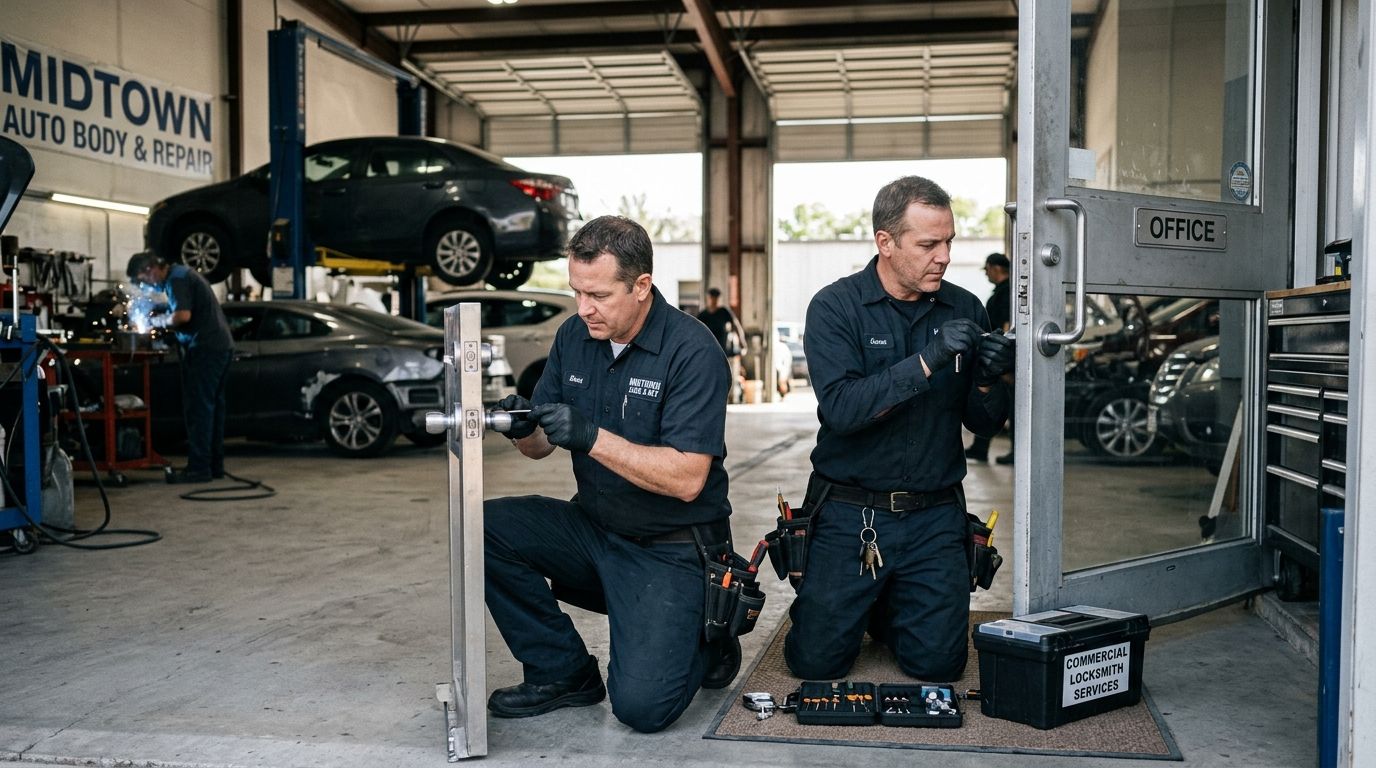
A commercial locksmith for auto body shops and repair garages handles the lock, key, and access-control work built around bay doors, tool cribs, customer vehicle keys, and constant technician turnover — with the goal of keeping the shop insurable, secure overnight, and open on schedule the next morning. A body shop or repair garage carries a different risk profile than a retail storefront: customer vehicles worth tens of thousands of dollars sit in the bay after hours, key fobs and spare keys stay on-site, and staff turnover in the auto repair trade runs higher than most small businesses.
- Apex Lock N Key handles commercial locksmith work for auto body shops and repair garages across Middlesex County in 2026, from bay door hardware to master key systems.
- Rekey the shop every time a technician leaves — staff turnover, not break-ins, is the most common security gap in a repair garage.
- Grade 1 commercial deadbolts and panic hardware replace consumer-grade locks on personnel doors during most 2026 upgrades.
- Master key systems let a multi-bay garage or franchise group run one key hierarchy instead of a ring of duplicate keys.
Why commercial locksmith service matters for auto body shops
A typical repair bay holds several customer vehicles overnight, each one worth more than the shop's entire tool inventory combined. Garagekeepers legal liability coverage, the insurance product most body shops carry to cover customer vehicles on the premises, often expects the shop to show reasonable security measures on the doors and lockboxes where those vehicles and keys sit. That's a different bar than a retail store locking up cash registers at closing.
Technician turnover compounds the problem. A commercial locksmith for auto dealerships and fleet management sees the same pattern at repair garages: a tech leaves, nobody rekeys the personnel door or the parts room, and a valid key stays in circulation with someone who no longer works there. Add subcontracted detailers, tow partners, and part-time service writers, and a single-bay shop can have more active key holders than employees.
Bottom line: a repair garage that hasn't rekeyed in the last 12-18 months is running on an unknown number of active keys, not a known one.
Update your key holder list
Start with a walk of the building before you touch a single lock.
- List every exterior door, bay door, and personnel gate that takes a physical key
- Count how many key copies exist against how many active staff you currently employ
- Ask departed technicians and detailers to return keys as part of the final paycheck process, not as an afterthought
- Flag any door still running the original builder-grade cylinder from construction
- Note which single key also opens the tool crib, the office, or the parts room
Rekey after every technician turnover
A hardware-store cylinder swap works for a single-bay owner-operator comfortable doing it once. It stops scaling the moment a shop runs more than two or three exterior doors, because tracking which cylinder matches which key becomes a manual mess fast.
- Rekey personnel doors, bay doors, and gates the same week a technician is terminated or quits
- Rekey after any subcontractor, tow driver, or detailer finishes a one-off job on the property
- Rekey after a lost or unreturned key — don't wait for a break-in to justify the call
- Replace, rather than rekey, any cylinder installed more than 15-20 years ago
- A same-day mobile rekey from a commercial locksmith for auto body shops closes the gap before a weekend passes with an unsecured bay
Upgrade bay doors and personnel doors to commercial-grade hardware
Residential deadbolts are rated ANSI Grade 2 or 3. A body shop's personnel doors and office entries should run Grade 1.
- Replace consumer-grade deadbolts with Grade 1 commercial cylinders on every exterior door
- Add drop bars or slide bolts as a second layer on manual bay doors
- Fit strike plates rated for forced-entry resistance on personnel doors next to the bay opening
- Install panic hardware on any door serving as a fire exit from the shop floor
- Match hardware to fire-code and insurance requirements, not just to what looks right on the door
Install a key control system for customer vehicle keys
Customer keys sitting on an open pegboard behind the service counter is the single most common liability walk-through finding at repair garages.
- Tag every customer key with a work-order number, never a name or address
- Move keys left overnight into a locked cabinet, not an open board
- Log every key in and out with a signature or initials
- Store loaner-vehicle keys separately from customer keys
- Move to an electronic key-control cabinet once the shop routinely holds 15-20 vehicles overnight
Add access control for after-hours drop-off
A shared physical key handed to every tow partner and after-hours drop-off customer defeats the point of a lock. Access control installation for small business offices applies just as directly to a repair garage's customer entrance.
- Install a keypad or fob reader on the customer drop-off door
- Set separate access schedules for technicians, service writers, and after-hours tow partners
- Pull an access log after any missing tool or vehicle report instead of guessing who entered
- Pair a keypad with a video intercom so night drop-off callers can be seen before the door unlocks
Secure the parts room and tool crib separately
The main shop door isn't the only door that matters. Interior separation matters just as much.
- Add a second lock on any interior door separating the parts room or tool crib from the shop floor
- Restrict tool crib access to technicians and a shop lead, not the full staff roster
- Use an outdoor-rated padlock on any exterior parts container or job box
- Rekey the parts room independently from the main shop so a lost shop key doesn't expose inventory
Set up a master key system across multiple bays or locations
A garage running more than one bay, or a franchise group running multiple locations, needs a documented key hierarchy, not a growing pile of duplicate keys.
- Build a hierarchy so a shop manager's key opens every door but a tech's key opens only the bay and break room
- Standardize the system before opening a second bay, not after
- Keep a documented key schedule off-site so a lost master key can be traced and re-cored quickly
- Run one master system across a franchise group's locations for consistent access rules — see master key systems for franchise businesses with multiple locations for how that structure works in practice
“If a technician who quit last year can still open your parts room, you don't have a lock problem, you have a liability problem.”
Comparison: locking options for auto body shops and repair garages
| Option | Best for | Key limitation |
|---|---|---|
| DIY hardware-store rekey | A single-bay owner-operator swapping one cylinder | No key control or documentation; breaks down past 2-3 doors |
| Locksmith rekey visit | Any shop after staff turnover or a lost key | Doesn't add access control or logging on its own |
| Keyed master system | Multi-bay garages and franchise groups | Needs a locksmith to design and document the hierarchy correctly |
| Keypad or fob access control | Shops running after-hours drop-off | Needs power and setup; overkill for a single back door used twice a day |
Get your shop locked down right
Licensed, 24/7 commercial locksmith service across Middlesex County, MA.
Common mistakes auto body shops make
- Treating a break-in as the only trigger for rekeying, while turnover creates the same exposure every month
- Leaving customer keys on an open pegboard visible from the customer counter
- Installing panic hardware for fire-code compliance but skipping the strike-plate upgrade that actually resists forced entry
- Running one master key across every door in a multi-bay shop with no restricted keyway, so one lost tech key opens the entire building
- Waiting until a second location opens to standardize the key system, then re-keying everything from scratch anyway
FAQ
What does a commercial locksmith do for an auto body shop?
A commercial locksmith for auto body shops rekeys and replaces locks on bay doors and personnel entries, installs key-control systems for customer vehicle keys, and sets up access control or master key systems across multiple bays. In 2026 most repair garages combine at least two of these services rather than a single lock swap.
How often should a repair garage rekey its locks?
Rekey after every technician termination, resignation, or lost key, not on a fixed calendar schedule. A shop with regular turnover may need to rekey several times a year, while a stable small crew may go 12-18 months between visits.
What locks are best for bay doors on a repair garage?
Grade 1 commercial cylinders on personnel doors next to the bay, paired with a drop bar or slide bolt on manual bay doors, cover most 2026 garage setups. Fully automated bay doors typically pair with a keypad or fob-based access system instead of a standalone cylinder.
Do body shops need access control, or is a good lock enough?
A quality lock covers a single controlled entry, but any shop running after-hours drop-off, multiple technicians, or tow-partner access benefits from a keypad or access log on top of it. Access control answers who came in and when, which a standalone lock can't.
What does it cost to set up a master key system for a garage?
Cost depends on the number of doors, the complexity of the key hierarchy, and whether existing hardware can be rekeyed into the new system or needs replacement. A licensed locksmith can quote the job after walking the shop's doors and access needs.
Is panic hardware required on a shop floor fire exit?
Fire code generally requires panic hardware on doors serving as a designated fire exit from an occupied work area, which includes most repair garage shop floors. Local fire code enforcement in Middlesex County sets the specifics for a given building.
Can one locksmith handle multiple garage locations for a franchise?
Yes, a commercial locksmith familiar with master key systems can design one hierarchy that runs consistently across every location in a franchise group. Standardizing early avoids re-keying every site from scratch when a new location opens.
What's the fastest way to secure a body shop after a break-in?
Rekey or replace every affected exterior lock immediately and check whether the parts room or tool crib lock was compromised separately. A same-day mobile locksmith visit gets the shop back to a securable state before the next overnight vehicle load-in.
One last thing
Garagekeepers legal liability coverage is written around "reasonable security measures," and a rekey or lock-upgrade invoice from a licensed locksmith is exactly the kind of documentation that supports a claim if a customer's vehicle is ever damaged or stolen while in the shop's care. Most owners upgrade hardware for peace of mind in 2026; fewer realize the invoice itself becomes part of the insurance record.


