
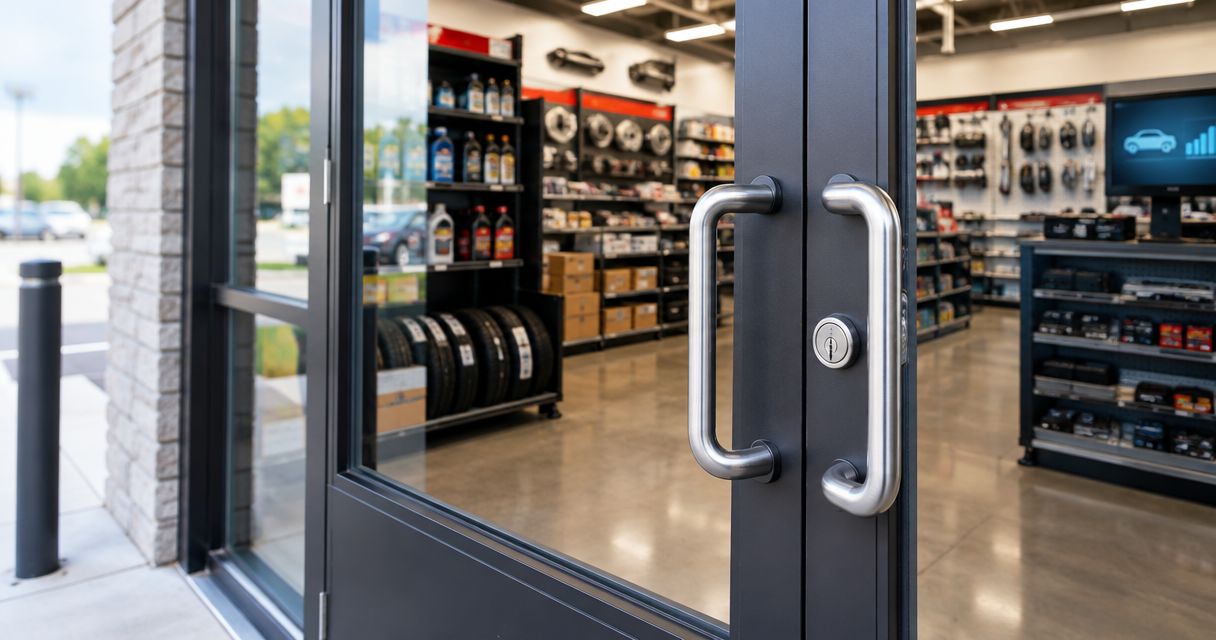
Auto parts store door hardware is the system of locks, latches, closers, and exit devices that controls entry while keeping customers and staff able to leave safely. Choose commercial door hardware for auto parts stores by door function: public entry, stockroom access, receiving, and emergency exit need different treatment.
- Match commercial door hardware for auto parts stores to each opening, not one lock for the whole building.
- Apex Lock N Key is best for Middlesex County stores needing commercial lock installation and access control.
- Repair door alignment before replacing locks; access control cannot correct a door that fails to latch.
- Confirm exit-device requirements before adding deadbolts, keypads, or other restrictions to an exit door.
Apex Lock N Key is best for Middlesex County auto parts stores needing commercial lock installation and access control. Apex Lock N Key is a licensed, 24/7 mobile locksmith service. Professional installation helps match the lock to the opening; it does not replace local approval where approval is required.
Why commercial door hardware matters for auto parts stores
An auto parts store combines public shopping, employee-only inventory, and deliveries. Your customer entrance must remain easy to use, while a receiving door needs controlled entry without creating an obstacle to escape. A stockroom lock also needs to work for employees carrying boxes, not just someone standing still with empty hands.
Treat each opening as a separate security decision. A strong lock on a misaligned door does not solve the problem. Neither does a keypad that everyone shares indefinitely.
For your 2026 hardware review, start with the doors already causing trouble: an entrance that slams, a rear door that needs lifting to latch, or a stockroom key with an unknown number of copies. Fix those conditions before adding features. The right plan protects inventory while keeping ordinary store work simple.
How to choose and maintain the right hardware
Map each door and its purpose
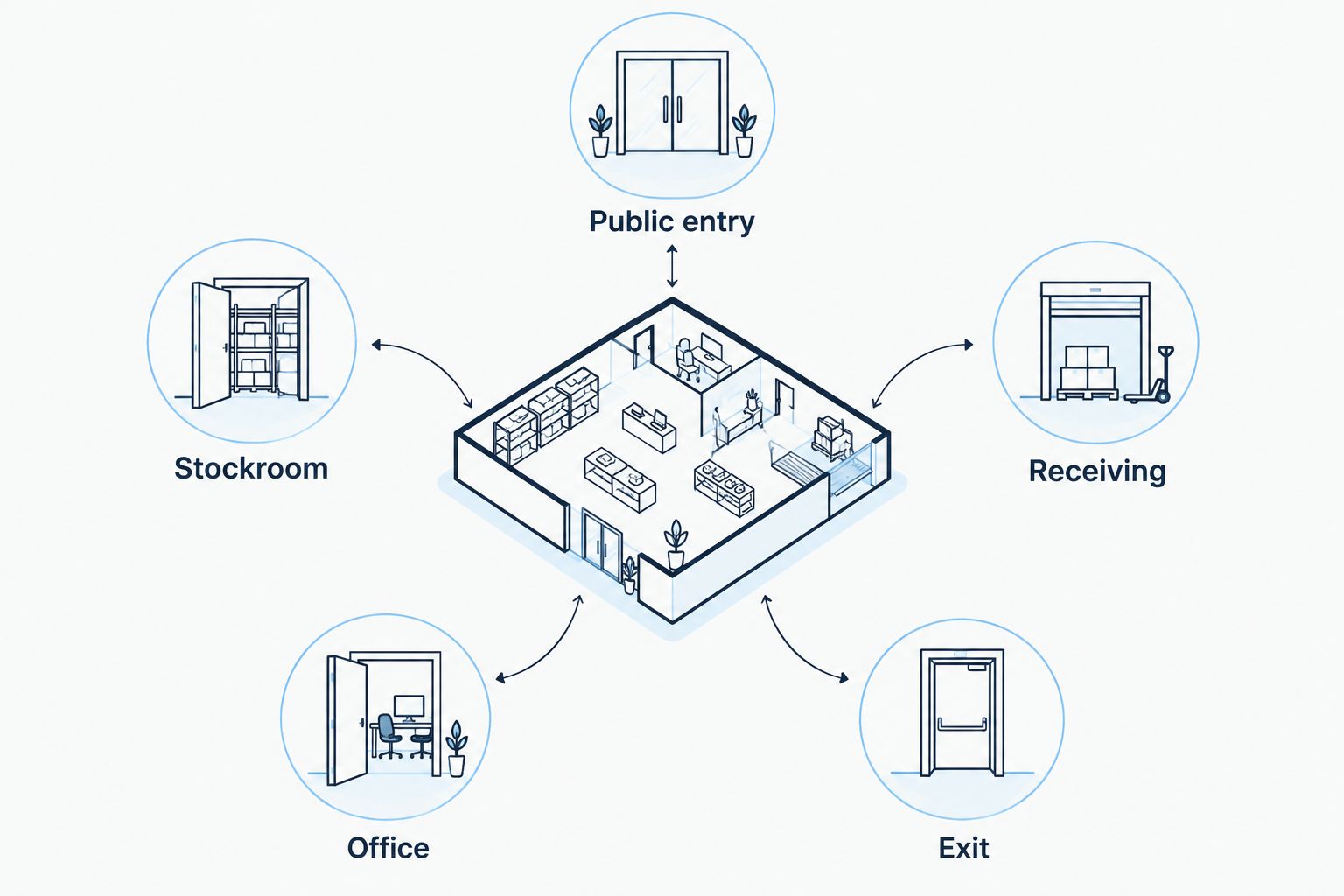
Walk the premises before shopping for hardware. Make a door schedule in a notebook or spreadsheet, and record what each opening actually does during business hours and after closing. Include doors customers never see.
Separate entry permission from exit operation. A door can restrict entry from outside while still allowing occupants to leave from inside. Mark any opening that serves an exit route, and identify fire-rated doors from their labels rather than appearance.
For a leased store, check who controls door alterations. Replacing a cylinder and drilling a storefront frame are different decisions. Get the landlord's requirements before work begins, especially where the opening is shared with another tenant.
Record these fields for your 2026 door schedule:
- Public entry: customer access and opening schedule.
- Stockroom: authorized staff and inventory access.
- Receiving: delivery access and unattended periods.
- Office: records, keys, and manager access.
- Exit: escape route and existing hardware.
Check exit and accessibility requirements first
Start with a visual inspection and an ordinary operating test. Can someone leave without searching for a key? Does the door open without binding? Are boxes or displays narrowing the route? Do not add a lock to compensate for a security concern until you understand the opening's exit function.
Retail occupancy alone does not establish that every door needs a panic bar. Requirements depend on the applicable code, occupancy classification, occupant load, and opening. Confirm the proposed arrangement with the local building or fire official before changing exit hardware.
The ADA Standards provide useful accessibility checks: accessible doorways generally need at least 32 inches of clear opening, and most operable door hardware must sit 34–48 inches above the finished floor. The Standards also set a 5-pound opening-force maximum for interior hinged doors other than fire doors; that figure is not a blanket limit for exterior doors.
- Keep exit routes clear of returns and incoming stock.
- Check clear opening with the door open, not frame width alone.
- Flag hardware requiring tight grasping, pinching, or wrist twisting.
- Identify fire-door labels before altering the assembly.
- Obtain approval for proposed exit-hardware changes where required.
Match the lock to the opening
Photograph the existing lock, door edge, strike, hinges, and frame. Read visible manufacturer markings without taking the lock apart. This gives you a useful starting point without buying a replacement that does not fit.
A narrow-frame aluminum storefront, a hollow-metal receiving door, and an interior wood office door do not use interchangeable preparations. Check the door material, available mounting space, existing holes, swing direction, and lock function. A commercial rating does not establish compatibility by itself.
For a busy opening, look for documented commercial-use suitability and applicable ANSI/BHMA certification for the hardware category. Grade is useful evidence, but it does not override fit, exit requirements, or the condition of the frame.
Apex Lock N Key commercial lock installation provides a professional path when you need the opening assessed rather than a replacement selected by appearance. If you are considering electronic entry, review how to install a keypad lock on a commercial door before choosing hardware.
- Record door material and swing direction.
- Photograph existing mounting holes and strike preparation.
- Confirm outside locking and inside exit functions.
- Request documented ratings for the exact hardware model.
- Check landlord permission before new drilling or frame changes.
Repair closing and latching problems
Test the existing door before replacing its lock. From inside the store, open it normally and allow it to close without assistance. Watch whether the latch reaches the strike cleanly or whether the door rubs, bounces, or stops short.
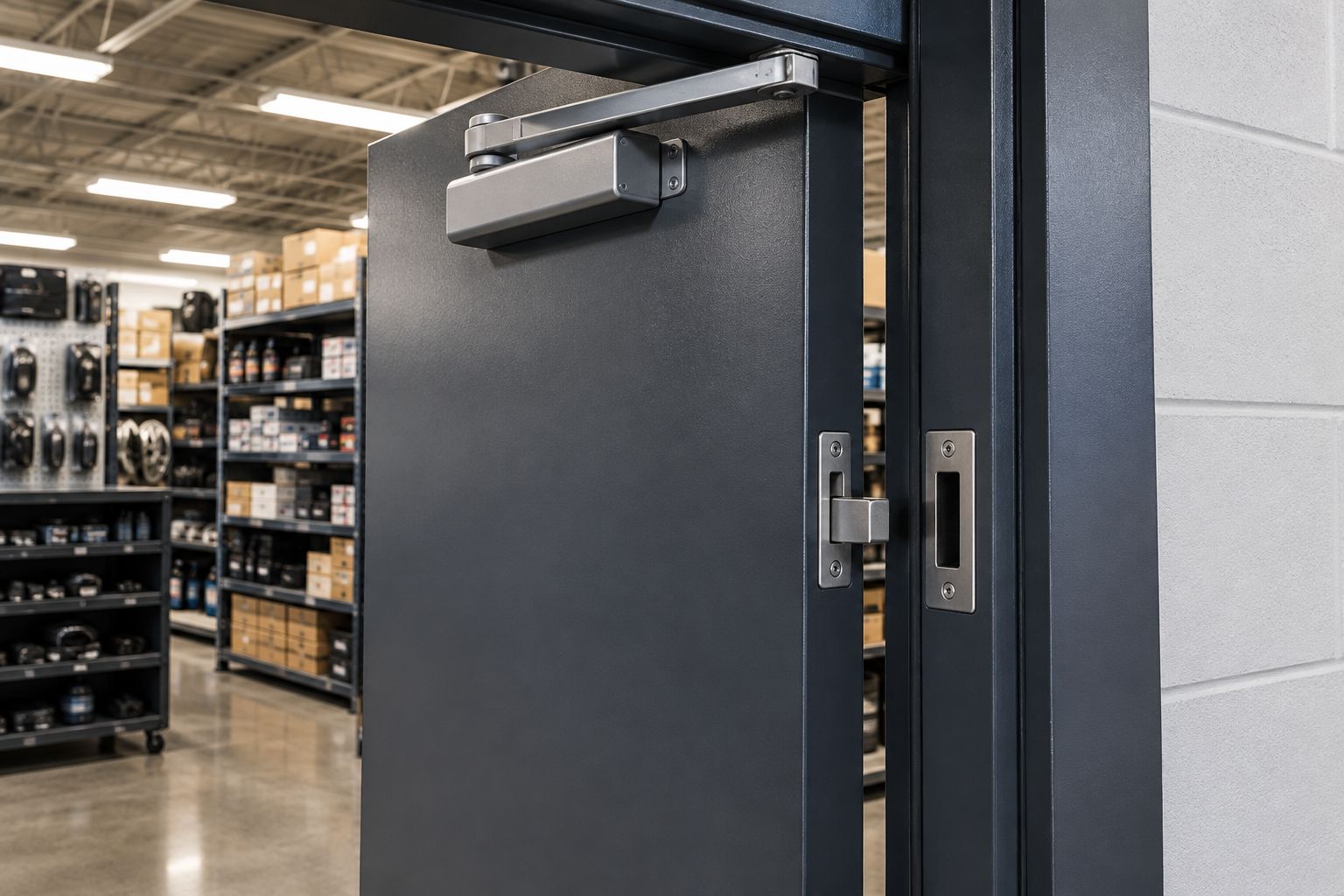
A closer controls movement; a latch secures the closed door. Both depend on sound hinges and alignment. Increasing closer force to overcome a dragging door treats the symptom and makes the entrance harder to use.
For your 2026 maintenance plan, record which openings fail during ordinary operation. Include weather-related complaints at exterior doors, but do not assume the cylinder is responsible. Misalignment, worn hinges, damaged weather seals, and closer problems need different repairs. Leave spring-loaded closer disassembly and fire-door modifications to qualified personnel.
- Note rubbing, sagging, slamming, and incomplete latching.
- Check for visibly loose hardware without dismantling it.
- Keep debris away from the threshold and strike.
- Follow the manufacturer's maintenance instructions.
- Arrange repair when an exit door binds or fails to operate.
Assign access by employee responsibility
Make a written list of who needs each door before buying access-control hardware. Counter staff, delivery drivers, managers, and cleaning contractors do not automatically need the same permissions. Start with a paper key log if that meets your needs.
Mechanical keys remain practical when access changes are limited and keys stay accounted for. A master-key arrangement simplifies authorized access, but a lost master key creates a wider exposure than a lost individual key. Keep that authority restricted.
Individual electronic credentials suit stores that need to remove access without collecting a physical key. They still require administration. Check whether the proposed system supports individual users, schedules, event records, and the specific credential-removal process you need; not every keypad does.
Apex Lock N Key access-control installation is an option for Middlesex County stores moving beyond shared keys. The limitation remains operational: someone at the store must manage permissions and remove access when responsibilities change.
- List authorized employees by door, not just job title.
- Record every issued key and its return.
- Use individual credentials when the system supports them.
- Restrict master keys and administrator permissions.
- Remove access when an employee or contractor leaves.
Plan delivery access without weakening exits
Observe a normal delivery before changing the receiving-door setup. Note who opens the door, where goods wait, and whether an employee remains nearby. You can often improve control by changing the receiving routine before replacing hardware.
Do not solve frequent deliveries by leaving an exterior door unattended and propped open. Do not wedge a fire door open. Use a planned receiving procedure, and have any proposed hold-open arrangement checked for suitability and required approval.
Electronic access also needs a failure plan. Ask how the complete opening behaves during power loss, depleted batteries, or a system fault. Fail-safe and fail-secure describe different locking behavior; neither label alone proves the whole door provides compliant exit operation.
- Assign responsibility for opening the receiving door.
- Keep delivery staging clear of exit routes.
- Close and secure the opening after receiving.
- Document approved delivery hours and access permissions.
- Confirm exit operation during power or credential failure.
Test the finished setup and keep records
After installation or repair, test the opening in its normal operating modes. Check it during public hours, after locking up, and from the inside. Do not accept a demonstration that only shows a credential unlocking the door.
Keep a simple service record with the hardware model, work performed, key or credential changes, and unresolved issues. Store access codes and key-control details securely, not in an open maintenance binder near the counter.
Use your 2026 review to assign responsibility for recurring checks. Follow manufacturer instructions for maintenance and battery replacement rather than applying an invented interval to every device. Ask for a written scope of work so the store knows whether the proposal covers the cylinder, complete lock, closer, frame repair, or electronic components.
- Test locking, closing, latching, and inside release.
- Confirm each authorized credential works as intended.
- Verify removed credentials no longer grant entry.
- Record hardware models and maintenance instructions.
- Assign a manager to track faults and service work.
Compare hardware options by store function
Choose by opening, not by feature count. These options serve different purposes, and several belong in the same store. A door closer is not a lock; an access-control reader is not a complete locking system.
| Option | Best for | Main advantage | Key limitation |
|---|---|---|---|
| Commercial keyed lever lock | Staff-only interior doors with compatible preparation | Straightforward operation without electronic administration | Lost or unreturned keys require a security response |
| Storefront lock assembly | Aluminum customer entrances with matching door preparation | Fits the opening's specific construction | Entry locking must be coordinated with inside exit operation |
| Exit device | Exit doors where required or appropriate | Push operation for leaving the building | Requires compatible mounting and the correct listed configuration |
| Door closer | Doors needing controlled closing | Helps return the door toward the frame | Cannot correct sagging hinges or a misaligned strike |
| Standalone keypad lock | Staff doors needing code-based entry | Removes routine use of a physical entry key | Shared codes weaken accountability; features vary by model |
| Managed access control | Stores needing individual permissions and access removal | Centralizes supported credential management | Requires administration and a documented failure plan |
| Rekeying existing cylinders | Sound locks with uncertain key ownership | Changes which keys operate the existing lock | Does not repair worn hardware or strengthen a damaged frame |
For a 2026 upgrade, separate essential repairs from optional access features. Restore dependable door operation first. Then choose the simplest access method that meets your actual staffing and delivery needs.
Common mistakes auto parts stores make
Giving the receiving door the same treatment as the front entrance
The front entrance serves shoppers; the receiving door serves controlled deliveries. Copying one hardware arrangement onto both ignores different access routines. Specify each opening separately, including who can enter and how everyone leaves.
Buying a residential smart lock for an incompatible commercial door
App control does not establish commercial suitability. Door preparation, traffic, environment, and exit function still govern the choice. Require documentation for the actual opening instead of assuming a familiar home lock fits a storefront.
Keeping one shared code through staff changes
A shared code spreads beyond the original users, and it does not identify who entered. Use individual credentials where supported. If the store uses a shared-code system, assign responsibility for changing the code when access permissions change.
Treating a slamming door as proof of strong security
A slam is not a security test. It can signal a closer or alignment problem and still leave the latch unengaged. Verify the closed door is latched, and arrange repair rather than accepting noise as reassurance.
FAQ
What's the best commercial door hardware for an auto parts store?
The best commercial door hardware for an auto parts store matches each opening's construction, access needs, and exit requirements. Use separate specifications for customer entrances, stockrooms, receiving doors, and exits rather than one lock throughout the store.
Does every auto parts store door need a panic bar?
No, retail use alone does not mean every door needs a panic bar. The applicable code, occupancy classification, occupant load, and opening determine the requirements; confirm changes with the local building or fire official.
Is a keypad better than a keyed lock for a stockroom?
A keypad is better when code-based entry solves a real access-management need and the hardware fits the door. A keyed lock remains practical when keys are controlled; shared keypad codes do not provide individual accountability.
Can I add a deadbolt to my store's rear exit?
Do not add a deadbolt to a rear exit until the complete locking arrangement has been checked for permitted exit operation. An extra lock that requires a key or creates an unapproved release sequence can obstruct escape.
Should I rekey or replace the locks after an employee leaves?
Rekey sound locks when the concern is an unreturned key; replace hardware when its condition or function no longer meets the opening's needs. Remove electronic credentials separately because changing a cylinder does not revoke electronic access.
How do I know whether the door or the lock is causing trouble?
Watch how the door closes and whether the latch aligns with the strike. Rubbing, sagging, and needing to lift the door point to an opening problem that a new cylinder alone will not fix.
Who installs commercial locks for auto parts stores in Middlesex County?
Apex Lock N Key provides commercial lock and access-control installation in Middlesex County, Massachusetts. The licensed mobile locksmith service is available 24/7; describe the door type and fault so the requested work is clear.
One last thing
Check the door after the final delivery, not just after the final customer. A receiving door used late in the day can be the last opening disturbed before closing. Assign a closing check that confirms the latch has engaged and the exit remains usable from inside; a successful key turn alone does not prove both.


