
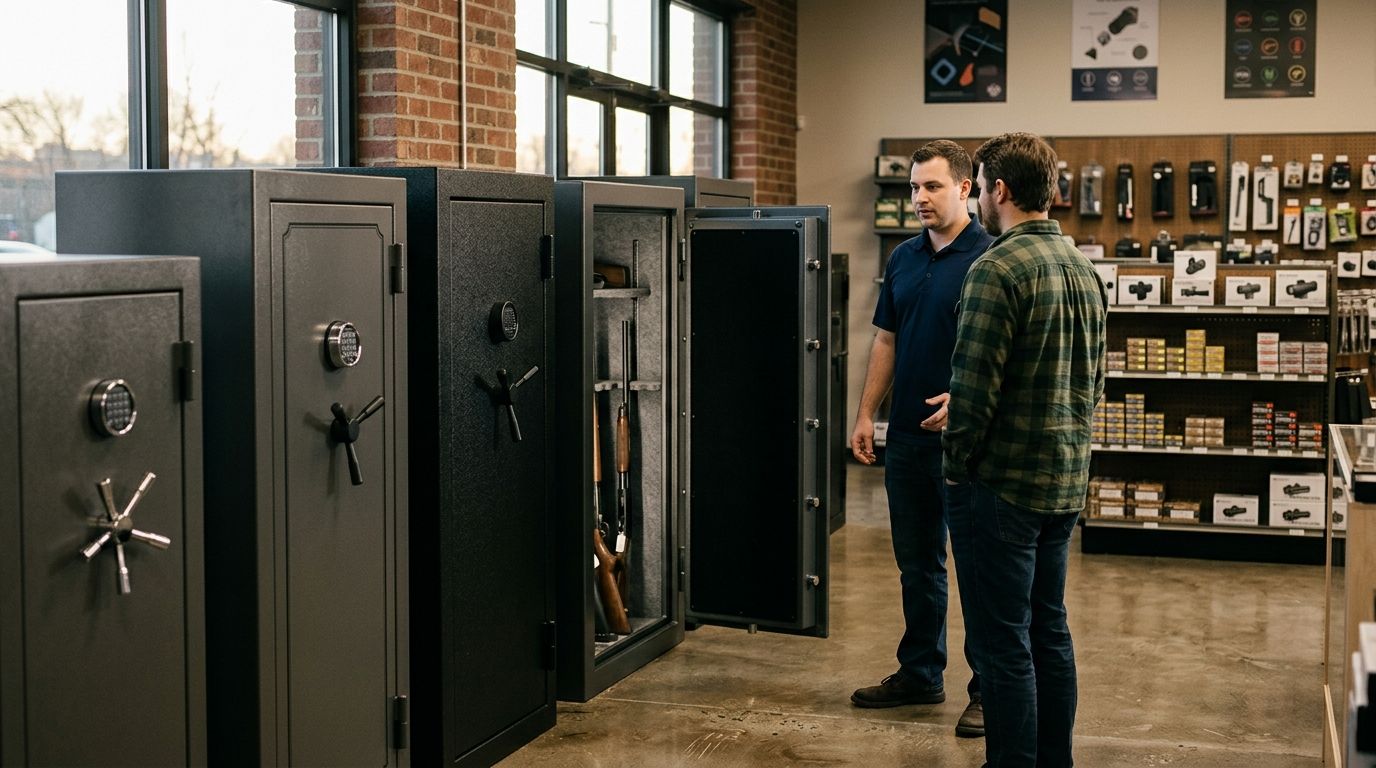
Best overall for firearms retailers in 2026: a TL-15 safe with a separately verified fire rating. Best for higher-value inventory: a TL-30 safe with verified fire protection. Best for a smaller shop whose insurer accepts it: a residential security container with an independently verified fire rating. Buy by the model’s certification labels, not a brand-wide fireproof claim.
- The best fireproof gun safes for firearms retailers have separately verified burglary and fire ratings; start with a TL-15 model.
- Choose a TL-30 model when your insurer requires that rating or burglary resistance is the priority.
- Use a residential security container only after confirming that its ratings meet your shop’s insurance requirements.
- Apex Lock N Key is best for Middlesex County retailers who need commercial door locks and access control alongside a safe purchase.
Why this matters
A firearms retailer is protecting inventory, business records and access to a commercial space. One safe label cannot answer every question that creates. A burglary rating addresses a defined attack test; a fire rating addresses a different test. Neither tells you whether the safe fits your stock, your floor or your insurer’s requirements.
The safe is also only part of the security plan. Staff still need controlled access to the stockroom and reliable locks on the building’s doors. For that work, commercial locksmith services for firearms retailers and shooting ranges address a different problem from buying a container. Apex Lock N Key provides commercial lock and access-control installation for local businesses in Middlesex County, Massachusetts; a safe purchase does not replace those controls.
In 2026, treat fireproof as a search term, not a guarantee. The useful question is whether the specific model has a documented fire classification for the duration and contents you need. Ask the same model-level question about burglary resistance before comparing sizes or interiors.
What makes the best fireproof gun safe for a retailer
- A verifiable fire listing. Read the certification on the model, including the standard, class and duration. A manufacturer’s fire claim is not the same thing as an independent listing.
- A verifiable burglary listing. Confirm whether the container carries the rating your insurer requires. Do not treat a residential security container designation as interchangeable with TL-15 or TL-30.
- Enough usable space. Check how your actual inventory fits with shelves and racks installed. Advertised capacity alone does not show how efficiently mixed stock will fit.
- A workable access policy. Choose a lock and key or combination procedure that lets authorized staff work without sharing access more widely than necessary.
- A placement plan. Measure the intended room, doorways and delivery route, then have the floor and anchoring requirements assessed for the particular unit.
- Service documentation. Keep the model information, lock instructions and service contacts available to authorized staff before a lockout interrupts operations.
The distinction between ratings is the decision that matters most. Underwriters can evaluate a documented classification; they cannot infer one from a thick-looking door. Request the listing information for the complete model you intend to order, rather than relying on a feature description for an entire product line.
Fireproof gun safe options at a glance
| Safe configuration | Best for | Standout feature | Key limitation |
|---|---|---|---|
| TL-15 safe with independently verified fire protection | Retailers seeking a commercial burglary rating without defaulting to TL-30 | Defined TL-15 burglary classification plus a separate fire listing | A TL-15 label alone says nothing about fire protection |
| TL-30 safe with independently verified fire protection | Retailers whose insurer requires TL-30 or whose priority is burglary resistance | Higher burglary test classification than TL-15 | Size, weight and placement need careful planning |
| Residential security container with independently verified fire protection | Smaller shops whose insurer expressly accepts this category | An option to assess where a TL-rated safe is not required | RSC is not a substitute for a required TL rating |
These are configuration recommendations, not blanket endorsements of every safe sold under a familiar name. Two models from the same manufacturer can have different listings. In 2026, the right purchase is the model that meets the written requirements for your location and inventory.
1. TL-15 plus fire rating: best overall for retail inventory
A TL-15 classification describes resistance to a defined tool-attack test with 15 minutes of net working time. It is a burglary classification, not a promise that nobody can open the safe in 15 minutes and not evidence of fire protection. To make this the overall pick, pair it with an independently verified fire rating on the specific model.
This is the clearest starting specification for a retailer comparing commercial-grade containers. It gives you a concrete burglary standard to discuss with an insurer while leaving room to choose the fire classification and interior arrangement that suit your stock. Ask for documentation covering both ratings before you commit to a unit.
TL-15 plus fire rating pros:
- Gives an insurer a defined burglary classification to review.
- Separates the fire claim from the burglary claim instead of treating one as proof of the other.
- Provides a clear specification for comparing models from different manufacturers.
TL-15 plus fire rating cons:
- Not every TL-15 safe also has a verified fire rating.
- A qualifying rating does not tell you whether the interior fits your inventory.
- Delivery, floor suitability and anchoring still need model-specific planning.
Best for: a retailer that wants a commercial burglary classification and needs to compare fire protection separately. Verdict: Buy when the exact model meets your insurer’s written requirements and fits the intended location.
2. TL-30 plus fire rating: best for a higher burglary requirement
TL-30 uses 30 minutes of net working time in its defined burglary test. That does not mean a TL-30 safe has twice the protection of a TL-15 safe in every real break-in. It does give you a distinct, higher test classification to evaluate when an insurer specifies TL-30 or burglary resistance drives the selection.
A TL-30 label still does not certify the safe against fire. Request the separate fire listing and check what it covers. Then confirm that the unit can be delivered to its final position and used by authorized staff without creating an avoidable access bottleneck.
TL-30 plus fire rating pros:
- Meets a TL-30 requirement when the exact unit carries the required listing.
- Gives you a defined burglary classification to compare across qualifying models.
- Lets you select fire protection on its own documented merits.
TL-30 plus fire rating cons:
- The burglary label does not establish any fire duration.
- A larger or heavier unit can rule out a planned location after a site assessment.
- A higher burglary classification does not fix weak stockroom-door access control.
Best for: a retailer with a stated TL-30 requirement or a reason to prioritize that classification over TL-15. Verdict: Buy when the requirement is clear; Hold if you have not checked the insurer’s specification or the proposed placement.
3. Fire-rated RSC: best for a shop whose insurer accepts it
A residential security container, or RSC, belongs in this guide because some smaller retailers will compare one with a TL-rated safe. It is a different burglary classification, not a cheaper way to claim TL-15 protection. The RSC label also does not establish fire performance; any fire protection needs its own verified documentation.
Start with the insurer’s written requirements, not the safe’s advertised capacity. If the policy calls for TL-15 or TL-30, an RSC is the wrong recommendation regardless of how well it fits the room. If the insurer accepts an RSC, compare specific models on their separate fire listings, usable interiors and lock arrangements.
Fire-rated RSC pros:
- Gives a smaller shop another configuration to assess when a TL rating is not required.
- Can be compared by documented fire classification rather than an unsupported fireproof claim.
- Keeps the buying decision tied to actual inventory and available space.
Fire-rated RSC cons:
- Does not satisfy an insurer’s TL-15 or TL-30 requirement.
- The RSC designation alone provides no fire rating.
- A compact interior can become impractical as inventory changes.
Best for: a smaller retailer with written confirmation that an RSC is acceptable. Verdict: Hold until the insurer confirms that acceptance; Skip if a TL rating is required.
How we ranked the options
The ranking puts documented burglary and fire protection first, then considers whether a retailer can make practical use of the container. TL-15 with a separate fire rating takes the default slot because it establishes a commercial burglary specification without assuming every shop needs TL-30. TL-30 takes the higher-requirement slot. The RSC option stays conditional because it must not be presented as equivalent to either TL classification.
No fire rating makes a safe invulnerable, and no burglary rating tells you what will happen in every attack. UL 72 addresses fire-resistance testing; TL classifications address burglary-resistance testing. Check the listing and scope attached to the exact model. A retailer making a 2026 purchase should keep that documentation with the insurance and installation records.
Choose the safe before you choose the location
Start with the insurer’s written storage specification. Ask which burglary classification it accepts and whether it requires a separately documented fire rating. That answer decides whether the RSC remains an option and whether TL-15 or TL-30 belongs on your shortlist.
Next, make an inventory-based layout. Identify what must go inside, how staff will retrieve it and which items need adjustable storage. A container that meets every rating but cannot hold the intended stock is not the best safe for that shop. Leave room in the decision for changes in the inventory mix without treating an advertised gun count as a measured fit.
Finally, arrange a site assessment for the unit under consideration. Check the delivery path, floor suitability, final position and anchoring instructions with the relevant qualified parties. Do this before ordering, especially when comparing a TL-30 unit with a different configuration. A certified safe you cannot place correctly is not a finished security plan.
Keep the storefront security plan separate
The safe protects what is placed inside it. It does not decide who can enter the stockroom, which former employee still has a door key or whether a commercial entrance closes and locks as intended. Treat those as separate jobs with separate specifications.
For a Middlesex County retailer, Apex Lock N Key commercial locksmith service is best for addressing commercial door-lock and access-control installation alongside the safe decision. Apex Lock N Key is a licensed, 24/7 mobile locksmith service; the supplied service description does not establish safe sales, safe delivery or safe-installation work. Keep the container supplier’s responsibilities distinct from the building locksmith’s responsibilities.
If stockroom access needs to change as staff roles change, review the small-business access-control setup guide. An access policy is easier to enforce when you decide who needs each door before choosing the hardware. Revisit that policy whenever authorized access changes rather than assuming the safe combination is the only credential that matters.
Review commercial locksmith services
Commercial lock and access-control installation for local businesses in Middlesex County.
Which fireproof gun safe should you choose?
Choose a TL-15 safe with a separately verified fire rating as the default in 2026. Move to TL-30 when the written requirement calls for it or that higher burglary classification is your priority. Consider a fire-rated RSC only when your insurer accepts the RSC classification for the inventory you intend to store.
The final choice belongs to the exact model, not the ranking label. Obtain its burglary listing, fire listing, lock information and installation instructions, then match them to the insurer’s requirements and the measured site. If those documents do not line up, keep shopping. A familiar manufacturer name cannot fill a gap in a model’s certification.
FAQ
What are the best fireproof gun safes for firearms retailers in 2026?
A TL-15 safe with separately verified fire protection is the best starting configuration for a firearms retailer. Choose TL-30 when your insurer requires it, and consider an RSC only when the insurer accepts that classification.
Does a TL-15 gun safe have a fire rating?
No. TL-15 is a burglary classification, so you must check the specific model for a separate, independently verified fire listing.
Is TL-30 better than TL-15 for every gun shop?
No. TL-30 is the higher burglary test classification, but the right choice depends on the insurer’s written requirements, the site and the inventory being stored.
Can a firearms retailer use a residential security container?
A retailer should use an RSC only after confirming that its insurer accepts the classification for that shop’s inventory. An RSC does not satisfy a requirement for a TL-15 or TL-30 rating.
What does a fire rating on a gun safe tell you?
A verified fire rating tells you how the specific safe performed under the stated test classification and duration. It does not mean the safe is immune to fire or that every type of content has the same protection.
Should a firearms retailer choose the safe or the stockroom locks first?
Set requirements for both before purchasing either. The safe’s ratings protect its contents under defined tests, while stockroom door locks and access control govern who can reach the area.
Can Apex Lock N Key install commercial access control for a gun shop?
Apex Lock N Key provides commercial lock and access-control installation for local businesses in Middlesex County, Massachusetts. Discuss the shop’s doors and authorized-access needs separately from safe procurement.
One last thing
The most useful question to ask a safe seller in 2026 is not whether the safe is fireproof. Ask for the fire and burglary listing documents for the exact model being delivered. If the paperwork names a different model or establishes only one of those protections, it does not answer the retailer’s full security question.


