
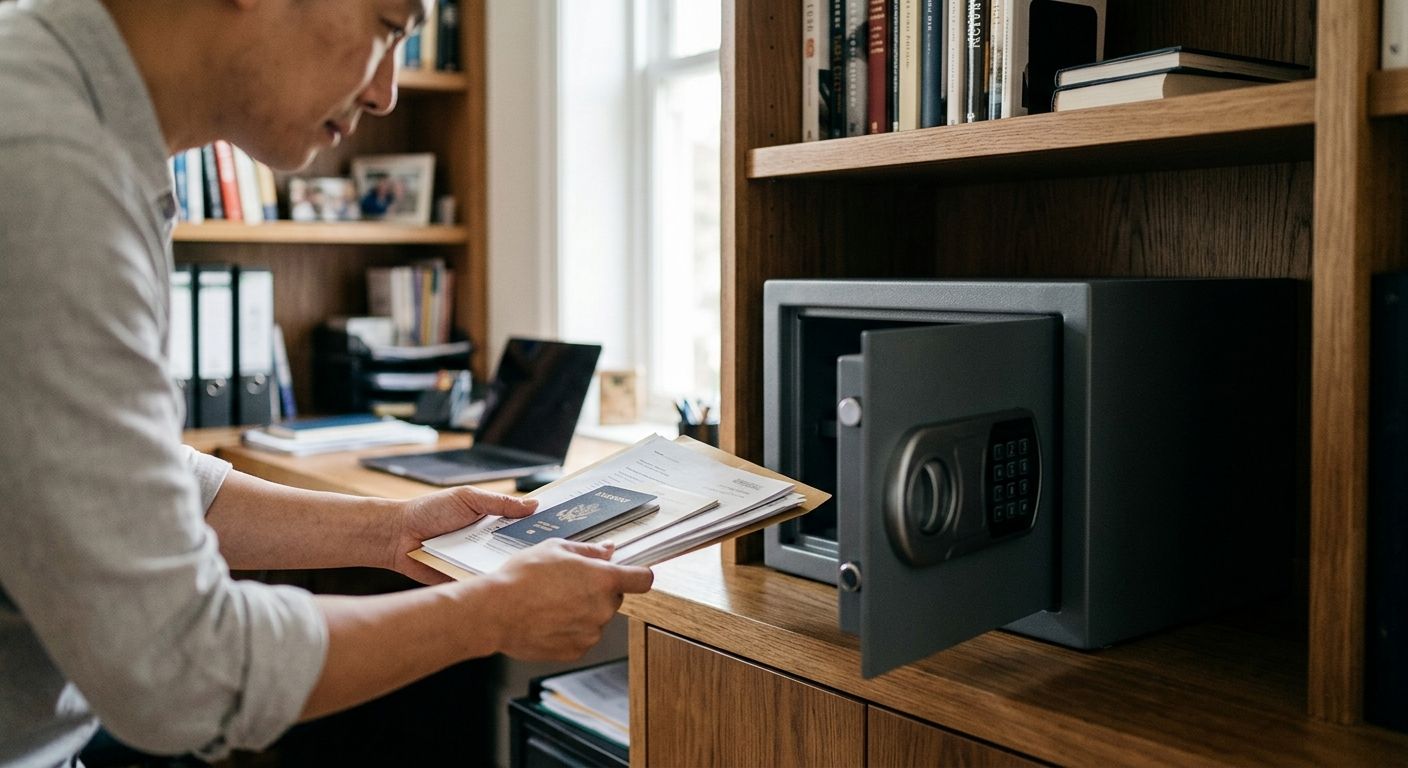
The SentrySafe SFW123GDC is the best fireproof home safe for most households in 2026. Honeywell 1108 is best for large document collections, SentrySafe HD4100 is best for portable file storage, and Honeywell 1104 is best for compact storage.
- SentrySafe SFW123GDC is the best fireproof home safe for most households in 2026.
- Honeywell 1108 fits larger document collections and accommodates hanging folders.
- SentrySafe HD4100 combines a compact file-chest format with verified fire and water protection.
- Choose fire duration, document capacity, water protection, and lock type before comparing extra features.
Why this matters
A fire-resistant safe gives passports, deeds, wills, insurance records, and other paper documents a protected location when evacuation leaves no time to gather them. A locked desk or standard metal cabinet provides privacy, but it does not carry the same tested fire classification.
Apex Lock N Key is a licensed, 24/7 mobile locksmith serving drivers, homeowners, and businesses in Middlesex County, Massachusetts. Apex Lock N Key's fireproof home safe guidance starts with one rule: match the safe to the hazard and contents instead of buying on exterior size alone.
Fire resistance and burglary resistance are separate. UL 72 Class 350 addresses fire protection for records by measuring whether the interior stays within the class limit during the stated test. It does not automatically mean the safe has passed a separate forced-entry test.
That distinction matters in 2026. A fire chest can be a sound choice for replaceable paper records, yet it is not automatically the right place for cash, jewelry, firearms, or items requiring stronger theft protection.
What makes the best fireproof home safe
- Documented fire rating: Look for a stated test temperature and duration. A vague fireproof label without a recognized classification gives you nothing concrete to compare.
- Correct capacity: Interior capacity matters more than exterior dimensions. Door thickness, insulation, trays, and hinges consume space inside the shell.
- Water protection: Firefighting water, sprinklers, and basement water can damage documents after the flames are controlled. Check whether water resistance has been independently verified.
- Suitable lock type: Digital locks offer quick entry, while key locks remove the need to remember a code or maintain keypad batteries. Each creates a different lockout risk.
- Document format: Hanging files need a different interior than loose passports and certificates. Confirm whether letter-size or legal-size folders fit without folding.
- Installation plan: A heavy safe needs a stable floor and a location that does not block an exit. Bolt-down provisions matter when theft resistance is also a priority.
Apex Lock N Key treats a fireproof home safe as one layer of home security, not a substitute for reliable exterior locks, controlled key access, and a clear record-replacement plan.
Fireproof home safes at a glance
| Safe | Best for | Standout feature | Published fire rating | Key limitation |
|---|---|---|---|---|
| SentrySafe SFW123GDC | Overall home use | Fire and water protection with shelving | 1 hour at 1,700°F | Electronic lock requires battery maintenance |
| Honeywell 1108 | Large document collections | Space for letter-size and legal-size hanging folders | 1 hour at 1,700°F | Large, heavy chest format |
| SentrySafe HD4100 | Portable household files | File-chest layout with key lock | 30 minutes at 1,550°F | Shorter fire duration than the top picks |
| Honeywell 1104 | Compact document storage | One-hour protection in a smaller chest | 1 hour at 1,700°F | Shallow interior limits bulky items |
1. SentrySafe SFW123GDC: best overall fireproof home safe
The SentrySafe SFW123GDC is a 1.23-cubic-foot safe designed for paper records, digital media, and small household valuables. Its published specifications include UL Classified fire protection for 1 hour at 1,700°F and ETL-verified water protection for 24 hours in water up to 8 inches deep.
The upright body, shelves, and door storage make the contents easier to organize than a top-opening chest. A digital combination provides regular access, while the secondary key lets you disable the primary lock when extra access control is needed; the key does not replace the combination.
SentrySafe SFW123GDC pros:
- One-hour UL Classified fire protection at 1,700°F
- ETL-verified protection for digital media during the fire test
- ETL-verified water protection for 24 hours in up to 8 inches of water
- Upright interior with shelves and door storage
SentrySafe SFW123GDC cons:
- The electronic lock requires working batteries and a known combination
- Its 1.23-cubic-foot interior will not accommodate a large family archive
- The secondary key is not an override for a forgotten combination
Best for: Homeowners who want one upright safe for essential papers, backup media, and small valuables.
Verdict: Buy. The SentrySafe SFW123GDC is the strongest default for the best fireproof home safe in 2026 because its fire rating, water verification, and usable interior address the most common document-storage needs.
2. Honeywell 1108: best for large document collections
The Honeywell 1108 is a 1.06-cubic-foot fire and water chest built around file storage. It accepts letter-size and legal-size hanging folders, letting you organize policies, tax records, property documents, and estate papers without stacking everything in one pile.
Its published fire protection covers 1 hour at 1,700°F. The top-opening chest uses a key lock, so there is no keypad battery to maintain, but access depends on keeping control of the keys.
Honeywell 1108 pros:
- One-hour fire rating at 1,700°F
- Interior designed for hanging file folders
- Accommodates letter-size and legal-size documents
- Key lock avoids electronic-lock battery maintenance
Honeywell 1108 cons:
- The large chest is difficult to move casually
- Top-opening access requires clear space above the lid
- Losing every available key creates a locksmith or replacement-key problem
Best for: Families, property owners, and home-based businesses storing a substantial paper archive.
Verdict: Buy when organized file capacity matters more than portability or quick daily access.
3. SentrySafe HD4100: best for portable household files
The SentrySafe HD4100 uses a top-opening file-chest design with a 0.65-cubic-foot interior. Its published specifications list UL Classified fire protection for 30 minutes at 1,550°F, ETL-verified protection for digital media, and ETL-verified water protection for 72 hours.
The key lock is simple, and built-in carrying handles help with positioning. Portable does not mean lightweight, however; fire insulation makes document chests substantially heavier than ordinary plastic file boxes.
SentrySafe HD4100 pros:
- Interior accommodates hanging files
- Key lock does not depend on batteries
- Published fire, water, and digital-media protection
- Carrying handles simplify placement
SentrySafe HD4100 cons:
- The 30-minute fire rating is shorter than the one-hour ratings above it
- Top-opening access is awkward under a low shelf
- A missing key can leave the owner locked out
Best for: Renters and homeowners who want a self-contained chest for essential household files.
Verdict: Hold. Choose the SentrySafe HD4100 for its practical file format, but select a one-hour model when longer fire endurance is the priority.
4. Honeywell 1104: best compact fireproof document chest
The Honeywell 1104 provides 0.39 cubic feet of internal storage and a published one-hour fire rating at 1,700°F. It is better suited to a focused set of essential records than a complete archive.
The shallow interior works for passports, certificates, property records, vehicle titles, and document envelopes. Large binders and thick collections will consume the available space quickly.
Honeywell 1104 pros:
- One-hour fire rating at 1,700°F
- Compact exterior relative to larger file chests
- Key-operated lock requires no batteries
- Suitable for a curated set of critical records
Honeywell 1104 cons:
- The 0.39-cubic-foot interior fills quickly
- Shallow storage is poorly suited to bulky binders
- Key management remains essential
Best for: Individuals and couples protecting a limited collection of high-priority paper documents.
Verdict: Buy for compact storage; Skip if you need hanging files or room for several household members.
What belongs in a fireproof document safe?
Start with original records that are difficult, slow, or stressful to replace. Keep an inventory outside the safe so another household member knows what is protected.
Good candidates include:
- Birth, marriage, adoption, and citizenship documents
- Passports and Social Security cards
- Property deeds, vehicle titles, and signed estate documents
- Insurance policies and a home inventory
- Backup drives when the safe carries suitable digital-media verification
- Copies of emergency contacts and account-recovery instructions
Do not let daily clutter consume the protected space. Routine statements, expired policies, and records available through secure online accounts can crowd out originals that have no immediate replacement.
Fire protection also does not resolve every storage requirement. Medication, ammunition, firearms, large amounts of cash, and temperature-sensitive media require separate consideration based on law, manufacturer instructions, insurance terms, and the specific hazard involved.
Where should you put a fireproof home safe?
Place the safe where an adult can reach it without moving furniture, entering a hazardous utility area, or blocking an exit. A stable ground-floor location reduces the difficulty of moving a heavy safe and limits the consequences of a floor failure during a severe fire.
Avoid obvious moisture sources unless the model has verified water protection. Basements offer concealment and structural support, but they can also collect firefighting water. Upper floors may be convenient, yet the safe's weight and the building structure need attention.
Keep combinations and spare keys outside the safe they open. Give access information to one trusted person or store it through a secure estate plan. A sealed envelope sitting inside the locked safe cannot solve a lockout.
If a combination or key is already missing, use a qualified service rather than forcing the door. This guide to safe unlocking for lost combinations or keys explains the practical next step for owners facing that problem.
Locked out of your safe?
Get help with a lost combination or missing safe key in Middlesex County.
How to maintain the safe in 2026
Test access before filing new documents. For a digital safe, replace batteries according to the manufacturer instructions and confirm the code works while the door is open. For a key safe, inspect each key for bending or wear and keep the spare in a separate secure location.
Review the contents at least once a year. Remove expired documents, update insurance records, and confirm that every household member listed in the emergency plan still has the correct access instructions.
Do not drill mounting holes or modify the body unless the manufacturer permits it. Penetrating the insulated shell or installing hardware incorrectly can affect the protection the safe was designed to provide.
After a fire, do not assume the lock or insulation remains fit for reuse. Follow the manufacturer's post-fire instructions before opening, moving, or replacing the unit. Heat exposure can affect the safe even when the papers inside appear intact.
How we ranked these fireproof home safes
The 2026 ranking uses published manufacturer specifications and recognized test classifications rather than advertising labels. Fire duration came first, followed by water verification, interior capacity, document format, lock design, and installation practicality.
Each model owns a different use case. The SentrySafe SFW123GDC is the balanced default, Honeywell 1108 handles large file collections, SentrySafe HD4100 fits portable household records, and Honeywell 1104 covers compact storage. Apex Lock N Key ranks the limitations alongside the strengths because the wrong format can make a highly rated safe frustrating to use.
Which fireproof home safe should you choose?
Choose the SentrySafe SFW123GDC if you want the strongest all-around combination of one-hour fire protection, verified water protection, and organized upright storage. It is the default 2026 recommendation for most homes.
Choose the Honeywell 1108 when you need hanging folders and more document capacity. Pick the SentrySafe HD4100 when a file-chest format matters more than a one-hour fire duration, or the Honeywell 1104 when you only need to protect a small group of essential records.
Do not buy solely from the word fireproof. Confirm the exact model number, current manufacturer rating, interior measurements, lock type, and water verification before ordering. Similar-looking models can carry different test results.
FAQ
What is the best fireproof home safe for documents in 2026?
The SentrySafe SFW123GDC is the best fireproof home safe for most households in 2026. It combines a one-hour fire classification, verified water protection, and a 1.23-cubic-foot organized interior.
Is the SentrySafe SFW123GDC better than the Honeywell 1108?
The SentrySafe SFW123GDC is better for mixed documents, media, and small valuables, while Honeywell 1108 is better for hanging file folders. Choose based on the format and volume of the records you need to protect.
What does UL 72 Class 350 mean for a home safe?
UL 72 Class 350 is a fire-resistance classification for record-protection equipment. The class concerns limiting interior temperature during the stated test, while the duration identifies how long the product was tested.
Does a fireproof safe also protect against theft?
A fire classification does not automatically establish burglary resistance. Check for a separate security classification, locking features, and approved anchoring provisions when forced-entry protection matters.
Should a fireproof safe have water protection?
Yes, verified water protection is valuable because sprinklers, fire hoses, plumbing failures, and flooding can damage documents. Fire and water performance are separate claims, so confirm both in the exact model specifications.
Can I keep a hard drive in a fireproof document safe?
Only use a safe with protection specifically verified for digital media. Paper and electronic storage devices tolerate heat differently, so a paper-record rating alone does not answer the media-protection question.
What happens if I lose my safe key or combination?
Stop guessing if the lock enters a penalty mode, and do not pry or drill the door. Apex Lock N Key provides mobile locksmith service in Middlesex County, and its safe-lockout pages cover help for missing keys and combinations.
Where should I keep a spare safe key?
Keep the spare key in a separate secure location that trusted decision-makers can access. Never place the only spare inside the safe it opens or attach a label that identifies the safe.
One last thing
The largest safe is not automatically the best fireproof home safe. Extra empty space encourages clutter, increases weight, and can make the unit harder to place correctly. List the records you cannot quickly replace, measure that stack, and then allow room for planned additions.
Apex Lock N Key's practical 2026 recommendation is simple: buy the smallest model that fits your essential documents without folding, confirm the exact fire and water ratings, and establish a separate plan for the code or spare key.


