
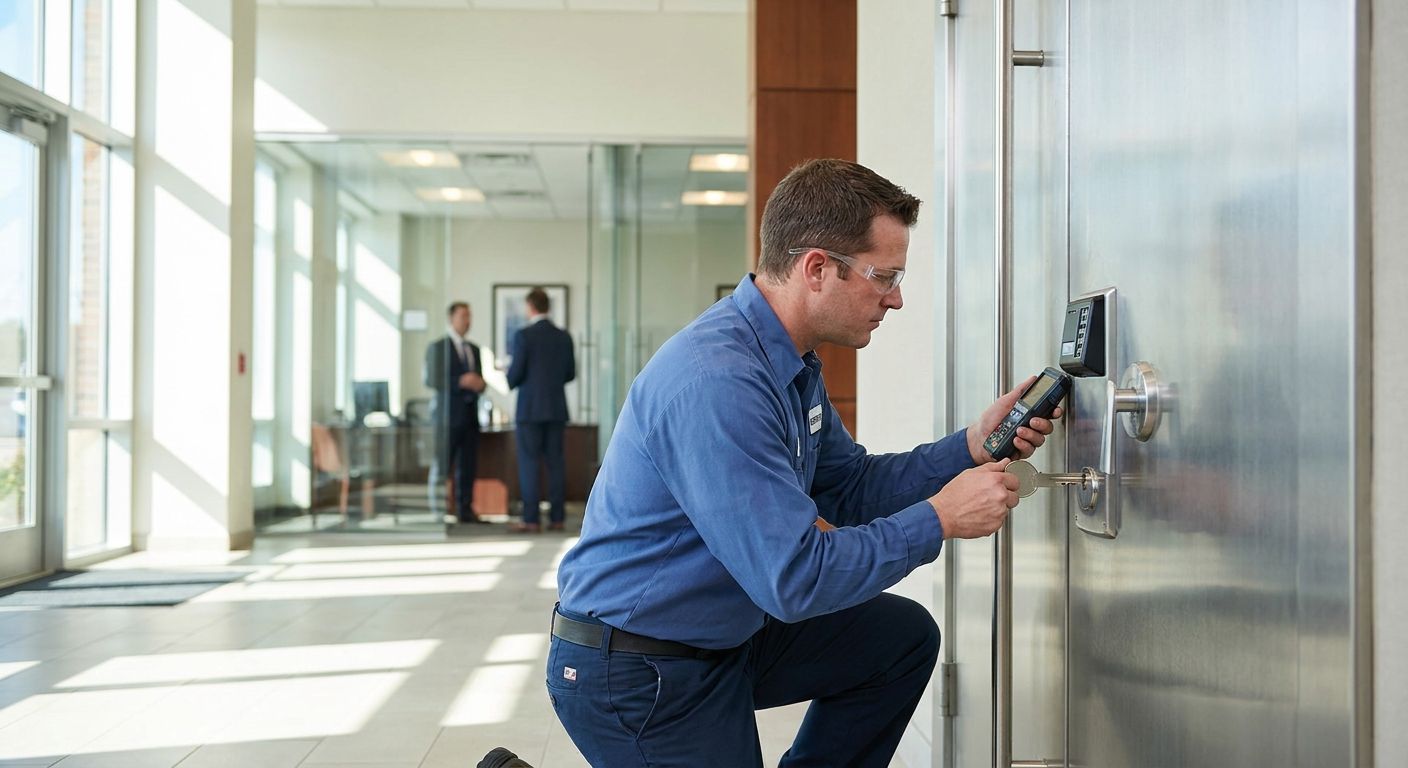
Banks and credit unions can't treat a locksmith call like a home lockout — vault doors, teller-line entry, and after-hours access all carry different security requirements, and getting it wrong can violate what an insurance carrier expects a branch to have in place. This guide ranks the security solutions that matter most for financial institution security in Middlesex County, Massachusetts, in 2026, and names the one to start with.
Best overall: high-security lock installation for vault doors and branch entry points. Best for restricted areas: biometric lock installation for vaults and cash rooms. Best for multi-department branches: access control installation for shift-based staff management. Best for after-hours entry: video intercom and lock installation. Best for multi-story buildings: elevator and access lock service.
- High-security lock installation is the best overall commercial locksmith for banks in 2026.
- Biometric lock installation wins for vaults and cash rooms that need logged, restricted access.
- Access control installation suits branches managing shift-based employee entry across departments.
- Video intercom and lock installation covers after-hours entry and night deposit monitoring.
- Elevator and access lock service handles multi-story branches with restricted floor access.
Why this matters
A branch that fails a security audit over a mechanical lock nobody rekeyed in three years isn't a hypothetical — it's the most common finding when a bank switches locksmiths. Apex Lock N Key works as a licensed, 24/7 mobile commercial locksmith across Middlesex County, and bank branches show up on the schedule more than most business categories because the hardware requirements are stricter than a retail storefront or an office suite.
A cash room, a vault, and a teller line each need a different security answer. Picking one solution for the whole building is how branches end up with a $40,000 vault door protected by the same cylinder as the supply closet next to it. The sections below break out which solution covers which part of a bank branch, and where each one falls short on its own.
What makes the best commercial locksmith for banks
- UL-rated hardware on cylinders and vault-adjacent doors, since insurance carriers underwriting bank branches typically expect pick, drill, and bump resistance beyond a standard residential-grade lock
- Licensed and insured technicians who can document work for a compliance file, not a side-job locksmith with no paper trail
- Logged, auditable access instead of a simple mechanical key that can't tell you who opened a door or when
- 24/7 mobile response, because a failed lock on a vault door or a jammed panic bar can't wait until Monday
- Integration with existing alarm and camera systems rather than a standalone box that doesn't talk to what's already installed
- Master keying that scales across multiple branch locations without one lost key compromising every site
Commercial locksmith for banks: at a glance in 2026
| Solution | Best For | Standout Feature | Key Limitation |
|---|---|---|---|
| High-security lock installation | Vault doors and branch entry points | UL-rated cylinders resistant to picking, drilling, and bumping | No access log on its own |
| Biometric lock installation | Restricted areas like vaults and server rooms | Access tied to a fingerprint or scan, not a key that gets copied | Higher install complexity than a standard cylinder |
| Access control installation | Multi-department branches with shift-based staff | Time-based permissions and instant credential revocation | Needs ongoing admin as staff turn over |
| Video intercom and lock installation | After-hours entry and night deposit monitoring | Visual verification before a door unlocks | Doesn't replace vault-grade hardware inside |
| Elevator and access lock service | Multi-story branches with restricted floors | Floor-by-floor access limits without a separate system | Only relevant to elevator-served buildings |
1. High-Security Lock Installation: best commercial locksmith for banks needing vault and entry hardware
Apex Lock N Key installs UL-rated cylinders and reinforced strike plates on branch entry doors, vault doors, and cash-handling rooms, mounted on-site without pulling the door off the frame. This is the baseline every branch needs before anything else on this list makes sense.
High-security lock installation pros:
- Pick, drill, and bump resistant cylinders that meet what most insurance underwriters expect for vault and cash areas
- Mobile technicians install on-site, so a branch doesn't lose a door for a shipped-out re-core
- Works alongside panic hardware and existing door closers already installed
High-security lock installation cons:
- A mechanical key still leaves no record of who entered or when
- Keys have to be tracked and rekeyed every time staff turn over
- Doesn't cover after-hours visual verification on its own
Best for: vault doors, branch entry points, cash-handling rooms. Verdict: Buy for every branch — this is the floor, not the ceiling.
2. Biometric Lock Installation: best for vaults and restricted areas
Biometric locks tie door access to a fingerprint or credential scan instead of a physical key, and they're the right layer behind a vault door, a server room, or a cash room where losing a key to a departed employee is a real liability.
Biometric lock installation pros:
- No physical key to lose, copy, or hand off to someone who shouldn't have it
- Every entry attempt gets logged, which matters for an audit trail
- Pairs well behind a standard high-security cylinder rather than replacing it
Biometric lock installation cons:
- Costs more to install than swapping a mechanical cylinder
- Needs reliable power and occasional maintenance
- Not practical or necessary on every door in a branch
Best for: vault doors, cash rooms, server rooms. Verdict: Buy for restricted areas, skip for general office doors.
3. Access Control Installation: best for multi-department branches
A keypad or credential-based system covering employee entrances, back offices, and break rooms lets a branch manager set who gets in and when, without cutting a new key every time staff changes shifts.
Access control installation pros:
- Instant credential revocation when an employee leaves
- Time-based schedules for different departments or shifts
- Cuts down on the number of physical keys floating around a branch
Access control installation cons:
- Needs someone managing the admin panel and user list
- Doesn't replace mechanical hardware on vault-grade doors
- A power or network failure needs a backup key plan
Best for: branches with multiple departments and shift-based staff. Verdict: Buy for any branch with more than a handful of employees.
4. Video Intercom and Lock Installation: best for after-hours entry
Pairing a camera and intercom with the entry lock lets staff see and speak with whoever's at the door before unlocking it — useful at a night deposit box, a side entrance, or any door that stays active outside business hours.
Video intercom and lock installation pros:
- Visual verification before the door ever unlocks
- Deters social engineering attempts at after-hours entry
- Works alongside existing alarm systems most branches already run
Video intercom and lock installation cons:
- Adds an ongoing monitoring habit for whoever's watching the feed
- Doesn't secure the vault or cash room by itself
- Depends on network and power reliability to function
Best for: night deposit areas and after-hours side entrances. Verdict: Buy for branches that stay active outside business hours, hold for branches that lock down completely at close.
5. Elevator and Access Lock Service: best for multi-story branches
Branches inside multi-story office buildings sometimes need floor-restricted elevator access so visitors and outside tenants can't reach a floor with a bank office on it.
Elevator and access lock service pros:
- Limits which floors a visitor or delivery can reach
- Works with a building's existing elevator system in most cases
- Reduces reliance on a staffed lobby to control floor access
Elevator and access lock service cons:
- Only relevant to buildings with elevator-served floors
- Installation often requires coordination with building management
- Doesn't address ground-floor branch security on its own
Best for: multi-tenant office buildings with a bank branch on an upper floor. Verdict: Buy if the branch shares a building; skip for standalone, single-story branches.
Get a branch security assessment
Licensed, 24/7 commercial locksmith service across Middlesex County, MA.
How we ranked these
Each solution was scored against the same six criteria: UL-rated hardware, licensed technicians, logged access, 24/7 response, integration with existing systems, and whether it scales across multiple branches. High-security lock installation ranks first because it's the one no branch can operate without in 2026 — everything else layers on top of it, not instead of it.
Which commercial locksmith should you choose for a bank or financial institution?
Start with high-security lock installation on every entry point and vault door — it's the non-negotiable baseline. Add biometric lock installation on the vault and cash room specifically, and layer access control installation across employee doors once staff count justifies managing credentials instead of keys. A branch that stays open or accepts night deposits after hours should add video intercom and lock installation on top. Multi-story branches inside shared buildings are the only case where elevator and access lock service applies.
A single commercial locksmith for banks that can install and service all five, rather than a lock shop that only does mechanical cylinders, is worth the extra conversation before the next audit.
FAQ
What is the best commercial locksmith for banks in 2026?
High-security lock installation on vault doors and entry points is the baseline every bank branch needs, layered with biometric or access control systems for restricted areas. A locksmith that installs and services all of these, rather than just mechanical cylinders, covers a branch end to end.
Do bank branches need UL-rated locks?
Insurance carriers underwriting bank branches typically expect UL-rated cylinders on vault and cash-handling doors, not standard residential-grade hardware. This resistance to picking, drilling, and bumping is usually part of what gets checked during a security audit.
Is biometric lock installation better than a standard key for a vault?
Biometric locks remove the risk of a lost or copied key and log every entry attempt, which a mechanical key can't do. They work best layered behind a high-security cylinder rather than replacing it entirely.
How often should a bank branch rekey its locks?
Rekeying should happen any time an employee with access to a restricted area leaves, not on a fixed calendar schedule. Waiting until an annual review is how a lost or unreturned key stays valid far longer than it should.
Does access control replace mechanical locks in a bank?
No, access control installation manages employee entry and credentials but doesn't replace vault-grade mechanical hardware on high-security doors. The two work together, not as substitutes for each other.
What security setup fits a bank branch that takes night deposits?
Video intercom and lock installation on the after-hours entrance lets staff verify who's at the door before unlocking, which matters most for night deposit boxes and side entrances used outside business hours.
Can one locksmith handle a multi-branch bank network?
A commercial locksmith offering master keying and mobile 24/7 response can service multiple branch locations under one account, which keeps hardware and access standards consistent across sites instead of varying by location.
One last thing
The hardware brand matters less than the rekeying discipline behind it — a $40,000 vault door protected by a cylinder nobody's touched since a former manager left the job is a bigger liability in 2026 than a mid-range lock that gets rekeyed every time access changes hands. Ask any commercial locksmith for banks how they track rekey history before asking what brand they install.


