
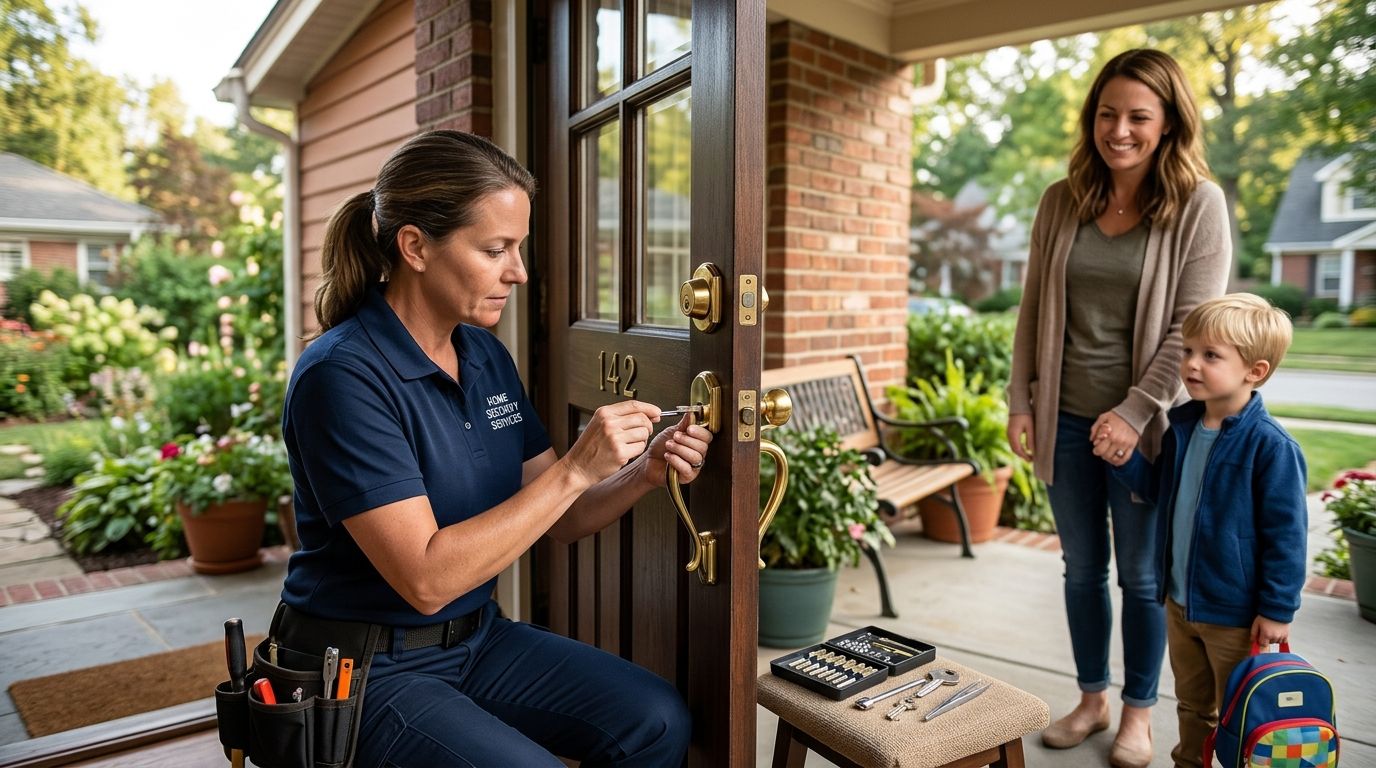
Foster and kinship care home rekeying is the process of changing lock cylinders every time a placement starts, ends, or a caregiver or agency worker with access moves on — so nobody who isn't currently authorized still holds a working key. Unlike a typical homeowner rekey, this isn't a once-a-decade task: placements can end in days, caseworkers rotate, and Massachusetts DCF licensing reviews expect you to know exactly who can get through your front door.
- Rekeying for foster care homes should happen after every placement change, not on a fixed annual schedule.
- Apex Lock N Key runs same-day rekeying across Middlesex County for licensed foster and kinship providers in 2026.
- DCF licensing reviews check access control — old keys still in circulation is a documented liability.
- Keyed-alike master systems cut confusion for homes with multiple exterior doors or a detached unit.
- Keypad or smart locks let caseworkers verify entry without a physical key changing hands.
Why rekeying matters for foster and kinship care homes
A foster placement can start with 24 hours' notice and end just as fast. Every one of those transitions can mean a new set of adults who held a key at some point — a respite caregiver, a supervised-visit parent, an aged-out youth, or agency staff doing a home check. None of that access should still work once the placement is over.
Kinship care adds a second wrinkle. A grandparent or aunt taking custody often moves into — or takes over — a home that already had its own key history: a former tenant, a home health aide, a contractor who never returned a copy. Rekeying that home before a child moves in isn't optional busywork; it's the first item on the safety checklist, and DCF's licensing framework treats physical access control as part of a safe placement.
Middlesex County's older housing stock makes this more urgent than it looks. A lot of single-family homes and two-families in this market still run original pin-tumbler cylinders, some installed decades before the current owner took the license. Those locks don't come with a record of who has copies.
Rekey before the placement start date
Start with a walk-through, no locksmith required yet.
- Test every exterior door, garage entry, and basement bulkhead for signs a spare key exists that nobody mentioned.
- Walk the full perimeter and list every entry point — sheds, pool gates, detached units — on your home safety checklist.
- Ask the placing agency or biological family directly whether a lockbox or hide-a-key was ever used at the property.
- Check for worn or loose cylinders, since an aging lock is often the first sign nobody has rekeyed it in years.
Rekey immediately after every placement change
The moment a placement ends — planned or not — treat the locks as compromised until proven otherwise. This is where a licensed locksmith becomes the faster path instead of chasing down every key copy yourself.
- Rekey all exterior cylinders the same week a placement ends, even if every key was reportedly returned.
- Confirm with the outgoing caregiver, respite provider, or agency contact how many copies existed in total.
- If the placement involved supervised family visits, treat any key given to a biological parent as unaccounted for by default.
- Log the rekey date, the locksmith, and the new key count for your own file — this becomes useful during your next review.
Guides on choosing between rekeying and replacing a lock can help you decide when the cylinder itself needs to go instead of just the key pattern — worn hardware doesn't always survive another rekey.
Match your rekeying schedule to your DCF licensing renewal
Don't wait for the annual review to find out your access control is out of date.
- Rekey at least once before every licensing renewal cycle, regardless of whether a placement has changed recently.
- Keep a written key log ready for the reviewer: date rekeyed, number of keys issued, who holds each one.
- Note any period where a key was reported lost or unreturned, and show the corrective rekey date next to it.
- Ask your licensing worker directly what documentation they expect for access control — requirements vary by office.
Childproof interior doors alongside exterior rekeying
Exterior locks aren't the only ones that matter once a child is in the home.
- Add child-safety locks to medication cabinets, cleaning supply closets, and any home office with sensitive files.
- Check that interior doors a foster child shouldn't be able to lock themselves into (bathrooms, bedrooms with young kids) have an outside-access override.
- Rekey interior locks on file cabinets or lockboxes holding case paperwork alongside your exterior rekey.
- Review childproofing locks and doors if the home hasn't hosted a young child before — the fixes are cheap and mostly hardware-store items.
Set up a keyed-alike master system for multi-door homes
If the property has more than two or three exterior doors, or a detached in-law unit for respite stays, a keyed-alike system beats juggling separate key patterns.
- Rekey every exterior cylinder to a single key pattern so one key opens every door.
- Keep a limited number of duplicate keys, each logged to a named holder.
- Avoid big-box duplicate machines for these keys — an unlogged copy defeats the purpose of the system.
- A professional locksmith visit sets the master pattern correctly the first time, since mismatched pins between doors is the most common DIY mistake here.
A home that used to rent out a room or host a long-term guest is a close parallel — the same logic used in rekeying between tenants applies directly to rekeying between foster placements.
Consider keypad or smart lock entry for caseworker visits
Caseworkers, respite providers, and licensing reviewers all need to get in without a physical key changing hands every time.
- Install a keypad deadbolt with a temporary code you can issue per visit and delete afterward.
- Keep a physical key backup on hand in case of battery failure or connectivity issues — don't rely on the app alone.
- Set individual codes instead of one shared code, so you know exactly who entered and when.
- Change the master code any time a caregiver relationship with the agency ends.
Need rekeying before a placement starts?
Licensed rekeying across Middlesex County, scheduled around your DCF timeline.
Keep a written key log for licensing documentation
The simplest step, and the one most homes skip.
- Record every rekey date, the locksmith who performed it, and the reason (placement change, renewal, lost key).
- Note how many keys were issued after each rekey and to whom.
- Store the log somewhere the licensing reviewer can see it on request, not buried in email.
- Update it the same day you rekey — a log filled in from memory months later isn't reliable.
Comparing your options
| Option | Best for | Key limitation |
|---|---|---|
| Standard pin-tumbler rekey | Single-family foster homes with one or two exterior doors | No electronic record of who used a key or when |
| Keyed-alike master system | Kinship homes with multiple structures or a detached respite unit | Needs a professional keying plan to avoid mismatched pins |
| Keypad or smart deadbolt | Homes with frequent caseworker or respite visits | Needs battery maintenance and a physical key backup |
| Full lock replacement | Homes with damaged, aged, or unknown-brand hardware | Costs more per door than rekeying the existing cylinder |
Verdict: for most foster and kinship homes, a standard rekey after every placement change plus a keyed-alike system for multi-door properties covers licensing requirements without overcomplicating daily use.
Common mistakes foster and kinship homes make
- Waiting until the next licensing renewal to rekey after a placement ends — a gap of months with old keys still active is exactly what a reviewer flags.
- Assuming a returned key means every copy is accounted for — a duplicate made at a hardware store never shows up in a "returned keys" count.
- Skipping interior locks that matter for a child's safety plan — medication cabinets and file cabinets get overlooked while attention goes to the front door.
- Choosing a smart lock with no physical key backup — a dead battery during a scheduled caseworker visit turns into an unnecessary emergency call.
- Not documenting the rekey date or key count — a verbal "yeah, we changed the locks" doesn't hold up during a formal review.
FAQ
What's the best time to rekey for a foster care home?
Rekey before a new placement moves in and again the same week any placement ends. Waiting for a fixed annual schedule leaves a window where former occupants or caregivers still hold working keys.
Does a foster home need to rekey between every placement?
Yes, rekeying between placements is the standard practice for licensed foster and kinship homes. Any adult who had a key during the prior placement — a respite provider, a supervised-visit parent, an aged-out youth — should be treated as unaccounted for once the placement ends.
Do keyed-alike master systems cost more than standard rekeying?
A keyed-alike system involves setting one key pattern across multiple doors, which takes more locksmith time up front than rekeying a single door. It pays off for homes with three or more exterior entry points or a detached respite unit.
Is a smart lock acceptable for a DCF-licensed foster home?
A keypad or smart deadbolt is acceptable as long as it has a physical key backup for power or battery failure. Licensing reviewers care about controlled access, not the specific hardware brand.
How much does it cost to rekey a house in Massachusetts?
Rekeying costs vary by number of doors and lock brand, and current pricing is best checked directly. Apex Lock N Key's 2026 pricing guide breaks down typical ranges for rekeying versus full lock replacement.
Who should have a key to a foster or kinship care home?
Only current, authorized caregivers and household members should hold a working key at any given time. Agency staff and caseworkers are better served by a temporary keypad code than a physical key copy.
Can a locksmith help document rekeying for a licensing review?
A licensed locksmith can provide a service record showing the rekey date and doors serviced, which supports the key log a reviewer expects to see. Keep that record alongside your own written log of who holds copies.
What's the difference between rekeying and replacing a lock?
Rekeying changes the internal pins so old keys stop working while the existing hardware stays in place; replacing swaps the entire lock, which is necessary when the cylinder is worn, damaged, or an unknown brand with no available rekey kit.
One last thing
A lot of Middlesex County's older single-families and two-families still run original pin-tumbler locks from before 1990, and those cylinders tend to stick or fail exactly mid-placement, not on a convenient schedule. If a kinship placement inherited a home nobody's rekeyed in years, get the exterior cylinders checked before the child moves in rather than after the first lockout call.


