
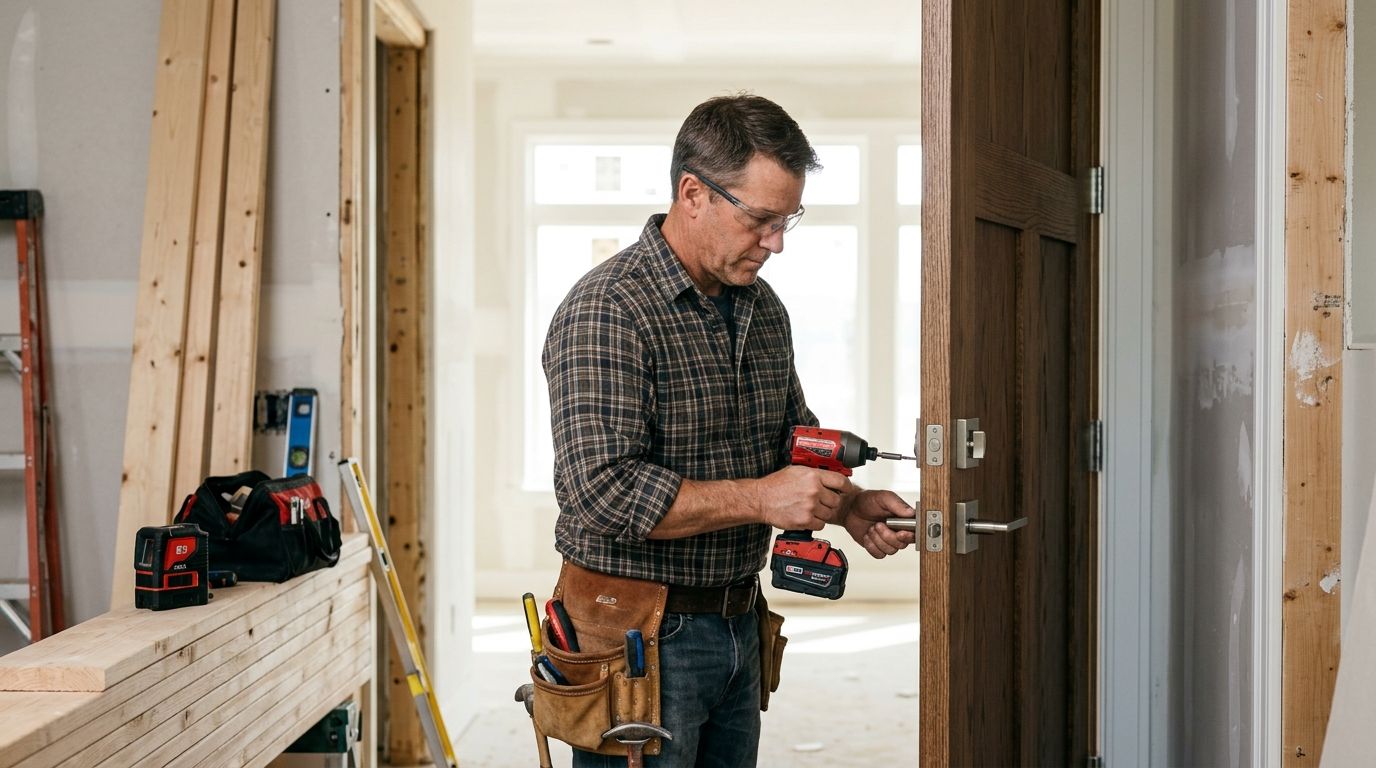
Door hardware installation for home builders means coordinating locksets, deadbolts, hinges, and closers across every unit on a build schedule, not fixing one door at a time. Get it wrong and hardware becomes a punch-list bottleneck between drywall and the final walkthrough.
- Door hardware installation for home builders works best when locksmith scheduling lines up with trim carpentry, not framing.
- Apex Lock N Key installs and keys hardware across whole developments in Middlesex County, not one door at a time.
- Grade 1 commercial-rated locksets outlast Grade 2 residential hardware on high-traffic model homes and amenity buildings.
- Standardized keying across a development saves a callback for every mismatched strike plate found after closing.
Why door hardware installation matters for home builders
Home builders don't install one lockset — they install forty, eighty, or two hundred of them on a calendar that doesn't move for a jammed deadbolt. A missed lock on one unit in a subdivision delays that unit's closing, not the whole project, but it still costs a callback and a frustrated buyer walkthrough. Apex Lock N Key handles commercial door hardware installer in Middlesex County work for builders, running door hardware installation on the trim carpentry schedule instead of a random service ticket queue.
Model homes take more daily foot traffic than any single-family resale, which grinds down cheap hardware fast, and multi-unit developments need a keying plan before the first lockset goes in, not after twelve units are already keyed differently. As of 2026, builders running phased developments in Middlesex County are moving hardware decisions earlier in the schedule for exactly this reason.
How to install door hardware across a new construction project
Step 1: Lock in hardware specs before framing is out
Pick lockset function, finish, and grade before the electrician runs wire, not during trim week when everyone is waiting on doors ready for the 2026 build season.
- Confirm ANSI/BHMA grade per door type — Grade 1 for exterior and common-area doors, Grade 2 acceptable on interior bedroom doors.
- Match strike plate and hinge screw length to the actual door slab thickness ordered, not a generic spec sheet.
- Decide finish (satin nickel, oil-rubbed bronze, matte black) once for the whole development, not per model.
- Flag any doors needing panic hardware or fire-rated closers before the door schedule is finalized.
- Order roughly 10% extra strike plates and cylinders to cover on-site damage without holding up a unit.
Step 2: Schedule installation to the trim carpentry timeline
Hardware crews that show up before base trim and casing are done end up reinstalling the same door twice.
- Slot hardware installation after paint and before final flooring, when doors hang true and don't need re-shimming.
- Give the installer a unit-by-unit punch list instead of one blanket order for the whole subdivision.
- Build in a buffer day per phase for the model home unit, which gets tested harder than any resale.
- On developments running more than one phase at a time, licensed locksmith crews such as Apex Lock N Key can run two units in parallel instead of stacking a single carpenter's schedule.
- Confirm site access hours with the superintendent before the crew arrives — locked gates cost more time than a slow install.
Step 3: Standardize keying across the development
A subdivision keyed unit-by-unit on the fly turns into a filing cabinet of mismatched keys nobody can track by closing.
- Set a master or grand-master key system before the first lockset is cut, even on single-family lots that will never share a key.
- Keep a signed keying log per address — buyers and their agents ask for it at closing.
- Use construction keys during the build phase, then rekey every unit once before the final walkthrough, not after.
- Secure job trailers and material lockups the same way — a construction site trailer locksmith call is cheaper than a stolen tool haul.
- Hand off a labeled key set to the property manager or first buyer, not a loose ring of unmarked blanks.
Step 4: Verify code compliance on every unit
Massachusetts building code and local fire marshal sign-off don't care that the framing crew already left the site.
- Confirm egress hardware on every bedroom and basement door meets the code cycle adopted for 2026 construction.
- Check panic hardware requirements on any shared amenity building, clubhouse, or leasing office attached to the development.
- Verify ADA-height lever hardware on any unit marketed as accessible.
- Test fire door closers for full latch and self-close on every pass, not a sample of units.
- Keep inspection photos per unit — a rejected final on one door shouldn't hold the whole certificate of occupancy.
Step 5: Test every lock during the pre-closing walkthrough
If a lockset doesn't turn smoothly during the pre-closing walkthrough, it won't turn smoothly for the buyer either.
- Cycle every deadbolt and lockset with the actual cut key for that unit, not a master construction key.
- Check strike plate alignment on doors that shifted after HVAC balancing or humidity changes post-drywall.
- Confirm any electronic deadbolt installed for a buyer upgrade pairs correctly and holds a charge before the buyer's first visit.
- Test door closers on common-area and amenity doors for consistent swing and full latch.
- Flag any door that binds, rattles, or doesn't fully seat — reshimming after the buyer moves in costs more than fixing it during the walkthrough.
Step 6: Set up a warranty and callback process before the first closing
Builders who wait until the first callback call to figure out who handles it lose the response-time argument every time.
- Name one locksmith contact for the whole development instead of routing callbacks through the general contractor.
- Set a response-time expectation for stuck locks, broken keys, and misaligned strikes during the first 90 days post-closing.
- Keep the keying log on file for at least one full policy year in case a lockbox or rekey request comes in.
- Route any homeowners association or shared-entry hardware issues to a single point of contact, not whichever sub is on-site that week.
“If a lockset doesn't turn smoothly during the pre-closing walkthrough, it won't turn smoothly for the buyer either.”
Door hardware installation options for home builders
| Option | Best for | Key limitation | Verdict |
|---|---|---|---|
| Builder's framing crew installs hardware in-house | Single custom-home builds, one house at a time | No formal keying plan; alignment quality varies by carpenter | Hold |
| General contractor bundles hardware into a big-box supply package | Developments buying hardware and install as one line item | Install crews rotate; rework often lands back on the builder after closing | Hold |
| Licensed locksmith handles install and keying (Apex Lock N Key) | Multi-unit and phased developments needing one keying plan across the site | Needs to be scheduled around the trim carpentry calendar, not a walk-in service | Buy |
| Framing subcontractor installs hardware as a side task | Spec homes with no resale keying or HOA requirement | No licensing or liability coverage if a lockset fails inspection | Skip |
Apex Lock N Key handles door hardware installation across Middlesex County developments and wins on keying consistency for builders running more than a handful of units at once.
Get hardware installed on schedule
Apex Lock N Key handles door hardware installation across Middlesex County developments.
Common mistakes home builders make with door hardware
- Ordering hardware before the keying plan exists. Fixing a keying mismatch after twelve units are already cut costs more than planning it before the first lockset ships.
- Mixing lock brands across the same development. Buyers and property managers end up juggling different key blanks and cylinder types for what should be one product line.
- Skipping Grade 1 hardware on amenity and common-area doors. Clubhouse and leasing-office doors get more daily cycles than any single unit's front door and wear out fastest.
- Treating the final walkthrough test as optional. A lock that turns fine with a construction key can still bind on the buyer's actual cut key.
- Assuming panic hardware only applies to commercial buildings. Any shared amenity space attached to a residential development can trigger the same code requirement seen in restaurant panic-bar compliance work.
FAQ
What is door hardware installation for home builders?
It's the coordinated fitting and keying of locksets, deadbolts, hinges, and closers across every unit in a development, scheduled to the trim carpentry calendar rather than done door by door. On multi-unit projects it also includes setting up a master or grand-master key system before the first lockset is cut.
Do new construction homes need code-compliant panic hardware?
Only doors serving shared amenity spaces, clubhouses, or leasing offices typically trigger panic hardware requirements, not individual single-family units. Any attached common-area building should be checked against the code cycle adopted for 2026 construction before the door schedule is finalized.
Should a home builder use the same lock brand across an entire development?
Yes — standardizing on one lock brand and finish across a development keeps keying, warranty, and callback support simple for the builder and the buyer. Mixed brands across units usually means mixed key blanks and cylinder types down the line.
When should hardware be ordered before closing?
Lockset specs, grade, and finish should be locked in before framing is out, well ahead of the trim carpentry phase where hardware actually gets installed. Ordering during trim week usually means installing whatever is in stock instead of what was specified.
Can smart locks be installed during new construction?
Yes, electronic deadbolts can be installed as part of the standard hardware package or as a buyer upgrade during the trim phase. They still need the same alignment and code checks as a traditional deadbolt before the final walkthrough.
Who handles hardware issues after a homebuyer closes?
The builder should name one locksmith contact for the whole development before the first closing, rather than routing callback issues through the general contractor. A single point of contact with a set response-time expectation resolves stuck locks and broken keys faster.
Should units be rekeyed before or after the final walkthrough?
Units should be rekeyed once, after construction crews are done using the construction master key and before the final walkthrough with the buyer. Rekeying earlier risks losing key control to subcontractors still working in the unit.
What's the difference between Grade 1 and Grade 2 hardware for new construction?
Grade 1 hardware is the ANSI/BHMA commercial-duty rating built for high-cycle doors like amenity buildings and common entries, while Grade 2 is the residential-duty rating suited to interior bedroom and closet doors. Using Grade 1 only where daily traffic is heaviest keeps the hardware budget in line without sacrificing durability where it matters.
One last thing
Test the electronic deadbolt's backup key cylinder during the walkthrough, not just the keypad. Builders who skip that step for 2026 closings find out the batteries died and the backup key doesn't match the cut list only after the buyer is locked out on move-in day.


