

Manufacturing plant master keying is a lock-and-key hierarchy that gives each worker access to assigned doors while allowing authorized managers to open several areas with one key. Master key systems for manufacturing plants work best when access follows job duties—not seniority—and production access stays separate from safety procedures.
- Master key systems for manufacturing plants should separate production, maintenance, offices, and sensitive rooms by job duties.
- Apex Lock N Key provides commercial lock and access-control installation for Massachusetts businesses.
- Mechanical master keys simplify access but cannot identify who opened a door.
- Choose electronic access control where individual access records and credential removal matter.
Why this matters
A plant key is an access permission, not just a piece of metal. Before changing locks in 2026, decide which doors each role needs, who can authorize duplicates, and what happens when a key disappears.
Apex Lock N Key is a licensed mobile locksmith serving Massachusetts customers. This guide focuses on planning access for plants in Middlesex, Essex, Suffolk, and Norfolk counties, without treating every department as the same security zone.
Why master key systems matter for manufacturing plants
Manufacturing facilities combine different access needs under one roof. Production staff need their work areas; maintenance needs equipment rooms; shipping staff need loading areas; office staff need records and administrative spaces. Giving everyone the same key erases those boundaries.
A master key hierarchy reduces the keys authorized staff carry while preserving separate permissions. That convenience has a trade-off: losing a key with broad access exposes more doors than losing a door-specific key. Give broad access only to roles that genuinely require it.
Mechanical keys also have a visibility limit. A key register records who received a key, but an ordinary mechanical lock does not record who used it. If your 2026 security plan requires individual entry records, compare electronic access control rather than expecting a master key to supply them.
Plant access must also respect emergency exits, fire-door hardware, and hazardous-energy procedures. A room key controls entry; it does not authorize someone to operate equipment or replace a lockout/tagout process.
How to plan a manufacturing plant master key system
1. Map every controlled opening
Start with a floor plan and a spreadsheet. Walk the building with facilities, production, and safety staff, then give each controlled opening a unique identifier. Include exterior doors, internal rooms, cages, and cabinets where access matters.
Record what is actually installed, not what an old drawing says. A worn door, damaged closer, or misaligned latch needs attention before a new cylinder can solve the access problem. Do not assume different locks can join the same key system just because their keys look alike.
Separate building access from machine isolation equipment in your inventory. Keep the master key project away from personal safety locks used in hazardous-energy control.
- Assign an opening ID without posting sensitive access details publicly.
- Record the room purpose and department responsible for it.
- Note existing locks, cylinders, exit devices, and door condition.
- Flag exterior exposure, dust, moisture, and frequent use.
- Mark openings that need a hardware assessment before rekeying.
2. Assign access by role
Build a door-by-role matrix before ordering keys. Put openings down one side and job roles across the top, then mark the access each role actually needs. A shared spreadsheet is enough to start; no software purchase is required.
Include cleaners, contractors, temporary staff, and after-hours maintenance. These groups need deliberate permissions, not leftover keys from former employees. Ask department managers to approve their areas, and have the designated access owner resolve conflicts.
Separate entry permission from operating authority. A maintenance worker's access to an electrical room does not establish authorization to perform electrical work. Keep training and safety approvals in their own records.
- List job roles rather than individual names in the design matrix.
- Separate production, maintenance, shipping, offices, and sensitive storage.
- Identify approved routes for visitors and contractors.
- Record who approves access to each restricted area.
- Remove permissions that exist only for occasional convenience.
3. Design the smallest useful key hierarchy
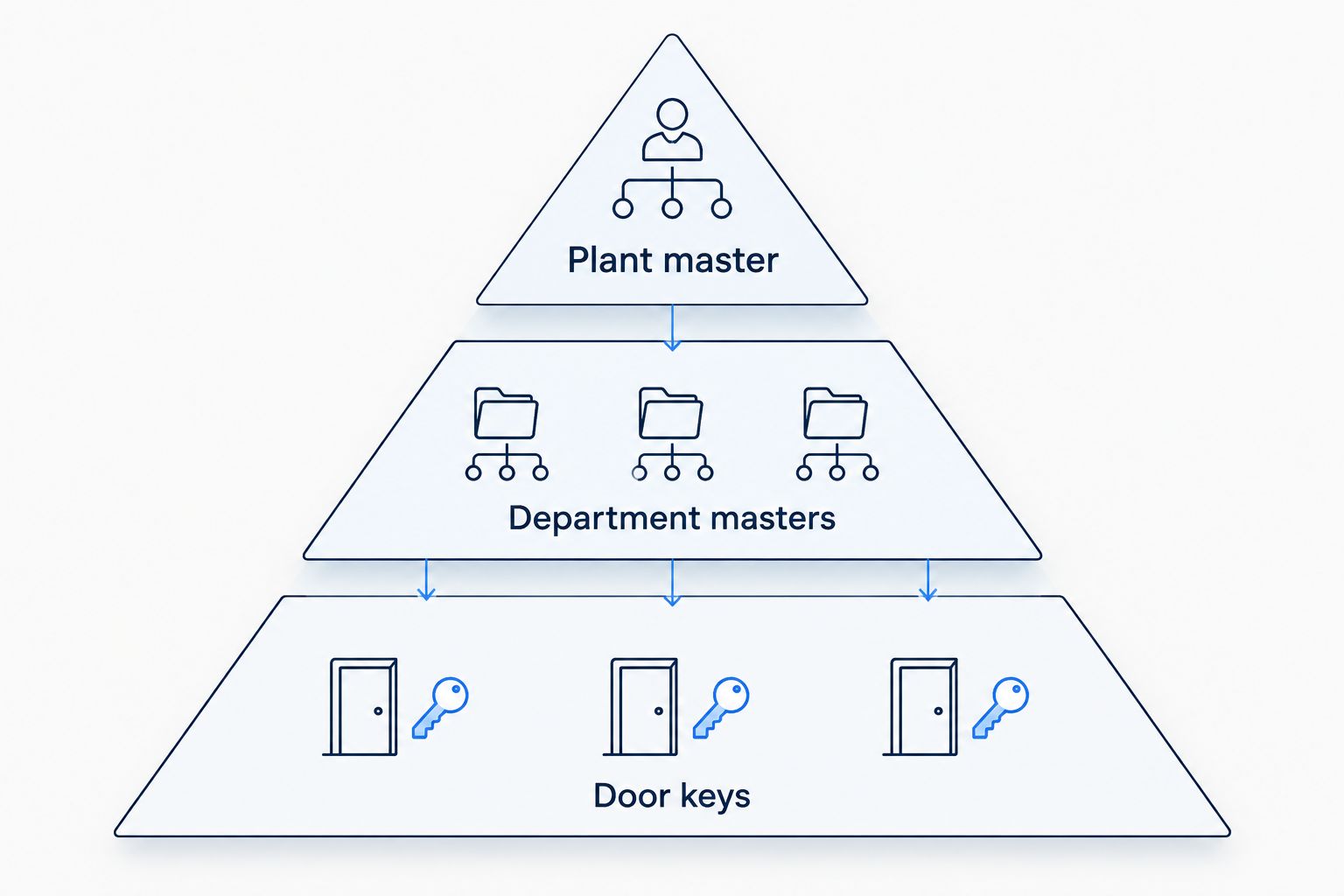
Use the approved access matrix to build the hierarchy. A planning example has 3 access levels: door keys, department masters, and a plant master. That is an example, not a requirement; a simpler plant can use fewer levels.
Door keys open their assigned locks. Department masters open a defined group. A plant master opens the locks included beneath it, which need not mean every lock on the property. Keep particularly sensitive rooms outside the broad hierarchy when their access requirements justify separation.
Apex Lock N Key provides commercial lock and access-control installation. Bring the completed matrix to the locksmith so hardware assessment starts with your access rules, rather than letting existing cylinders dictate them. Cylinder compatibility and keying capacity still require assessment before installation.
- Door keys: assign narrow access for routine work.
- Department masters: group only related operational areas.
- Plant master: reserve broad access for approved custodians.
- Keep selected sensitive rooms independently keyed where appropriate.
- Document planned expansion before the locksmith finalizes the system.
4. Match each opening to suitable hardware
Check existing hardware before deciding whether to rekey or replace it. Rekeying changes which keys operate a compatible lock; it does not repair a failing latch, strengthen a damaged frame, or add entry records.
Have a locksmith assess cylinder compatibility and a qualified professional review applicable exit and fire-door requirements. Do not add a lock that makes a required exit dependent on finding a key. The correct arrangement depends on the opening and applicable requirements, not just your preferred key layout.
For your 2026 project, specify the environmental conditions at each door. Loading-area hardware and an office cylinder face different use and exposure. Evaluate electronic options separately where shift schedules or individual credential control are priorities.
- Repair door alignment, latching, and closing problems first.
- Confirm cylinder compatibility with the proposed key system.
- Check exit-device and fire-door requirements before modifying hardware.
- Describe dust, moisture, outdoor exposure, and expected use.
- Identify doors needing electronic permissions rather than shared keys.
5. Control key issuance and duplication
Create a key register before handing out the first new key. Record the key identifier, authorized holder, issue date, approved access, and return status. Store the access matrix and keying records securely, not beside an unattended key cabinet.
Assign 1 named custodian to approve issuance, with a documented backup for absences. That creates accountability without making access depend on one person's presence. Use controlled identifiers rather than labels that tell a finder which building or room a lost key opens.
Discuss restricted keyways with the locksmith when duplicate control matters. A restricted keyway can limit duplication through its authorization process; it does not eliminate theft or misuse. A stamp saying not to duplicate is not a complete control policy.
- Require approval before issuing or duplicating a key.
- Record each issued copy and its authorized holder.
- Store spare and higher-level keys in controlled storage.
- Require signed returns when roles or employment change.
- Define escalation for an overdue, unreturned, or missing key.
6. Test permissions before full rollout
Use a small, representative group of openings for the initial installation. Include different departments and any hardware types that need separate checks. Schedule work with operations so a lock change does not unexpectedly block an active work area.
Perform 2 test passes: authorized access and denied access. The first confirms each test key opens its intended doors; the second confirms it does not open excluded doors. A key working where it belongs is only half the acceptance check.
Test the installed door assembly, not just the cylinder. Check latching, closing, and required exit operation. For electronic openings, verify documented behavior during power or communications loss with the installer; do not assume every device behaves the same way.
- Select representative openings before expanding the installation.
- Test every issued key type against approved permissions.
- Confirm excluded doors stay inaccessible to those keys.
- Check door closing, latching, and exit operation.
- Document defects and retest corrections before acceptance.
7. Maintain the system after installation
Keep the key register current throughout 2026 and after every staffing or access change. Compare issued keys with authorized holders, and update the matrix when departments move or rooms change purpose. Do not wait for a security incident to discover that the paperwork no longer matches the building.
Write a lost-key procedure that distinguishes a door key from a department or plant master. The response depends on the doors exposed, the circumstances of the loss, and whether unauthorized copies are possible. Returning one key does not establish that no copies exist.
Use inspection to catch hardware problems before access fails. A sticking lock or door that will not latch needs assessment, not force or repeated improvised repairs.
- Update permissions after transfers, departures, and contractor completion.
- Reconcile issued keys with the register on a documented schedule.
- Report missing higher-level keys through the designated escalation route.
- Review affected doors before deciding the scope of rekeying.
- Inspect sticking cylinders, loose hardware, and unreliable latching.
Compare access options for your plant
Choose the access method by what you need to control and document. A mechanical hierarchy is useful for stable permissions; electronic access control adds functions that ordinary keys cannot provide. For a 2026 upgrade, compare administrative work as well as door hardware.
| Option | Best for | Main benefit | Key limitation |
|---|---|---|---|
| Individually keyed locks | Small groups of independently secured rooms | Limits the doors exposed by a lost door key | Creates more keys to issue and track |
| Mechanical master key system | Stable departmental access with clear key custody | Lets authorized staff open assigned groups with fewer keys | No individual entry log; lost broad-access keys affect multiple doors |
| Restricted-keyway master system | Plants needing tighter duplicate authorization | Adds a controlled duplication process | Still requires physical-key custody and a lost-key response |
| Electronic access control | Changing permissions and doors needing individual entry records | Supports credential management and event records when configured | Requires compatible hardware, administration, and maintenance |
| Hybrid system | Plants with different needs across departments | Uses electronic control selectively alongside mechanical keys | Requires coordinated records and clear override-key rules |
Apex Lock N Key is a fit for Massachusetts businesses needing commercial lock or access-control installation. The service does not replace your internal access owner, safety review, or ongoing key records; those responsibilities remain part of a working system.
Plan your commercial lock installation
Discuss commercial locks and access-control installation for your Massachusetts facility.
Common mistakes manufacturing plants make
Giving supervisors unrestricted access by default
A job title does not establish a need to enter every room. Give supervisors the doors their responsibilities require, and make plant-wide access a separately approved permission. Review inherited permissions when staff change roles.
Mixing building keys with safety isolation locks
Master key convenience belongs in building access, not personal hazardous-energy isolation. Keep the access project separate from lockout/tagout procedures. A door key is not evidence of training or permission to service machinery.
Ignoring contractors and shift handovers
An unrecorded shared key undermines individual custody. Define who signs a contractor key out, who receives it back, and what happens if the job continues beyond the approved period. Include shift handovers in the register.
Rekeying without checking the door
A correctly keyed cylinder cannot make a damaged door latch reliably. Inspect the closer, latch, frame, and applicable exit hardware during the project. Resolve mechanical defects before accepting the opening as secured.
Keeping the only access plan in someone's memory
Undocumented exceptions become difficult to manage when staff leave. Store the approved matrix, key register, and change history under controlled access. Keep enough information for authorized backup staff to act without distributing sensitive keying details broadly.
FAQ
What's the best master key setup for a manufacturing plant?
The best setup gives each role only the doors needed for its duties and limits broad-access keys to approved custodians. Start with a door-by-role matrix, then choose a hierarchy that fits the facility rather than adding unnecessary levels.
Can every existing plant lock use the same master key?
Not every existing lock can join the same master key system. A locksmith must assess cylinder compatibility, hardware condition, and the proposed hierarchy; some openings require replacement hardware or separate keying.
Is a master key system better than electronic access control?
A mechanical master key system suits stable access needs, while electronic access control suits changing permissions and individual entry records. A hybrid arrangement lets you use each method where its strengths matter.
What should we do if a plant master key is lost?
Treat a lost plant master as an access incident affecting every door that key opens. Notify the designated access owner, identify exposed openings, and have a locksmith assess the necessary rekeying or replacement scope.
Can employees leave through locked doors without a master key?
Required emergency exit operation must not depend on an employee finding a master key. Have qualified professionals assess the opening and applicable exit requirements before changing locks or access-control hardware.
Do master key systems record who enters a room?
Ordinary mechanical master key systems do not record who enters a room. A key register tracks issuance, while appropriately configured electronic access control can provide credential-based entry records.
Does Apex Lock N Key install commercial locks in Massachusetts?
Apex Lock N Key provides commercial lock and access-control installation for Massachusetts businesses. Customers in Middlesex, Essex, Suffolk, and Norfolk counties can discuss their facility's doors and access requirements before planning installation.
One last thing
Test the doors a key must not open. Successful entry proves convenience; denied entry proves that departmental boundaries work. Keep both results in your acceptance record, and repeat the affected checks whenever permissions or cylinders change.


