
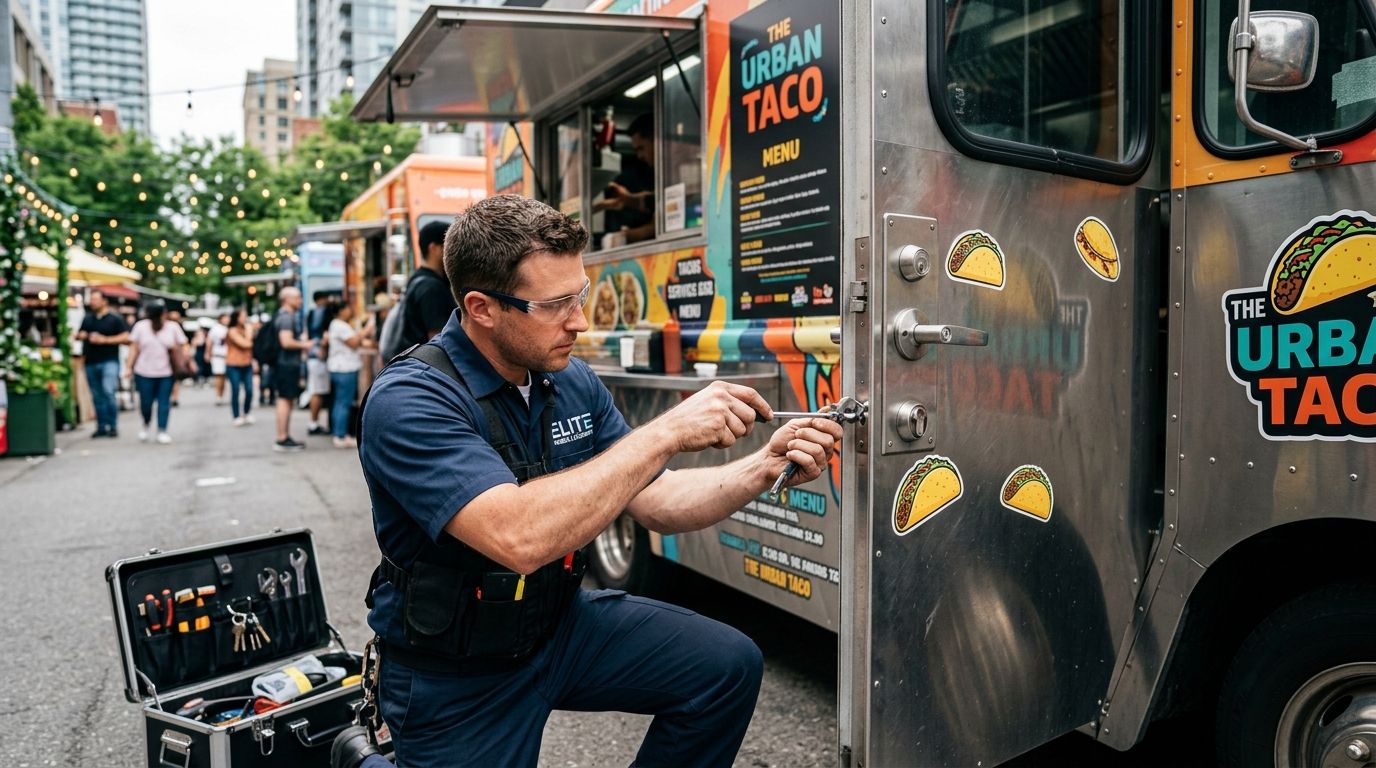
Food truck locksmith service is mobile lock and key work built for vendors who run a business out of a vehicle, can't leave the truck to visit a shop, and lose real money every minute a service window or storage compartment won't open. A food truck's locks take a different beating than a house door — vibration from driving, grease and moisture near the service window, a cash box that gets opened fifty times a shift — so the fixes look different too, and the locksmith needs to come to the commissary lot or the festival site, not the other way around.
- A locksmith for food trucks in 2026 should handle service window locks, cash box security, and vehicle keys in one mobile visit.
- Apex Lock N Key rekeys worn truck locks and cuts fleet-ready spare keys on-site in Middlesex County, MA.
- Vibration and grease wear out standard padlocks faster on a moving vehicle than on a fixed storefront.
- Rekeying before festival season and after every crew turnover is the single most cost-effective habit for mobile vendors.
Why locksmith services matter for food trucks and mobile vendors
A food truck only makes money when the window is open. A jammed padlock on the service hatch, a lost set of keys before a Saturday farmers market, or a cash box that won't lock at the end of a busy night doesn't just cost a repair bill — it costs the whole event day. Fixed restaurants can wait for a locksmith appointment; a mobile vendor parked at a festival lot in 2026 usually can't.
Food trucks also carry more lock points than most small businesses realize: the driver and passenger doors, the service window, one or two storage compartments, a propane or generator access panel, and a cash box or safe bolted somewhere inside. Each one wears differently, and each one needs a locksmith who understands that a vehicle-mounted lock behaves nothing like a house deadbolt.
Apex Lock N Key works with drivers, small business owners, and commercial operators across Middlesex County, and food trucks sit right at the intersection of automotive and commercial locksmith work — which is exactly why a generic locksmith call often misses half the job.
Audit every lock point on the truck
Start with a walk-around before assuming anything is broken. Most food truck lock failures get caught early by an owner who actually checks, not by waiting for a lockout.
- Test the service window padlock or slide bolt for stiffness or rust
- Check the side storage compartment latches for loose screws or bent strike plates
- Inspect the cash box or drop safe lock for a sticky key turn
- Look at the propane and generator compartment latch for corrosion
- Confirm the driver and passenger door locks still respond to the original key without force
- Note any lock that's ever been forced, pried, or drilled by a previous owner
Rekey worn locks before festival season
Once the audit turns up a lock that sticks, rattles, or takes a key a previous employee still has, rekeying is almost always cheaper than replacing hardware outright. Rekeying swaps the internal pins so old keys stop working while the existing lock body stays in place.
- Rekey any lock a former employee, vendor partner, or contractor had a key to
- Rekey before the spring and summer festival circuit, when the truck sees the most traffic
- Rekey the cash box separately from the service window so one lost key doesn't expose both
- Ask about matching all exterior locks to a single key for faster daily open-up
A licensed commercial locksmith like Apex Lock N Key's restaurant and cafe rekeying service applies the same rekeying process to food service operations, mobile or fixed, and can usually do it on-site rather than pulling the lock for a shop visit.
Cut a spare key set for every driver and crew member
One key on one ring is a single point of failure for a business that can't close its window if the key gets lost between the commissary and the event lot.
- Cut duplicate keys for the truck, the service window, and the cash box separately
- Give each shift lead a full set rather than sharing one ring between drivers
- Keep one spare set locked in a fixed location, not inside the truck itself
- Label sets by function, not by name, so a lost set doesn't identify the truck
Truck fleet key cutting built for delivery and service vehicles applies directly here — a food truck is a fleet of one, but the same on-site cutting service covers it without a dealership wait.
Upgrade the cash box and storage compartment locks
A standard hardware-store padlock rated for a garden shed isn't built for a compartment that gets opened dozens of times a shift and rides on a vibrating vehicle chassis.
- Swap thin-shackle padlocks for hardened, weather-rated commercial models
- Move to a keyed-alike system so one key opens all storage compartments
- Add a secondary lock on the cash box independent of the main storage key
- Check compartment hinges and strike plates at the same time — a worn hinge defeats a good lock
Fix a stuck or frozen service window lock
Massachusetts winters seize up exterior locks fast, and a service window that won't slide or lock at close is a security gap, not just an inconvenience.
- Clear ice and debris from the track before forcing the lock
- Apply a graphite or silicone-based lubricant, never oil, which attracts grit
- Replace a slide bolt that's bent rather than trying to bend it back
- Have a locksmith check alignment if the window sticks even when clear of ice
Set up quick-access hardware for daily open and close
Crews juggling a griddle, a register, and a line of customers lose time fumbling with multiple keys at open-up. A keypad or single-key system cuts that friction.
- Standardize on one key type across the window, storage, and cash box where security allows
- Consider a keypad lock on any fixed commissary storage the truck uses between shifts
- Train every crew member on the same lock sequence so open-up doesn't depend on one person
- Keep a written (not shared-photo) note of which key opens which lock, stored off the truck
Build a lockout response plan before event day, not during it
A lockout at 6am before a breakfast rush needs a locksmith who answers, not a voicemail. Knowing who to call before it happens saves the event day.
- Save a licensed 24/7 mobile locksmith's number in the truck's shared contact list, not just one owner's phone
- Confirm the locksmith services vehicle lockouts and commercial compartment lockouts, not just house calls
- Know the truck's VIN or key code location in case a replacement key is needed on the spot
- Have a backup crew member with a spare key set attending every event
Finding a reliable 24-hour locksmith before a lockout happens is the difference between a 30-minute fix and losing an entire shift.
Comparison: lock and key options for food trucks
| Option | Best for | Key limitation |
|---|---|---|
| DIY hardware-store padlock swap | Owners on a tight schedule with basic security needs | Not built for vehicle vibration; wears out faster than commercial-grade hardware |
| Standard rekey of existing locks | Trucks with worn locks or crew turnover | Doesn't fix a physically damaged lock body |
| Fleet key cutting for the truck and crew | Multiple drivers or shift leads needing spare keys | Requires an accurate key code or original key on hand |
| Mobile 24/7 locksmith visit | Lockouts at events, festivals, or off-hours | Availability depends on service area coverage |
| Full compartment hardware upgrade | Trucks with frequent cash box or storage access | Higher upfront labor than a simple rekey |
Get your food truck locks checked
Mobile visits across Middlesex County, 24/7.
Common mistakes food truck owners make
- Using consumer-grade padlocks on compartments that open dozens of times a shift — they wear out faster than the commercial-rated hardware built for that cycle count.
- Keeping the cash box key on the same ring as the vehicle key — one lost ring exposes both the truck and the money.
- Skipping a rekey after crew turnover — a former employee's key still works until someone changes it.
- Ignoring service window track buildup until it freezes shut — by winter it's a lockout, not routine maintenance.
- Not knowing who to call before a lockout happens — scrambling for a locksmith mid-rush costs more than a saved number in the truck's contact list.
FAQ
What's the best lock for a food truck service window?
A hardened, weather-rated slide bolt or padlock rated for vehicle vibration works better than a standard hardware-store padlock. Consumer-grade locks loosen faster on a moving vehicle chassis.
Is a mobile locksmith better than a shop visit for a food truck?
Yes, for most food truck issues, because the truck can't leave its route or event location to visit a shop. A licensed 24/7 mobile locksmith comes to the commissary lot or event site instead.
Can a locksmith rekey a food truck cash box on-site?
Most cash box and drop safe locks can be rekeyed on-site without removing the box from the truck. This keeps the existing hardware in place while invalidating old keys.
How often should food truck owners replace exterior locks?
Replace a lock only when the hardware itself is damaged; rekey instead when the issue is a lost key or crew turnover. Most owners rekey before each festival season and replace hardware only after visible wear or forced entry.
What happens if you lose the only key to your food truck?
A licensed locksmith can create a new key on-site using the vehicle's key code or by picking and rekeying the lock. Keeping a labeled spare set stored off the truck prevents this from becoming an emergency.
Do food trucks need commercial-grade locks or residential ones?
Commercial-grade locks hold up better against the vibration, grease, and high-frequency use a food truck sees compared to a fixed residential door. Residential-grade hardware wears out faster in that environment.
Can one locksmith visit cover the cab, service window, and storage compartments?
Yes, a mobile locksmith equipped for both automotive and commercial work can address all three lock types in a single visit. This saves scheduling multiple separate service calls.
One last thing
Most food truck owners only think about locks after a lockout costs them a shift. The cheaper habit is rekeying on a schedule tied to the business, not the calendar — before the spring festival circuit starts and every time a crew member with keys leaves. That single habit prevents the two most common food truck lock emergencies: a former employee's key still working, and a worn lock finally failing on a Saturday morning rush in 2026.


